
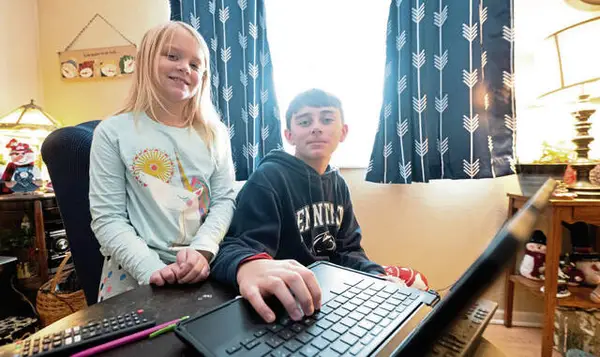
For Kelly Marsh, the pandemic wasn’t just a global health concern — it was a constant battle between a toddler’s curiosity and a kindergartner’s digital classroom.
Nearly six years ago, the covid-19 pandemic forced schools worldwide to close doors and adapt to remote learning, almost overnight. Marsh was left to juggle the education of her then-5-year-old daughter, Nora, while caring for her 1-year-old son, Jonas — all while working part time to support her family.
“At the time, I had a 1-year-old who was just trying to touch the screen and touch all the buttons, disrupting the other child from learning,” said Marsh, 43, of Sewickley. “You have a 5-year-old trying to sit in front of a device and not touch it. … It was such a stressful time.”
While Marsh’s struggle played out in a single household, the data suggests her experience was a microcosm of a national problem.
Students who were learning remotely did not receive the same quality of education as those whose schools remained open, according to a study of the pandemic’s impact on K-12 education conducted by RAND Corporation researcher Julia Kaufman.
But that hasn’t stopped school districts from resorting to remote learning. Educators have defended the choice to operate virtually on occasion, particularly in cases of inclement weather.
The majority — 401 — of Pennsylvania’s 500 K-12 public school districts are approved for so-called Flexible Instruction Days, according to the state Department of Education website. This includes all 17 of Westmoreland County’s school districts and 36 of the 43 school districts in Allegheny County.
How they work
Schools are permitted to use five Flexible Instruction Days each academic year, conducting classes virtually in the case of an emergency — including inclement weather, law enforcement incidents, damage to a school building or a disease epidemic.
Flexible Instruction Days were piloted from 2015 to 2018 by a dozen school districts statewide — including Elizabeth Forward and Seneca Valley. The program was formalized by state legislators in 2019, eerily before the onset of the pandemic.
Kaufman has worked 15 years at RAND — a global, nonpartisan research organization. Now the nonprofit’s director of education and employment, she spends much of her time in RAND’s North Oakland office conducting K-12 education research.
A survey Kaufman administered in October 2020 to nearly 1,100 teachers and about 1,150 principals revealed that teachers were falling behind in their lesson plans and struggling to maintain student attention as remote instruction skyrocketed.
Just 20% of principals reported that most students were receiving fully in-person instruction. About 33% reported fully remote instruction, and 47% said they used a hybrid model — teaching students through a combination of in-person and remote learning.
More than half — 56% — of teachers, regardless of instruction model, said they had covered half or less of the content they covered by that time in the previous school year.
About 85% of students were present for fully remote and hybrid instruction each day — a 6% decline from teachers’ estimates of previous years’ daily attendance.
Some students were impacted more than others, Kaufman said.
Students without reliable internet access at home were often unable to tap into their live lectures and online assignments. Special education students, missing out on valuable in-person resources and assistance, struggled to learn in a virtual environment, she said.
Derry Area Superintendent Greg Ferencak admits that Flexible Instruction Days — where educators teach lessons via a live video call — are not a perfect solution. But they are a good backup plan if the district exhausts the two traditional “snow days” built into its calendar, he said.
“I do believe that a lesson on a science experiment is going to be much better done in person than in a Google (Meet),” he said. “That’s why I would always push for in-person learning.
“But it does help us continue to revisit where we left off so that there’s not that learning slide or that learning gap.”
Opting for a remote day in place of canceling school also prevents districts from shortening students’ spring break or tacking on days to the end of the academic year, said Baldwin-Whitehall Superintendent Kara Eckert.
“Times are changing. Schools have to adapt, too,” she said. “In the workplace, you see a lot of remote work happening, and education is definitely changing. We’re able to be as flexible as possible, and we’re proud of what we have established as a remote learning option for our families in the event of these closures.”
‘Continuity of education is important’
Like Marsh, former educator Noah Stachelek remembers all too well the challenges presented by remote learning during the pandemic.
Stachelek, 36, of Belle Vernon is lead pastor at New Hope Assembly of God in Elizabeth. He left education in June after a 13-year career as a teacher and principal at a variety of Pennsylvania schools — including Freedom Area in Beaver County and Pine-Richland.
He worked five years as an assistant principal in Gettysburg Area School District in Adams County, two of which coincided with the pandemic.
“Attendance was not solid,” he said. “I spent a lot of time calling families, trying to get kids engaged, trying to get kids connected.”
The district conducted live virtual classes, requiring students to keep their cameras on. Stachelek led staff Zoom calls in an attempt to boost morale.
Most recently, Stachelek was a high school learning support teacher at Spring Grove School District in York County, where he also worked two years as an elementary principal.
Spring Grove had returned to fully in-person instruction upon Stachelek’s arrival in February 2022, he said. The district had not applied for Flexible Instruction Days but was conducting class remotely in cases of inclement weather — usually between two and four times a year.
Nothing beats in-person learning, said Stachelek, who fears districts that overuse remote learning will struggle to maintain students’ attention and effort.
But the occasional remote learning day can serve a purpose, he said.
“I think the continuity of education is important. Learning loss happens if we are not learning, even if it’s for a day,” Stachelek said. “I think if we can proverbially put our head on the pillow at night and say, ‘Our students benefited from this today,’ it’s a good use of a remote learning day.”
Preparation is key
It all comes down to how teachers prepare for virtual instruction and communicate with their students, Stachelek said.
While teaching at Spring Grove, Stachelek monitored the forecast throughout the winter months, making sure to send students home with their district-issued devices and relevant work materials if there was a possibility of a snowstorm.
He prepared online assignments in advance, saving them for a potential remote learning day. If one was called, he would post a video of himself explaining the day’s assignment for students to view and make himself available on a Zoom call to answer students’ questions.
As a principal at Spring Grove, Stachelek hopped in on his teachers’ virtual lessons from time to time. He could easily distinguish those who prepared from those who did not.
“If (teachers) weren’t preparing, if they weren’t sending devices home, if they weren’t giving the papers the students needed in advance, if they weren’t doing all those things,” he said, “you could see that.”
That’s why the Pennsylvania State Education Association has offered in recent years professional development on remote learning for its members — 177,000 educators and support staff statewide, said spokesperson Chris Lilienthal.
“I do think the quality of online instruction is significantly better today than it was five years ago, just because of the fact that there has been this shift in thinking,” he said. “There has been this focus on professional development, and there has been this development of online tools and resources for teachers to be able to shift to a remote setting on a short-term basis when they need to.”
Remote learning hurdles
Gilpin parent Amanda Ehrman has mixed feelings on Flexible Instruction Days.
Ehrman’s children — Blake, a sixth grader, and Addison, in second grade — attend Leechburg Area School District. To be marked present for the day, students must complete work independently and submit it to an online platform for their teachers to review, Ehrman said. Teachers are available on a video call that students can choose to join if they have questions.
Her kids enjoy the extra downtime they have on remote days, as they typically wrap up their work around lunchtime, Ehrman said.
But remote days are not all smooth sailing, she said.
“(Blake) is pretty self-sufficient. He can go through his schedule and do his work by himself,” said Ehrman, 46. “My second grader, she requires a little bit of assistance.
“Usually there’s a lot of frustration, and I don’t know if it’s because she’d rather be in school doing it or if it’s just because I’m mom and she doesn’t want to have me help her. We run into some roadblocks sometimes with her not wanting to sit there and do the work.”
Marsh is grateful that Quaker Valley builds traditional “snow days” into its calendar each school year, allowing for three school cancellations in cases of inclement weather. She believes the unscheduled time offered by snow days plays a role in a child’s development.
“The modern world that we live in is often so over-scheduled and so structured,” she said. “I think it’s imperative … that we protect those very rare times, that we preserve some of that magic of the old-fashioned snow days.”