
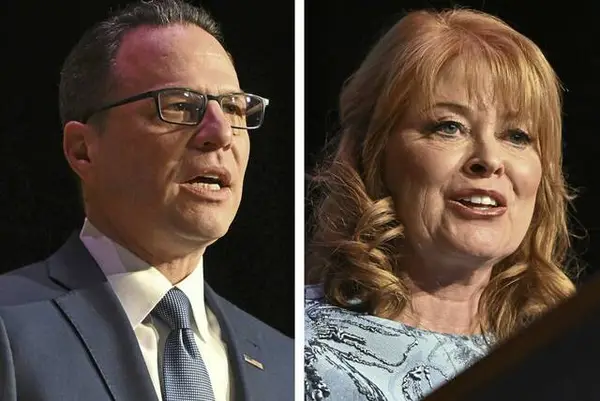
Pennsylvania Gov. Josh Shapiro didn’t mention his likely Republican opponent by name once last week when he launched his reelection campaign with a 26-minute speech in Pittsburgh.
President Donald Trump’s name didn’t come up either.
Shapiro’s likely opponent in the race for governor, state Treasurer Stacy Garrity, took a different approach when she delivered her first campaign speech of the year this week at a luncheon in Harrisburg. In her prepared remarks, lasting nearly 18 minutes, Garrity mentioned Shapiro by name more than 20 times as she criticized his record.
Their approaches offer a glimpse into how the two campaigns for Pennsylvania’s highest office figure to differ over the next 10 months, according to political observers.
“With any incumbent governor, you have to make a compelling case that you deserve to be rehired, so you need to focus on telling your story and ignoring your opponent as long as humanly possible,” said Mike Mikus, a veteran Democratic consultant from South Fayette.
“When you’re the challenger, you first have to get people to realize that an incumbent like Josh Shapiro has his faults and voters who voted for him the last time need to reevaluate their choice. Then you need to show them why you’re the better option,” added Christopher Nicholas, a Republican consultant from Harrisburg.
Money matters
As it stands now, neither candidate will face a rugged primary battle that could burn through money and divert focus away from the November election.
Four years ago, Shapiro cruised through the Democratic primary unopposed, while nine candidates appeared on the GOP’s primary ballot. That year, Republican nominee Doug Mastriano raised about $7 million — but had to use a good chunk of it to get through the primary.
Shapiro spent close to $70 million on his 2022 campaign, a record for a Pennsylvania gubernatorial race.
Shapiro holds a sizable money advantage again.
Shapiro’s campaign reported it ended 2025 with $30 million in available cash and raised $400,000 in the 48 hours after he formally launched his reelection effort Jan. 8.
Garrity, who was endorsed by the Republican Party of Pennsylvania in September, reported that her campaign raised nearly $1.5 million in 2025 and ended the year with about $1 million in available cash.
“It costs about $1 million just to run a week of television (ads) in Pennsylvania,” Mikus, the Democratic consultant, said of Garrity’s campaign war chest. “The disparity in money tells me that even Republican donors are not willing to place bets on her at the moment. If they think she has a shot at winning, Republicans would be pouring money into her campaign. It’s clear that donors are sitting on the sidelines.”
Garrity spokesman Matt Beynon dismissed that notion. He said Garrity, after launching her campaign in August, focused early efforts on consolidating Republican support — something that will bolster her ability to raise money going forward because there isn’t a crowded field of candidates scrambling for donor dollars.
“She has done a great job of uniting the party, and everyone has coalesced around her,” Beynon said.
As for the wide funding gap between Shapiro and Garrity, Beynon said, “We don’t think we have to go dollar-to-dollar with the governor. Our position is that we need to have a campaign that (has enough money to be) able to get her message out and tell the other side of the story about Josh Shapiro.”
Nicholas, the Republican consultant, predicted Garrity will need to raise, in terms of millions of dollars, “into the high teens or low 20s” for the race to be competitive.
‘I don’t accept mediocrity’
During her campaign speech in Harrisburg, Garrity, 61, of Bradford County, touted her experience as a longtime executive for Global Tungsten & Powders Corp. in northern Pennsylvania and as an Army reservist who retired as a colonel in 2016. She served three deployments overseas, including overseeing prison operations at Camp Bucca in Iraq during Operation Iraqi Freedom.
She made her first bid for political office in a 2019 special election race for Congress in Pennsylvania’s 12th District. One of numerous Republican candidates for a seat vacated by former U.S. Rep. Tom Marino, R-Lycoming County, she was not selected to be the GOP nominee at a party convention that March.
The following year, Garrity ran for state treasurer and upset Democratic incumbent Joe Torsella, despite being outspent by a wide margin. Four years later, she broke Pennsylvania’s record for the most votes collected by a candidate for any statewide office when she received nearly 3.5 million votes to defeat Democrat Erin McClelland of Harrison.
“Unlike our current governor, I didn’t spend my career climbing the political ladder. The treasurer was never a stepping stone for me. I saw serving as Pennsylvania’s treasurer as an opportunity to use the skills I learned in uniform and in business to give back,” Garrity said.
As treasurer, Garrity said she has worked to reduce fees associated with Pennsylvania’s college and career savings plan, tripled the assets in a program geared toward Pennsylvanians with disabilities and special needs, and returned more than $1 billion in unclaimed property and nearly 600 military decorations to their rightful owners.
She spent considerable time during her speech taking aim at Shapiro’s record.
“The fact is, Josh Shapiro sticks his head in the sand and blames President Trump for all our problems … but he takes no responsibility for the failures he’s caused,” Garrity said. “For all his grandstanding, Josh Shapiro can’t explain away the fact that Pennsylvania ranks 38th economically, 39th in education and 41st overall, so he sweeps it under the rug and runs to the nearest TV camera to tout an isolated success.
“Pennsylvania has, can and should lead, but Josh Shapiro’s failures have driven us into mediocrity. I don’t accept mediocrity, and I don’t believe Pennsylvanians do either.”
Among her top priorities, Garrity said she would work to improve the state’s infrastructure, from reducing its backlog of structurally deficient bridges to making its chronically cash-strapped transit agencies more fiscally accountable.
While Shapiro boosted education funding by nearly $900 million, Garrity said standardized testing results haven’t improved. She wants to set proficiency requirements for students in math and reading and expand opportunities for vocational education.
She also wants to create a state Office of Innovation that would use technology and artificial intelligence to improve government operations, and “utilize the God-given resources under our feet (natural gas) to fuel the technological revolution of the 21st century.”
‘A governor for all Pennsylvanians’
Shapiro, 52, of Montgomery County, promised to be a “governor for all Pennsylvanians” when he formally launched his reelection campaign last week.
Three years into his first term, Shapiro’s job approval rating — 60%, according to a Quinnipiac University poll released in the fall — has never been higher and it has been buoyed by strong support from independents and the backing of more than 1 in 4 Republicans. The polling showed 93% of Democrats approved of the job Shapiro has been doing, as did 28% of Republicans and 66% of independents.
By comparison, Trump’s approval rating stood at 43% in the same poll, with approval from 90% of Republicans, 2% of Democrats and 29% of independents.
Shapiro has been involved in politics for nearly all of his adult life. He was elected student body president at the University of Rochester as a freshman and served as a congressional staffer on Capitol Hill, a state representative in Harrisburg, a Montgomery County commissioner and two terms at Pennsylvania’s attorney general.
He trounced Mastriano by about 15 percentage points in his bid for governor four years ago.
Last year, after President Joe Biden dropped out of the presidential race, Shapiro’s name surfaced as a potential running mate for Democratic presidential nominee Kamala Harris. He has consistently been mentioned as a potential Democratic candidate for president in 2028 — though he hasn’t confirmed publicly that he intends to run.
Regarding Shapiro’s potential White House bid, Garrity said the governor is “more concerned with Pennsylvania Avenue than solving the problems facing Pennsylvania families in 2026.”
Despite the increasingly polarized and toxic nature of today’s political climate, Shapiro said during his reelection campaign kickoff speech, “Most Pennsylvanians want the same few things.”
He said most Pennsylvanians want access to good schools, safe communities, economic opportunities and affordable housing, and they want to see their rights and freedoms protected.
“We may not all agree on exactly how to get there, but what’s clear is every single Pennsylvanian should have the freedom to chart their own course and the opportunity to succeed no matter what you look like, no matter where you come from or who you love or who you pray to or choose not to pray to,” he said.
Among his accomplishments, Shapiro said he pushed to boost public education funding by 30%. That helped schools to improve test scores, hire more teachers and mental health counselors, and expand vocational and technical education programs, he said.
Increased funding for law enforcement helped communities hire 2,000 officers, contributing to a 42% drop in gun violence, he said. Pennsylvania’s unemployment rate has been at or below the national average for 30 straight months, the state has seen more than $35 billion in private sector investment during his first term, and companies are producing more energy than ever before, according to Shapiro.
“Three years ago, we chose to keep darkness and division and extremism out of the governor’s office and, you know, this year they’re running that same playbook again,” Shapiro said. “In Pennsylvania, I’m optimistic that we’re going to reject it again.”