
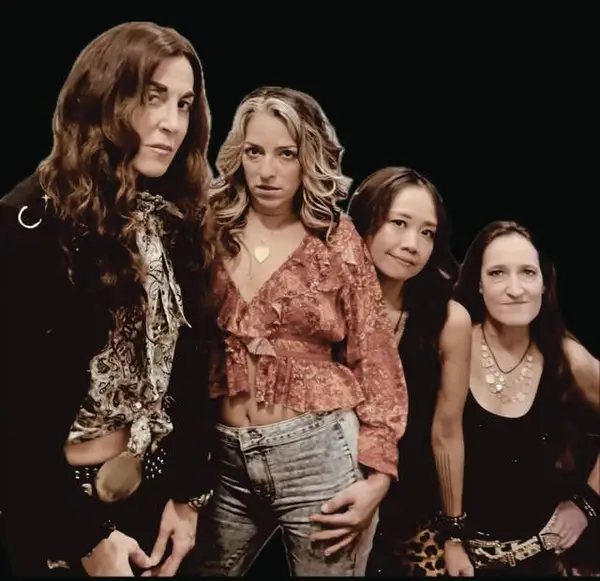
Lez Zeppelin will mark the 50th anniversary of “The Song Remains the Same” by performing Led Zeppelin’s 1976 soundtrack in its entirety on its current tour.
But Lez Zeppelin — that’s Lez with a “z” — doesn’t consider itself a cover band or a tribute act, according to Steph Paynes, the band’s guitarist and founder. Paynes, who started the band in 2004, prefers to think of the band as a “she-incarnation.”
“Someone from Psychology Today coined that phrase, and I thought it was genius,” Paynes said this week. “I think what it means for us is that we inhabit the music and we bring it to life, not as an imitation but as if we were generating it in a way that we would like to imagine Led Zeppelin did. Which means that when you jump into a piece like that, there is a part of yourself in it, the she, us, and we’re reincarnating it to make it live again and have a new life, come back to life, as it were, through us.
“And rather than an imitation or an impersonation, we are taking this music and, like a classical musician would approach a classical piece that’s very well known, you make it your own with your own musicianship in the spirit of how the composer intended. So that is what we feel.”
Paynes admitted that the definition is complicated, but today’s classical musicians aren’t considered cover acts.
“I think (Led Zeppelin) is the classical music of our time, certainly of this genre, and that’s how we approach it. And we have fun with it, too. It’s not like this sacred thing, every single note has to be (the same), because that’s more of an impersonation. If I were to copy every single note Jimmy (Page) played as an improvisation, I mean, he would never do that,” she said with a laugh. “It’s very hard, say, to copy a blues solo exactly that way and make it feel authentic. It’s great to learn how to play it, to copy a solo, to get it into your fingers and your bones, but then you have to release into it. And that’s what Lez Zeppelin does. We release into that music, and the result is very explosive.
Lez Zeppelin’s tour hits The Oaks Theater in Oakmont on Jan. 24, with locals Neutral Loss opening the show.
In a Zoom conversation Tuesday from Massachusetts, Paynes spoke with TribLive about the show, Led Zeppelin’s music, her approach to channeling Jimmy Page and more.
Find a transcript of the conversation, edited for clarity and length, below.
You’ll be marking the 50th anniversary of “The Song Remains the Same” so what should people expect out of the show?
Oh, that setlist, first of all, “The Song Remains the Same” movie was really, for so many years, the only real video document of Led Zeppelin, aside from bootlegs here and there, but it was really the only thing everybody had. And hence it’s the most familiar look of the band, the way they looked. If you see tribute bands … they all copied that because that’s really what they had. (laughs) And the setlist is just classic. It’s not only because it’s what everyone heard over and over and saw, but it’s just got pretty much everything — maybe with the exception of “Kashmir” that people like to hear, but sometimes we add that on to the end. If people are nice, then we might consider it. But it just moves, and it’s got lots of energy, and that’s what we do. And also there’s improvisation, and we do that as well. So that’s kind of our hallmark thing.
What is it about Led Zeppelin’s music that you feel has kept it so timeless for all these years?
I think that there is a diversity of style and feel – what they did was very well-rounded and had a lot of depth. I think the musical composition of it is really interesting and challenging. They took well-known genres and they made it their own and they mixed things together. There’s also a lot of dynamics in Led Zeppelin. People throw it into this category of heavy metal and it’s not. I mean, it may have given birth to something that became heavy metal, but it is so much more than what people think of as heavy metal. There are so many shades, as Jimmy liked to say, light and shade, in that music and that’s what makes it classic and that’s what makes it great. I think that that’s what’s made it last this long.
This band began back in 2004. Whenever you first started, did you have any inkling that it would be able to last this long?
(laughs) The whole thing is this crazy, wild, dream-like episode. I just started this band to have some fun. I really just was aching to play. I wanted to have fun. I was super deep into this music. I thought it would challenge me, chop-wise and everything else. And what could be more fun? Think of your wildest dream, like you’re going to go play the music of your wildest dream. That would be this. So I figured we would just do it. Now did I think it out? Not terribly much, because the challenge of it is significant. And once you jump in, if you’re really in tune with that, then you understand quickly what it takes to play this music correctly. And then it becomes a whole other kind of endeavor.
But did I think that this would take off into some crazy career that would last this long? It wasn’t even a career move. It was just for the love of it, which is a very important lesson, I think, because if you truly, truly love what you’re doing and it comes out on stage, audiences feel it. You connect with that, and your joy becomes their joy, and then people want to be part of that. And I think at the time also, 2004, there weren’t this plethora of cover bands, tribute bands, whatever you want to call them. It was not like that. There certainly were no women doing it yet aside from us. I just think that it hit a timing thing, and the band was powerful, man. It was just really a great band, and people couldn’t believe women were playing like this. They’d never seen it. So it sort of took on a life of its own and continues to do that.
RELATED
• The Runarounds’ Will Lipton on sold-out concerts, Amazon Prime series and more ahead of Pittsburgh show
• Q&A: Deraps guitarist/singer Jacob Deraps on 1st U.S. tour, Van Halen influence and more
• 2026 Pittsburgh area concert calendar
If you were comparing your guitar style to Jimmy Page, what do you consider the biggest similarities and the biggest differences between you and him?
Let’s just put it this way, I did not woodshed on Jimmy Page growing up as a guitar player. I was woodshedding on Joe Pass and Charlie Christian, and I played jazz for a long time. and Pat Metheny maybe. Certainly when I was little, I played folk music, James Taylor stuff, and all of that, and Beatles, but then I segued into this serious crazy jazz-head thing and did that, and then worked my way back into rock, maybe with bands like Jane’s Addiction and stuff like that. So I was sort of circling Page, but I never really dug in to the same things he did, which is partially why I wanted to do this. There was a learning curve for me to get to Jimmy, and I think that maybe that’s possibly why I think that I somehow managed to bring his playing alive, because I was not raised on that.
For me to find where he lived in that music, I had to dig in deep. I had to study it, I had to listen to where the influences were coming from. Celtic blues, more psychedelic, I played some psychedelic rock, but not exactly like him, and I wasn’t deep deep into the blues like that yet. So me listening so carefully to what he did, I think, was one of the reasons I could somehow capture the zeitgeist of it more than maybe somebody who had listened to Led Zeppelin forever and was playing those riffs, because you get into this thing and you think you’re playing it right and you’re playing it, but you’re not listening that carefully to try to get it. I think that there’s a lot in there that people miss a lot, and my playing was not like his to begin with, but now I think I kind of play like Jimmy, and I’m able to sort of take those jazz influences and hear things in his playing that, not to sound it, but a lot of people don’t hear it. He plays so behind the beat, man. And for me, that’s familiar turf. As a jazz player, that’s where I live. My band members sometimes are like, it’s so pulling back. They had to get used to it, but that’s him. That’s how he plays. People who don’t have that, I’m not even sure they can hear it or whatever. It’s just that it was very familiar for me, some of those elements.
He also has a certain swagger and aura. Are you like that offstage or is that completely different?
You know, I’m wearing a pink leather jacket, I’m just saying. (laughs) I think there’s a real connection in all of those ways. I don’t dress up to be Jimmy particularly. I’ve got clothes that are, of course I had to do that, but I think all of us have this, this is kind of what we do. It’s not a fake. I don’t put on my little mint green sweater and go off to work. You know what I mean? It’s not exactly like them, which is why it’s not an impersonation, but there is something to the swagger that lives in us.