
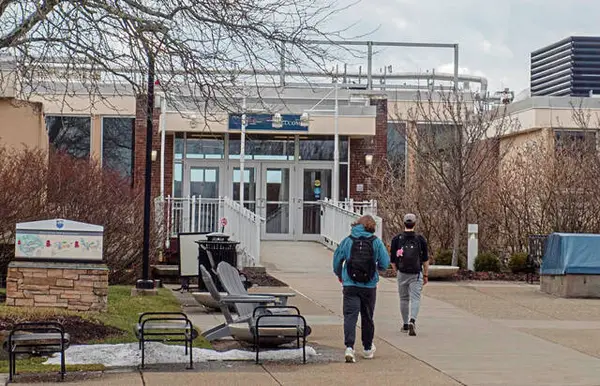
Penn State officials say the process to repurpose seven of its closing commonwealth campuses is making “steady progress.”
“There are three or four potential deals emerging, arrangements emerging, a few others that we are still working to hammer out — who will be the anchor, who will be the tenant, etc.,” PSU trustee Rob Fenza said during an executive committee meeting of the board of trustees last week. “Verifying information that the communities are desperately looking for.
“So, we’re navigating some of the areas of Pennsylvania where we’re trying to satisfy multiple interests and bring it all together with a successful outcome.”
Fenza didn’t elaborate, and Penn State’s media team did not return a TribLive request for comment about the plans.
Penn State trustees last spring voted to close seven branch campuses: New Kensington, Fayette, Shenango, Mont Alto, Wilkes-Barre, DuBois and York. Trustees cited declining enrollment, finances and the limited potential for growth in closing those campuses. The campuses will close at the end of the Spring 2027 semester.
Renata Engel, vice president for commonwealth campuses and executive chancellor, and Mike Stefan, vice president for government and community relations, along with Fenza, have been leading teams to repurpose the closing campus properties and transition operations.
Not every campus will have the same outcome at the same time, Stefan said.
“We are making progress at each of these campuses, and conversations are continuing and opportunities are starting to develop and arise,” Stefan said. “We’re pleased with the progress that’s been made so far.”
Penn State has held meetings with elected officials in the communities where campuses are closing to brainstorm ideas and paths forward for the properties.
Fenza said the process to find a use at the closing campuses that benefits each community’s needs is complex.
“This is a challenging and encompassing endeavor, but let me underscore that we are committed to finding, developing and delivering seven workable solutions for the communities where our campuses have become part of the local fabric,” he said.
“It’s infinitely more challenging than the other path we could have chosen, which is putting up for-sale signs and walking away.”
Winding down
Students enrolled at a closing campus who are taking more than 19 credits a semester don’t have to pay the additional surcharge that normally applies when exceeding 19 credits, Engel said. They also won’t have to pay a fee that covers student clubs and programs.
“We wanted to make sure the students who are at the campuses that are closing, that intended to be there for their full degree programs, they could make as much progress as possible before having to relocate to another campus,” Engel said. “This will afford them the opportunity to do that without additional financial expense.”
Penn State also updated additional scenarios and guides for students at closing campuses, and launched a survey asking students their enrollment intentions for next year, and what additional support they need, Engel said.
A priority hiring process launched this summer has been used regularly across the university, Engel said. That process makes sure non-tenured line faculty and staff at closing campuses are given priority as the university fills open positions.
Engel said the process of identifying where faculty are needed is underway. Reassignments wouldn’t take effect until fall 2027.
Officials also are working through degree programs at closing campuses and where they’ll be relocated, Engel said.
In Western Pennsylvania, associate degree programs in biomedical engineering technology and radiological sciences that were exclusive to the New Kensington campus will be relocated to the Greater Allegheny campus.
“If we look at the enrollment, the interest in the programs, the applications, etc., we are seeing really impressive growth in associate degrees at Greater Allegheny, and it’s a result of some of those early decisions we made,” Engel said.
“There’s good indication at the stage we’re in that these decisions we’re making, both thoughtful with good information to the right places, with the right audiences that we will reach, are bearing the right kinds of outcomes we had envisioned us seeing.”