
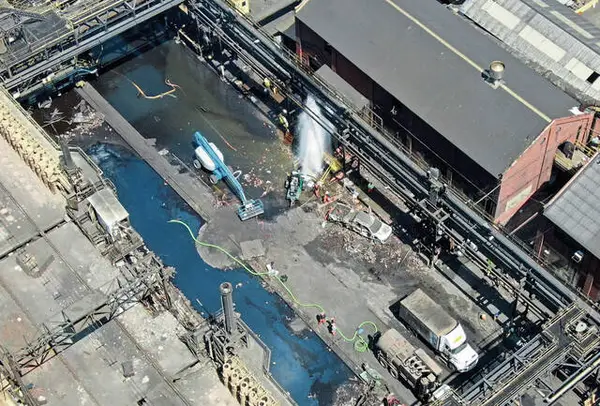
The federal Chemical Safety Board, which has been targeted for elimination by President Donald Trump, is likely to keep its funding and continue investigating a deadly explosion in August 2024 at U.S. Steel’s Clairton Coke Works.
An appropriations bill passed by Congress earlier this month would give the board $14 million to work with this fiscal year. Past budgets set aside $14.4 million.
The bill, which passed with veto-proof majorities, awaits Trump’s signature.
Neither board nor the White House returned requests for comment.
With just over 40 employees, the Chemical Safety Board investigates the country’s most devastating industrial accidents and provides recommendations on how to prevent them. It lacks enforcement power, but companies tend to adopt its guidance, anyway.
Outside the world of heavy industry, the board may be best known for producing animated recreations of the various blasts, fires and toxic plumes it investigates. These videos routinely get hundreds of thousands of views on YouTube.
A White House budget proposal last year sought to eliminate the board as part of “fiscal responsibility” efforts, despite widespread support from chemical firms, unions and trade groups. The Trump administration argued it was redundant with the Environmental Protection Agency and Occupational Health and Safety Administration.
Congress kept funding at existing levels when it passed a continuing resolution in November, ending a 43-day government shutdown. With a possible partial shutdown just nine days away, lawmakers have again moved to keep the agency’s allocation essentially flat.
United Steelworkers District 10 Director Bernie Hall welcomed the news, calling the agency’s work “vital.” His union represents more than 3,000 workers at the Mon Valley Works integrated steelmaking operation, including at the Clairton Coke Works.
“All workers deserve to remain safe and healthy on the job and to know that the federal government is doing everything in its power to work with them to complete thorough investigations when incidents arise, carry the lessons forward and ultimately make their workplaces safer,” he said.
Chemical Safety Board experts arrived in Clairton in mid-August, just days after an explosion at the coke works killed two U.S. Steel employees, Timothy Quinn and Steven Menefee. Another 10 workers were hurt, along with one contractor.
Batteries 13 and 14 sustained heavy damage. U.S. Steel restarted Battery 14 in October, while Battery 13 remains on hot idle.
A September preliminary report from the board found the explosion occurred between the two batteries during maintenance activities on a gas isolation valve.
Both of the workers killed were in control rooms in this transfer area, according to the board. Two of the five who suffered serious injuries were in a nearby break room.
Interim recommendations issued last month call on U.S. Steel to determine which occupied buildings at the plant could be impacted by future accidents and take action to protect workers.
This could mean moving personnel further away from hazards or restricting the number of workers who are near dangerous areas at one time, the board said.
U.S. Steel spokeswoman Amanda Malkowski said the company continues to cooperate with the Chemical Safety Board and Occupational Safety and Health Administration.
A final report is expected by the end of the year, though the corresponding video may take longer.
Without the board, the work of investigating the explosion would likely be left to contractors hired by U.S. Steel, according to Matt Mehalik, executive director of the Breathe Project, a Pittsburgh-based industrial watchdog.
“Having an independent federal agency doing that work is a really important center of expertise that can produce recommendations that people will view as credible and valuable,” he said.