
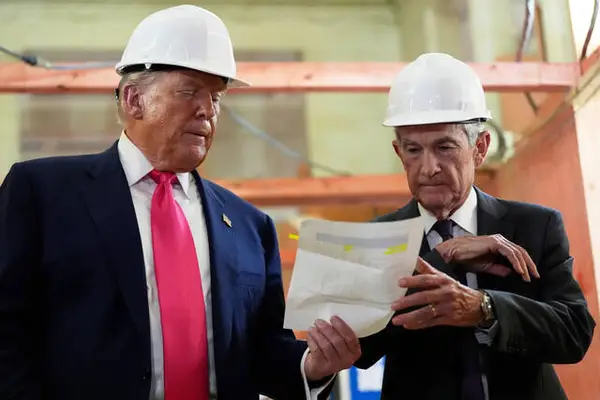
The Federal Reserve’s independence is under threat by the Trump administration, but experts say the central bank is built to resist executive influence better than most U.S. institutions.
In his quest to gain more control over the Fed, Trump will have to jump though hoops in the Supreme Court and Congress while stomaching discontent from Wall Street, a tall task even for a president accustomed to blowing past rules and norms.
“The defenses against presidential intrusion are multilayered and very well designed,” said Gary Richardson, an economics professor at the University of California, Irvine, and the Fed’s historian from 2012 to 2016.
Trump is on a campaign to get the Fed to slash the interest rate at which banks lend money to each other overnight, which influences the interest rates consumers pay on credit cards, mortgages and car loans.
It currently sits between 3.5% and 3.75%, putting a slight damper on spending to keep inflation manageable.
The president told The Wall Street Journal in December he’d like that figure to fall to “1% and maybe lower than that.” He’s also insulted Fed Chair Jerome Powell as a “moron” and a “stubborn mule,” among other critical remarks, for supporting only slight reductions in interest rates.
Supply and demand
Bringing rates down fast likely would juice the economy in the short term while sowing long-run cost hikes, according to John Canavan, lead U.S. analyst at Oxford Economics. That may be a fine trade-off to term-limited presidents looking to project strength, but it’s a bad outcome in the view of economists.
“When demand exceeds supply, you get inflation,” Canavan said. “If rates are kept too low, the economy will overheat.”
Unduly cutting rates also would violate the Fed’s congressional mandate to pursue stable prices and maximum employment regardless of the political climate.
Yet, Trump has made several moves that critics view as pressure on the central bank to go along with his wishes for lower interest rates.
In August, he tried to fire Fed governor Lisa Cook over allegations of mortgage fraud. She has not been charged and denies the claims.
Cook sued the government in response, arguing the law only allows presidents to dismiss Fed officials “for cause.” The Supreme Court heard arguments in the case Wednesday and seemed to favor keeping Cook in her job, although a decision likely won’t come until the summer.
A ruling favorable to the Trump administration would eliminate evidence of wrongdoing as an obstacle to remaking the Fed’s seven-member board of governors.
“If an allegation alone is enough to define cause for removal, then that could be done to anybody sitting on the board,” said Loretta Mester, a University of Pennsylvania finance professor and head of the Federal Reserve Bank of Cleveland from 2014 to 2024.
The Cleveland district covers Western Pennsylvania along with Ohio, eastern Kentucky and the West Virginia panhandle. Its current head, Beth Hammack, declined to comment.
Powell is also the subject of a criminal investigation related to cost overruns during renovations at the Fed’s headquarters in Washington, D.C. The Department of Justice issued subpoenas Jan. 9 related to the probe, which Trump said he has no knowledge of and Powell has dismissed as politically motivated.
Even with the Supreme Court on his side, the Senate could stop Trump from handpicking Fed governors, which typically serve staggered 14-year terms.
Lawmakers have thrown up red flags, including many Democrats and several Republicans. U.S. Sen. Thom Tillis, R-N.C., has said he won’t vote on any Fed nominees until the legal matter with Cook is resolved.
U.S. Sen. Dave McCormick, Pennsylvania’s Republican senator, has pushed for continued Fed independence, even as he remains aligned with Trump on the need for lower rates.
Speaking with bankers in Juniata County last week, McCormick said he finds it “very hard to believe that Chairman Powell was involved in anything criminal.”
Presidential resistance
It’s a common impulse among presidents to resent Fed independence.
Franklin D. Roosevelt, Harry Truman and Richard Nixon all mounted attempts to influence the central bank’s key interest rate in their day.
Roosevelt was the most successful, but only because he got Congress to change the law, according to Richardson. None have leaned on the courts and personal threats against Fed members as heavily as Trump, he said.
Market reactions also could restrain Trump in his bid to chip away at Fed independence.
Rising long-term bond yields would be one sign that investors fear the central bank’s decision-making could become clouded by politics. That happened to only a limited extent following news of the Powell investigation.
“That may be because the reaction was so strong by the political class that Wall Street was reasonably assured that there’s not going to be much of a challenge to independence,” said Chester Spatt, a finance professor at Carnegie Mellon University.
But the topic is clearly on the minds of prominent bankers.
Robin Vince, CEO of BNY Mellon, has warned the erosion of Fed independence could be “counterproductive” to the Trump administration’s efforts to lower the cost of living.
“Questioning one of the tenets that underlies the bond market runs the risk of doing the opposite — pushing interest rates higher — because markets may feel they have to worry about something they frankly shouldn’t have to worry about,” Vince said on a call with reporters last week.
Jamie Dimon, head of JPMorgan Chase, has made similar comments, prompting Trump to say he’ll be suing the company for “debanking him” after the Jan. 6, 2021, Capitol riots.
PNC Bank declined to make an executive available for an interview.
Political conflict aside, many economists believe the Fed should hold firm on the interest rate, for now. Inflation clocked in at 2.7% last month, reflecting a jump in prices compared to December 2024.
The Fed typically targets a 2% rate of inflation.
“I haven’t been convinced by the data I’ve seen that it’s on its way back down to 2%,” Mester said. “I think they’re in a good spot. This is a good time to just wait.”