
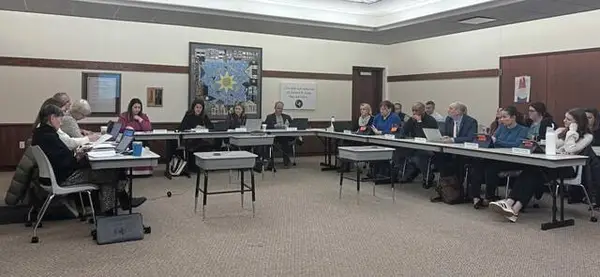
Quaker Valley School District officials have pledged to cap any potential real estate tax increase in their 2026-27 budget at 3.5%, the maximum allowed by the state Education Department without seeking a voter referendum.
Board members unanimously voted to pass a resolution affirming their decision to stay within the state-calculated inflation index as of Jan. 21.
The current tax rate is 22.075 mills, which equates to a $4,415 tax bill on a $200,000 property.
A tax hike to the max would raise the millage rate to 22.8476 mills. The aforementioned property owner would see the tax bill jump by about $155, to $4,569, should a 3.5% jump be approved.
The district raised taxes by 3.9% this school year.
Before the meeting, district business manager Brooke Baker stressed that no tax increase has been approved, and this is just a state-mandated step in the budgeting process.
“Actual impacts will vary based on a property’s assessed value and eligibility for exemptions, such as the homestead/farmstead exclusion,” Baker said. “This resolution only establishes the maximum rate the board could consider under Act 1 without seeking voter approval.”
Baker said the administration still needs to do a variety of things, including evaluate staffing needs, review operating expenses, use five-year financial forecasting to understand longer-term impacts and identify efficiencies and cost-containment opportunities before determining any tax increase.
“Together with the district’s healthy fund balance, this careful and methodical approach allows the board to plan responsibly while working to stay within the Act 1 index,” Baker said.
State law requires school districts to adopt a final budget by the end of June. Quaker Valley usually has its budget ready for approval in May.
Geoff Barnes, board vice president and finance chair, said the resolution not only sets a tax limit but keeps Quaker Valley on its planning timeline.
“Our preliminary budget process forces us to make a determination that we can stand by with respect to the Act 1 index, and that’s what we’re doing today,” Barnes said. “Had we not passed it tonight, it would be possible that at some point in the future we would be having to seek permission to raise taxes above the index. That’s not the condition we’re in.”
Barnes said managing tax rates is getting more difficult with the declining Allegheny County common level ratio, an esoteric formula used during appeals to value properties for tax purposes.
“Our fiscal discipline and careful budgeting are going to enable us come in under the index,” he said.
Superintendent Tammy Andreyko said budgeting is a year-round effort.
“We as an administration never really stop talking about decisions that we make,” Andreyko said. “It doesn’t really start or begin. It’s an ongoing conversation. We take a look at our personnel expenses. We take a look at our contractual obligations. We take a look at purchasing and whenever we can reduce costs, we do.
“Right now, we don’t have any anticipated programming reductions. We may be looking at consolidating software programs that we no longer use, or students don’t feel are valuable (and) staff doesn’t feel are valuable.”
The superintendent said a five-year capital improvement plan update is also expected later this year that will give some insight into other budgetary needs.
Projections in line
The 3.5% tax increase limit is very close to projections made by former business manager Scott Antoline in September 2023.
When addressing future district budgets and a proposed high school, Antoline said tax hikes would be necessary for at least the next five years at about 3.4%, with 2% just to cover operational needs.
“That story hasn’t changed,” Barnes said.