
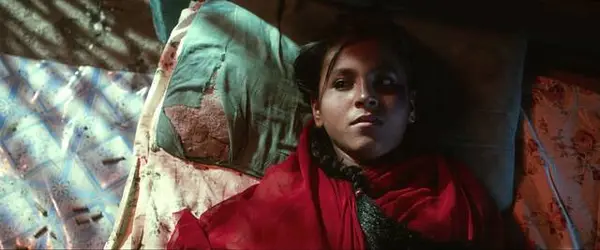
Erin Galey was a long way from her hometown of Fox Chapel when she discovered the story that would inspire her short film, “Brave Girl.”
She was a student at New York University’s Tisch School of the Arts in Singapore, pursuing her master’s degree in film production, when a friend asked her to help make a documentary about women in Nepal who were learning to kayak and become river guides.
When she heard a story about a local girl named who had gone missing, she began a journey that eventually would lead her to “Sahashi Chori (Brave Girl),” her short film about human trafficking that was recently rereleased on Apple TV, Google Play and YouTube TV to coincide with January’s designation as National Human Trafficking Awareness Month. It originally premiered at the 2013 SXSW film festival, was screened at 40 festivals worldwide and won multiple awards including Best Producer and the Women in Film Directing Award at the HollyShorts Film Festival, Best Short Film at the Palm Beach International Film Festival and Best Short Film at the Sene Film, Music & Arts Festival.
Galey, 46, who today lives in Bend, Ore., spoke with TribLive recently about making the film and what she hopes its impact might be.
Q: What inspired you to make “Brave Girl” in 2013?
A: On a river trip (in Nepal) with these girls, (my friend) shared some concern about a girl who disappeared from her program and her village. This got me very curious and began a detective-like journey that uncovered a hidden world in Nepal.
I asked my friend if she knew a local Nepali producer so I might enlist their help and perspective, and that was how I found Binod Adhikari, who became our key local producer on the project. I explained to Binod two things — I wanted to talk to survivors of trafficking, so we might better understand their story. Despite this being a very awkward ask for any man in Nepal, he went out of his way to find several women willing to share their stories. I think this process had a pretty profound effect on him.
Second, I explained it was important to understand how a girl would get from her tiny village in the mountains to the bustling metropolis of Mumbai (in India), and perhaps it would be worth doing that journey together, staying only where locals might stay. He hesitated about the “only locals” request — “Are you sure?” he said — which made me even more curious and encouraging that we must go. We started at his home village in the mountains outside Kathmandu, and as I got to know the local ways, I slept in a small loft above the yaks and goats in the barn. Once we set out on the road trip, the script practically wrote itself. I still can’t thank him enough for his immeasurable contribution to the project.
Q: It seems like one of the things that makes raising awareness of human trafficking difficult is that, for many people, it seems like it’s something happening in faraway places like China or Nepal. Have you or anyone you know ever had accidental contact with that world?
A: I feel very fortunate that I don’t know anyone in the United States who has been trafficked or has had contact with that world, although I know it exists. The story is set in Asia because I was living there at the time, otherwise perhaps it would have been a local story. What I learned applies to this industry worldwide: Trafficking is a lot closer to home than you might think. Many Westerners go to Nepal and experience the beauty and generosity of the people and the landscape there. And all of that is very real, but it’s also very removed from local politics and issues.
What I discovered in my many conversations and experiences with locals, including CNN’s Hero of the Year 2010 Anuradha Koirala, is that trafficking seems to come down to two things. One is that gender inequality in the country is a massive issue and contributing factor. It was a serious adjustment for me as a Westerner raised by a family that empowered both my sister and I, to understand this piece of it. The second is a certain preference for Nepali women in the brothels of India. There is a lot to unpack in that simple statement, but basically there’s a demand for girls like Bhumika (actor Albina Dahal). I imagine this type of demand is what keeps this industry afloat in any part of the world, near or far.
Q: What was the biggest challenge of creating “Brave Girl”?
A: The filming conditions, the availability of modern film equipment (and basic power), and the fact we shot authentically across four different regions, three regions of Nepal and several days in and around the red-light district of Mumbai. I wanted to shoot it authentically, and even though my producers were trying to streamline the process and all the travel, there really was no way to fake the locations, we just had to go there. And we did, with a blend of equipment we brought in to the country and local equipment that was available.
Remember, this was pre-drones, pre-handheld stabilizers outside a Steadicam (which we couldn’t afford at the time), pre-LED lights, and we were working in conditions where power outages were fairly common and gas for the generator was not always easy to come by. Had we shot this story anywhere in America, it probably would have taken 10 or 11 days, and we would have had access to much more modern equipment. But we budgeted 18 days and really needed every minute of it.
Q: Despite it being an emotionally fraught topic to tackle, what was the most enjoyable part of working on the film?
A: The team, a thousand times over. Every single person who touched this project was not only moved by the material, but gave it their absolute all and then some. Everyone pushed their talent and contributions to the very limit to make something meaningful. The team gelled together so well from start to finish, and we really had a blast making the film, which I think is an important vibe to help offset the material.
It’s also something I try to create on all sets I helm. We worked hard, everyone brought their A-game to the work, and then we were all able to pick up our heads and look at the beauty and joy around us. That’s the incredible dichotomy of Nepal: It’s tough, and it’s also just magical. I don’t think we had a ton of drama on set. The conditions themselves and the story were the drama. I know the cast and crew all took home many memories of working together on this film, and I can’t wait to share a glimpse into all that very soon as we plan to roll out some behind-the-scenes edits over the next month or so.
Q: How did the rerelease come about?
A: The rerelease has been a long time coming, and I’m so glad we’re finally able to celebrate this enormous milestone for the film. After the original release on the festival circuit, it lived on several channels on ShortsTV, DirectTV and other distribution outlets for many years. The contract with ShortsTV ran out sometime during the pandemic, I think, and as I was busy in my current career writing, directing and producing, it took a minute to figure out where to take the film next.
Unfortunately, we got caught up in that whole distribution debacle with Distribber, and it took me (and all the other independent filmmakers working with them) a while to get this project untangled from their mess. But I did eventually and found my current distributor who I’ve just been so impressed with.
I spent most of last year delivering the assets to them in my spare time between commercial projects, buying a house and having a baby. Most people don’t realize how labor intensive this process can be. Once everything passed QC, we decided January would be awesome to release as it was Human Trafficking Awareness Month. It just felt very serendipitous.