
It was an outrageous display.
On Dec. 14, four days after being acquired in a trade, goaltender Stuart Skinner made his debut for the Pittsburgh Penguins against his former team, the Edmonton Oilers.
And he wore a blue and orange Oilers mask with his black and yellow Penguins jersey.
And at the other end of the rink, Tristan Jarry, who went to the Oilers in the transaction, had the same laundry challenge, albeit in reverse, as he donned a Penguins mask.
“We should have switched,” Skinner quipped after the 6-4 home loss at PPG Paints Arena. “I’m definitely working on a (new mask) pronto. But, yeah, that would have been funny if we just saw each other in warmups at the red line and changed helmets.”
Given the cumbersome nature of goaltending gear, finding equipment that matches a team’s colors or themes in the event of trade or other in-season transaction isn’t as speedy a process as it is for forwards or defensemen needing new gloves or pants.
And as such, goaltenders can often look like a Jackson Pollock piece for a few games until their new gear arrives.
But by Dec. 27, Skinner began practicing in his new Penguins-themed mask and actually got to wear a fully black and yellow ensemble in a game of consequence by Dec. 30 in a 5-1 home win against the Carolina Hurricanes.
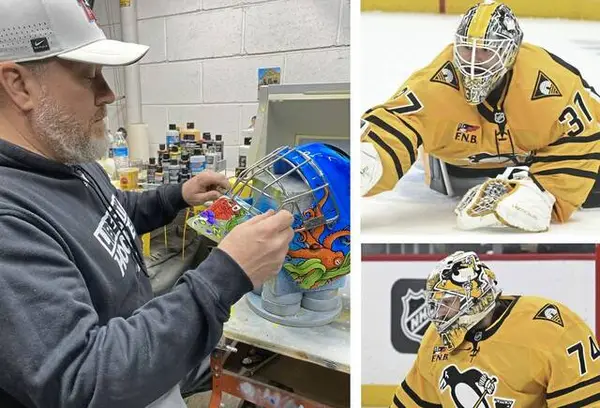
His new lid had plenty of Pittsburgh themes incorporated into it with an outline of the city’s modern skyscrapers as well as smokestacks calling to the region’s industrial history, adding a local flair.
And the mask was crafted locally by Scott Williams of Kittanning.
As was the mask the Penguins’ other goaltender, Arturs Silovs, wears. Ditto the Penguins’ goaltending consultant (i.e., practice goaltender), Mike Chiasson.
Williams, who has painted masks for goaltenders ranging from youth levels to college for several years, was contacted by Penguins head equipment manager Jon Taglianetti last summer about gear for the team’s non-goaltenders. Eventually, that led to an invitation to collaborate with Chiasson, then Silovs and Skinner.
“The whole thing has been kind of a whirlwind for me growing up as a Penguins fan,” Williams said by phone. “Then, the first time Jon reached out, I thought I was getting punked by one of my friends. … I thought, this can’t be real.
“Getting an opportunity to talk to these guys — not about hockey necessarily or anything like that, just kind of what they’re into — is really cool.”
His customers appear to be satisfied.
“Being able to work with him was awesome,” Skinner said. “It was a pleasure. We just kind of started texting. He sent me a couple of ideas, sent me his profiles (of other masks). We were able to talk about a few things and what I wanted and what he thought looks good. I like letting the artist bring out his creative side and do what he does. And he did a fantastic job.”
Williams, 46, has a full-time job working in road construction. Painting masks is a nice side gig and it’s something that started in 2012 when his mother gifted him with an air brush kit for Christmas in 2012.
His daughter, Cora, played for the Armstrong Arrows youth program based in Kittanning and the father of a teammate who was a goaltender asked Williams if he could paint her mask.
“The mask was around $400,” Williams said. “And I had a panic attack because I really had no idea of what I was doing. I thought if I mess this up and I have to buy a new mask, I couldn’t afford it.
“Fast forward, 10 years later, that girl still wears that mask in alumni games and stuff.”
Lots of goaltenders in the area wear Williams’ masks, as evidenced by the galleries he maintains on Instagram and Facebook.
He has something of a monopoly on painting masks in Western Pennsylvania, due in part to his obvious talents as well as the simple fact that there just aren’t many artists who can paint the finite and challenging canvas a goaltending mask has.
“Locally, if a goalie has a custom mask on, it’s a good chance that I did it,” Williams said. “There’s not many people, especially around here, that do it. It’s kind of a lost art.”
The first Penguins-adjacent goaltender Williams did work for was Jeff Siwik, a Monroeville native who has occasionally served as one of the team’s EBUGs (Emergency Backup Goaltenders) and will sporadically practice with the Penguins. Siwik has a replica of former Penguins goaltender Johan Hedberg’s blue “MOOSE” mask that became famous a quarter century ago.
This past summer, Chiasson turned to Williams for his newest mask after having previously worn masks designed by David Gunnarsson. Commonly known as DaveArt, the Sweden-based Gunnarsson might be the most famous mask designer in hockey.
“Jon Taglianetti mentioned that there’s this local guy that does them,” Chiasson said. “I got in contact with (Williams). Saw his Facebook page of his other masks and we just chatted. A great guy. We went back and forth. He’s obviously very passionate about doing it, especially for the Penguins being a local guy.”
Williams designed two masks for Chiasson. The first one incorporates elements of masks worn by former Penguins goaltender Ron Tugnutt (which had a “splash” look to it) and former Quebec Nordiques goaltender Stephane Fiset (who donned “bricks” on his lid).
The second mask is a bit more personal. In addition to paying tribute to longtime friends Kris Letang, Sidney Crosby and Evgeni Malkin along with the three Stanley Cup titles they have won with the Penguins, Chiasson incorporated his family.
“My daughter is a big Mickey Mouse fan and Disney fan. So, put the Disney castle and Mickey and Minnie playing hockey on the other side. Then, I’ve got my kids and dog at the lake on the back. He just lets it flow and does his thing. It’s perfect.”
Silovs joined the Penguins via a trade with the Vancouver Canucks in mid-July, so there was plenty of runway for Williams to create a mask to Silovs’ liking before the season opened.
“I was on vacation actually, when I was telling my wife, ‘Oh, the Penguins just traded for Arturs Silovs.’” Williams said. “Then, it wasn’t a half hour later and Jon was calling me and wanted to know if I wanted to do his mask. Of course, I accepted that for sure.”
Silovs’ mask has the Penguins’ logo and the team’s name on each side with “steel plates” and some of the city’s skyline serving as a background. On the chin is his No. 37 and a pair of griffins, which is part of the coat of arms for his home country, Latvia. On the backplate is the coat of arms of his hometown, Ventspils, Latvia.
“It’s good to go to a local (painter) to get the job quick,” Silovs said. “It’s good to have it pretty close to the area. … I just tried to get a connection with the city. Tried to get my initials, my country’s coat of arms.”
As for Skinner, the bulk of his personal touches are on the backplate (aside from his No. 74 on the chin). They include a silhouette of his signature mustache, a few Latin phrases and a few family-related icons, including a pink ribbon in recognition of breast cancer awareness.
“The things that I take seriously are the meaningful things that I put on my helmet, which goes on the back,” Skinner said. “My family, breast cancer symbol and a couple of sayings that I try to live by. That’s the most important.”
As for the Pittsburgh-themed parts of the mask, Skinner leaned on Williams.
“I learned a lot about the city, actually talking to Scott about the paint job,” Skinner said. “Been learning a lot about it, which has been awesome. … I’m really happy with the work that he put in.”
Simply talking to goaltenders about what their interests are may be the most rewarding aspect of this for Williams.
“That’s the best part,” Williams said. “Some guys come to me and they don’t really have an idea or a direction of what they want. But if they can give me a couple of things that are important to them, usually the backplate, especially, is usually more personal for the goalie than the main part of the mask. All the team stuff is going to be on the main part. But on the backplate, they get a lot more personal. I’ve done a lot of backplates with similar stuff. Initials of grandparents or cancer ribbons of loved ones or sayings or verses or anything that they want.
“It makes my job a lot easier when they have stuff like that that is important to them that can find a spot for it on the mask.”
The process of designing a mask has two vital components. Most notably, Williams’ skills create the finished product. But creating a concept is the initial step in the process and that often entails simply chatting with the goaltenders about their interests.
“Some goalies, they know exactly what they want,” Williams said. “They have a whole thing drawn out. And some, they don’t really care what you do. They just say, ‘Hey, put a logo on it and go with it.’ So, it really depends on the goalie. But usually, it’s just conversations back and forth. How about this, how about that? And we end up coming up with a pretty cool design in the end.”
Williams doesn’t have any formal training when it comes to painting or design and is largely self-taught. His process is highly intricate.
“I hand-draw it sometimes on the computer,” Williams said. “Or if it’s a logo like the Penguins’ logo, I can just pull that from their website and make a stencil out of that. It’s a combination of both hand drawing and computer work. And of course, the painting is all by hand.”
The painting is fairly labor-intensive.
“If I get a brand new mask, just sand it down to give it a good rough surface,” Williams said. “Some masks already have a clear coat on them, so you have to sand that down. Some come unfinished completely. Silovs’ mask came unfinished, so that makes it a little bit easier. You sand it down and prime it. I start the paint process, sometimes depending on graphics and shading, you have to spray them with an inter-coat so that locks those colors in. That way, you can start again on top of that without diluting or distorting the colors underneath. So, it is a bit of a layering process.
“Once all that’s done, I spray it with essentially a similar clear coat you would have on your vehicle, only it’s a little bit harder because it’s going to be getting hit with pucks and sticks and stuff. So, I put several coats of that on it. Sand it again, buff it and then send it out.”
Williams is a hockey lifer. Having grown up in Paintertown, just outside of Irwin, he was part of the first high school team at Penn-Trafford then continued to play the sport when he moved to Kittanning at age 15.
He skated for Penn State’s club team and continues to play in a “beer league” occasionally. He has also been behind the bench as a coach.
Given his passion for hockey and the Penguins, seeing his talent on display in NHL games offers a sense of elation that Williams is still trying to process.
“Seeing it on TV for the first time, it was crazy,” Williams said. “Then the first time that Skinner wore that mask and they had that little story on Pittsburgh SportsNet, I was in shock. I didn’t know that was coming. My phone started blowing up. My family is calling me, friends. It was really cool.
“Even now, Silovs has been wearing his three, four months now, and still, every time I see it, it’s surreal.”