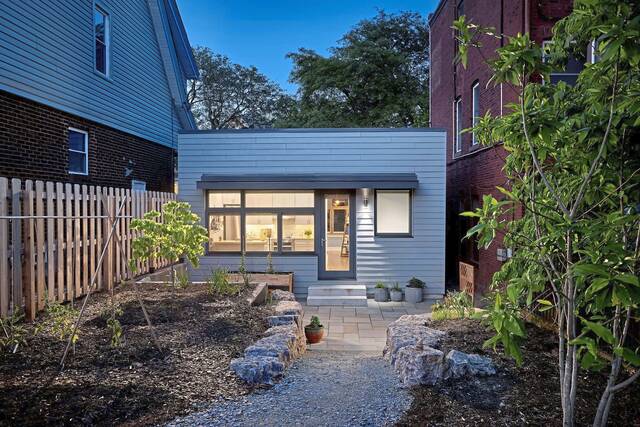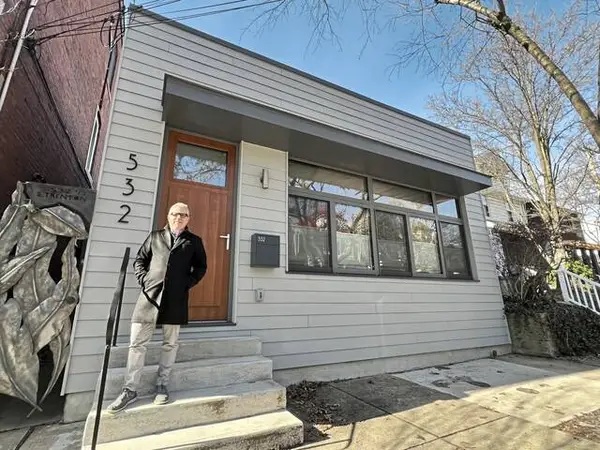
A small home in Wilkinsburg has earned a big architectural distinction.
Recently renovated for energy efficiency, the century-old building has earned a Passive House EnerPHit certification from the Passive House Institute — the highest certification available for energy efficiency in existing buildings.
It’s the first house in Pennsylvania to achieve this certification. Moreover, only four other single-family homes in the U.S. have earned this distinction from the institute, founded in Germany in 1996.
Passive House design (Passivhaus in German) creates buildings that use the least amount of energy, have superinsulation, heat recovery ventilation, window glazing and airtight construction. Thermal-bridge-free details prevent weak points where heat or air conditioning can escape.
The goal is to create a calm and comfortable indoor living space while obtaining maximum energy efficiency.
“It’s a rigorous, performance-based standard, with important features,” said project architect Nathan St. Germain, principal of Studio St. Germain in Sewickley. The result is what St. Germain calls “a healthy building.”
The owner of the Wilkinsburg residence hired St. Germain specifically to fulfill Passive House design.
“The building works for the owner,” he said. Recently retired, “she wanted to age in place and we made everything accessible to her in the interior.”
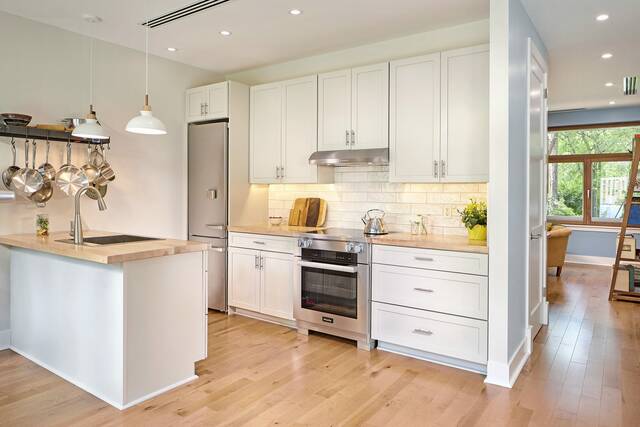
While the homeowner declined to comment, St. Germain said she was introduced to passive homes in Europe, particularly in Germany and France.
The Wilkinsburg house was originally a retail building that was later converted into a residence. The one-story structure has 720 square feet of living space and with an ample backyard.
Retrofitted residence
Designed to maximize natural light, the windows are triple-glazed to provide an ultra-tight fitting.
The one-bedroom residence contains a energy recovery ventilator that exchanges indoor air for filtered, fresh air. This process reduces air pollutants, manages humidity levels and removes airborne allergens.
“The Wilkinsburg residence suggests a potential new standard for homes in the future. A standard based on improving the day-to-day lives of its occupants,” St. Germain said.
Stephen Swarney is the executive vice-president and CEO of AIA Pennsylvania, the statewide office of the American Institute of Architects. He stressed that retrofitting existing building stock is one of the most critical challenges faced to promote sustainable architecture.
“By achieving the first EnerPHit certification for a single-family home in Pennsylvania, the Wilkinsburg residence proves that we don’t need to tear down our history to build a green future,” Swarney said. “We can transform it. This project sets a powerful precedent for adaptive reuse across the commonwealth.”
A total project cost was not provided. St. Germain noted that renovations for a passive home typically run 10 to 15 percent greater than standard new construction rates. But renovating the home with airtight construction and thermal insulation makes for a building with lower annual operating costs.
EnerPHit-certified homes are expected to produce an annual energy projected savings of more than 58 percent.
“The utilities are extraordinarily low, which in this case is important because the owner is retired and on a fixed income,” St. Germain said. “During inflationary times like now, one of the concepts we use in this design is called future-proofing.”
Future-proofing a building is designing it to go against rising energy costs that one can’t control.
Passive House design, which originated in Europe, is gaining popularity in the United States.
“We feel very proud to have earned this certification and especially because it is the first one in Pennsylvania,” St. Germain said. ”Passive housing is becoming more known but it’s still pretty niche.”
St. Germain, a graduate of the New Jersey Institute of Technology, worked in New York for a decade before moving to Pittsburgh in 2012. Working in New York exposed him to high-end, high-level commercial and residential buildings. He was inspired by architectural sustainability midway through his career.
“I noticed these buildings were aesthetically beautiful but I wanted to know how they performed,” he said. “My philosophy of my company is “building to give back” and that means we’re committed to architecture as an art but also architecture as a public good. The public good is where the sustainability really dovetails in.”