
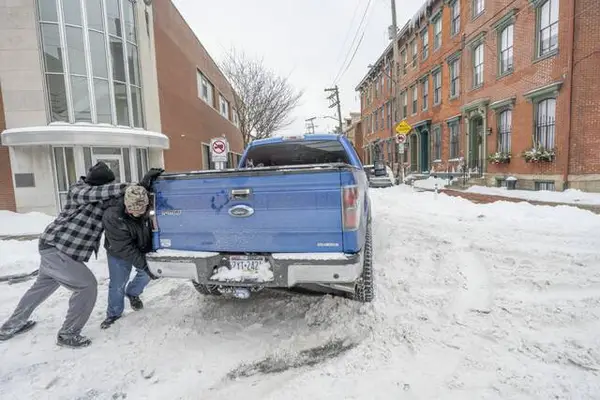
A large amount of the snow that pummeled the region continued to blanket roads across Pittsburgh on Tuesday.
“It’s still a bit of a mess, but I’m confident we’ll get through it,” Councilman Anthony Coghill, D-Beechview, told TribLive.
Pittsburgh Mayor Corey O’Connor said snow removal efforts will continue overnight. He acknowledged some roads have yet to see a plow.
“We see there are streets that haven’t been hit yet,” he said. “We’re deploying all our resources to you.”
As of Tuesday afternoon, O’Connor said main city roads were “drivable.”
“We are seeing on the maps where we have missed spots and picking up loose ends,” O’Connor said. “We still know we have a lot of work to do, and we’re trying to get there as quick as we can.”
The mayor on Monday declared a state of emergency — joining dozens of other nearby municipalities and Allegheny County — so that officials could more quickly hire independent contractors to help plow roads and haul snow away.
The emergency declaration, the mayor said, was prompted by plow problems the city experienced overnight Sunday into Monday. Pittsburgh started the storm with 95 plows, but 37 of them broke down during the weekend storm.
Of the more than three dozen plows that had broken down, 21 have been repaired and were back in service Tuesday, said Molly Onufer, a spokeswoman for the mayor.
Issues that took plows out of service, she said, ranged from needing to put a plate on a dented plow to hydraulic pressure problems.
Councilman Bob Charland, D-South Side, was riding along in a plow that got a flat tire, an issue that was quickly fixed.
“It was like a NASCAR pit crew addressing that,” he said.
Charland said he heard calls come over the radio that one driver’s plow was bending incorrectly. Another had difficulties with his salt spreader.
Fifty city snowplows will be out plowing and salting streets overnight Tuesday, O’Connor said, in addition to more than 25 vehicles from independent contractors.
Fleet problems
Officials frequently flag concerns about the state of the vehicle fleet, which is old and prone to breakdowns that can require expensive maintenance and pull equipment out of service.
City Controller Rachael Heisler in a November report indicated that nearly a third of the fleet is at least 10 years old and about half of the city’s more than 1,300 vehicles “exceed their life cycles.”
Given those fleet problems, Charland said, he wasn’t surprised to hear dozens of plows were out of service during the storm.
“I think that’s what would be expected with the fleet age that we have here,” he said. “They’re being pushed. They’re both hauling the salt they’re carrying, but also pushing a plow. Obviously, I’m alarmed at the age of our fleet, but that doesn’t strike me as a number that’s like, ‘Oh, something terrible happened this year.’ It’s the age of the fleet.”
Improving a beleaguered fleet will take time, Coghill said.
Council budgeted $20 million for fleet improvements in the 2026 spending plan — though it takes time to get new vehicles, particularly specialized ones like ambulances or firetrucks — and legislation being considered would mandate a similar investment each year.
“We can’t do it overnight,” Coghill said. “It’s been well-documented how bad of shape it’s in. Of course, it reared its ugly head.”
Charland on Tuesday told TribLive that primary roads throughout his district were “pretty cleared.” Smaller neighborhood streets remained problematic.
“The phone calls I’ve had this morning, the people who are snowed in are pretty upset about it,” Charland said.
The city called in 50 trucks from outside contractors who are helping to clear roads. Officials could not immediately say how much that would cost the city.
“We will find what we have to find in the budget,” Onufer said. “This is top priority.”
Some of those trucks will be tasked with removing the snow that has been plowed and is now piling up along streets, often blocking in cars or accumulating in parking spots.
Snow problems
Roads throughout the city — particularly the secondary and tertiary streets that aren’t cleared first — remained snowy and, in some areas, impassable Tuesday. Council members throughout the city acknowledged roads in their district remained untreated, though officials said crews continue to work around the clock.
“It’s still problematic,” Councilwoman Deb Gross, D-Highland Park, said. “Those secondary and tertiary streets are dangerous.”
Even some roads that were plowed once or twice remain slick, she said.
O’Connor Tuesday afternoon said garbage collection will be suspended this week because of the snow. It will resume Monday.
We are suspending refuse collection through the end of the week so Public Works crews can focus on snow. Garbage & recycling pick up trucks are plowing, residential snow is on curbs, & we are expecting low wind chills.
Collection will resume as normal on Monday, February 2nd. pic.twitter.com/pgx9gjv8b1
— Corey O'Connor (@CoreyOConnorPA) January 27, 2026
Police, fire and EMS crews have still been able to respond to emergencies, O’Connor said. Roads around public safety facilities are being prioritized.
The mayor said the city had enough salt in stock and received another shipment Tuesday.
Once crews have cleared this snow, Gross said, she wants to brainstorm whether there’s something “different, out of the box” the city could do to prepare for the next storm.
She said she wasn’t sure how Pittsburgh measured up in comparison to other cities in terms of clearing roads. It’s hard to compare, she said, because some cities are flatter or have wider roads. Others have more or fewer miles to clear.
In Washington, D.C., officials Monday urged people to avoid traveling unless absolutely necessary because of icy roads, The Washington Post reported. In Philadelphia, officials early Tuesday morning lifted the city’s state of emergency because conditions on main roads had improved — but officials acknowledged snow cleanup was not complete, with smaller roads still snowy.
Meanwhile, officials in Buffalo said they planned ahead by positioning equipment around the city and contracting additional crews in advance, efforts that helped mitigate issues they face with an outdated fleet of plows.
Temperatures in the Pittsburgh area have not crept above freezing since Sunday’s snow — and the National Weather Service is forecasting they will stay below freezing for more than a week.
Coghill pointed out that some areas have seen snow packed down into ice where cars have driven through. That can make it trickier for plows to tackle, he said.
“DPW is working as hard as they can on every street with what equipment they have,” said Councilwoman Kim Salinetro, D-West End, referring to the Department of Public Works. “I’m sure it’s the same in every district.”
Salinetro, a newly elected member of council, said she didn’t want to criticize the city’s snow response because it was such a major storm.
Pittsburgh hasn’t seen such a massive snowfall in about 16 years, according to the National Weather Service.
The 11.2 inches of snow that fell on Pittsburgh Sunday set a new daily record for Jan. 25, far surpassing the prior record of 5.2 inches, recorded in 2014.
The storm is tied for the 13th highest amount of snow to pummel Pittsburgh in 24 hours, based on records dating to the 1800s.
Salinetro acknowledged some people may be growing frustrated after being snowed in for days.
“We have no other choice but to remain patient,” said Salinetro, who noted she was still snowed in herself. “There’s not much we can do.”
O’Connor urged people to use caution when driving and stick to major roads as much as possible.