
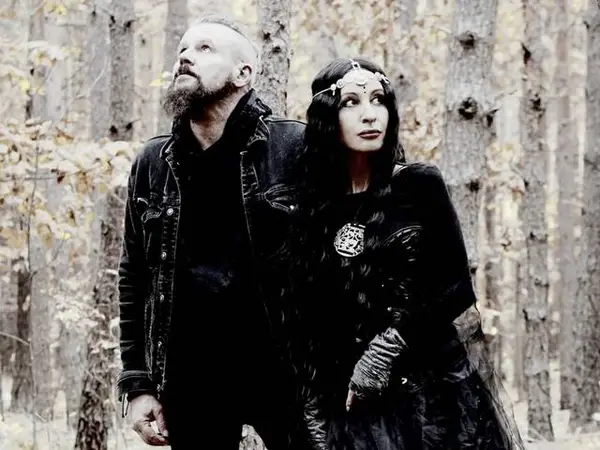
An international project like Death By Love is fraught with challenges, but White Oak’s Peter Guellard came up with a novel solution to make it work.
The new Pittsburgh-area band, which blends goth, industrial and trip hop, features music by Guellard and vocals/lyrics by Poland’s Inga Habiba. Trading files over the internet isn’t as big of a deal anymore, but that time change took some adjustments.
“One of the main problems is the six-hour difference between Pittsburgh and Warsaw, which means that I have to wake up really, really early, which is fine because my sleeping patterns since I met Inga changed,” Guellard said with a laugh. “So I’m kind of used to it. And on top of this, when I fly to Poland, I’m all right. I don’t have jetlag. So that works great.”
Their first album, “444,” is set to be released on Feb. 20 via Distortion Productions. But when it comes to concerts — with members in the U.S. and Europe — it gets more difficult. Live performances are slated this year at a pair of European festivals: the Castle Party Festival at a 13th century fortress and the Soundedit Festival, both in Poland.
Beyond that, Death By Love will be employing technology to replace Habiba when she’s not available in the states. They’re still fine-tuning a hologram — think Obi-Wan Kenobi in the original “Star Wars” movie — that captures an entire live performance from Habiba.
“We did all the pre-production. We recorded Inga’s performances. Now we’re just setting it up so it looks right,” Guellard said. “I realize it’s like a one-trick pony, but that’s what we can do. … It’s a novelty, and I’m hoping that because of that novelty, we’ll get noticed, too.
“We might get lots of enemies because of that, but I don’t care,” he added with a laugh.
There are no U.S. shows scheduled just yet, but the live lineup here will include two other Pittsburghers: guitarist Pam Simmons (ex-Motorpsychos) and drummer Joe Palermo (Kid Durango).
“We are still tweaking everything. Right now we are concentrating on booking big festivals, because that’s the most important thing where we can show our music to a broader audience,” he said. “But once we make that happen, we’ll feel much more comfortable with playing smaller shows here.”
Guellard moved from Poland to the Pittsburgh region in 1991, with his first band here called Mace. He’s also toured with Electric Hellfire Club and played with locals Venus in Furs and Dichro, among other projects. An attempted Mace comeback in 2020 fell apart because of the covid-19 pandemic.
“I decided I’m not going to sing anymore because, being a music producer, I worked with many singers, and I decided that those singers are way better than me,” he said with a laugh. “So I’m not going to sing anymore.”
In a Zoom conversation, Guellard spoke with TribLive about the hologram technology, the album title’s meaning and more. Find a transcript of the conversation, edited for clarity and length, below.
How did this Death by Love project come together then? How did you and Inga decide to start doing this?
Well, I knew Inga because of my friends back in Poland. I left my band in Poland called Blitzkreig, and those guys were forming other bands. We never lost any contact with each other and were involved in our music creation and being fans of each other pretty much. So when a bunch of my friends were playing on a band called Lorien, this Warsaw band, that’s when I noticed Inga. Inga was connected to a bunch of other bands in Poland as well.
So the way how we actually connected was a remix that I made for Inga’s band at the time called NUN Electro. It was also a two-person electronic outfit when she was a singer and she had a producer who did music for her. They asked me to do a remix and because of that remix Inga kind of got interested in what I’m doing, and we decided that we’re going to start writing music together. After writing two or three songs, we decided that we have to do a band together because that’s so natural. That’s how that album that we are promoting right now came to life by writing music and doing it via internet, which was really cool. She has her own little studio. I have my studio here, so we were able to do independent sessions at the same time via internet where I would coach her and I was saying how to approach certain songs. She would give me a bunch of ideas, and we’re just shooting files back and forth, and that’s how that’s how the record came out.
What are the challenges of an international collaboration like that?
The challenge is, of course, we can’t play as many shows as we would like here in the United States. So we came up with an idea of a hologram. The band is pretty much based on electronic music, based on computers, based on sequences. So we use pre-recorded tracks during our live performance. What it means is that we don’t have, per se, a keyboard player. All the keyboard parts are coming out of the computer. And live musicians, the drummer, guitar player, and myself playing bass, we play to the drummer who listens to the click track. The click track is coming from the computer so everything is synchronized.
Because of that, we can have a video synchronized to our music, which also comes out from the same program. So we can project the video images on the screen behind the band and it’s 100% synchronized to our music. By doing so, we can also “replace” Inga with a hologram. It is done by a little Chinese-made projector, which is like a propeller. I would say it’s about five, six feet in diameter with four blades. Each blade has a bunch of LED lights. When they spin at 500 revolutions per minute, the proprietary computer program sends impulses and lights up those LEDs so they create an “Obi-Wan Kenobi” kind of image in the air. So the way you do it is we recorded Inga performing all the songs that we play in a green screen studio. This way we can take out the background and have her float in the air pretty much. So we put that holographic projector in the middle of a stage. Her voice is coming out of the track, just like the keyboard parts, and the band plays around her.
How would you describe the band’s music to people who hadn’t heard it before?
It is a collision of three styles of music: industrial, gothic and trip hop. I would say that on this record, we have songs that can be considered one of those three types of music. On top of this we like to put in a little bit of Middle Eastern flavor in all those songs. Why? Because Inga, her family comes from the vicinity of Afghanistan and Iran, and she has that in her blood. So the way she sings, you can absolutely hear that she’s got that Middle Eastern blood in her and the way how she phrases, the way how she sings. It’s interesting. I like working with her because I’ve never worked with this type of a person yet. So this is like a new adventure for me.
The album title is “444,” so is there any meaning behind that?
Inga came up with the number because the number was coming up just by accident when we were working on music, when we were working on remixes, because after we started working on our own music, we also took some work as a remix team. So we did a bunch of remixes for other artists and so it happened a bunch of those remixes ended up at 4 minutes 44 seconds. We’re like, what’s going on here? So then Inga looked into the meaning of 444 and those numbers coincide in numerology with a “guardian angel.” So we decided that this is going to be like this power, this force that guides us and makes us do things that are right and we trust that power. That’s why we decided to name the album “444.”
It’s been described as a concept album. So what concept and themes were you hoping to explore?
Well, if you talk about industrial music or goth music, most of the time you can see a dark and gloomy kind of atmosphere, feel that atmosphere. I would say that we are the happiest goth band there is. (laughs) We are not afraid of exploring the light part of our souls. The whole album is a journey inside us, into Inga’s soul and my soul, and there’s lots of lyrics about love, about existence, about inner fight.
The music video for “Sellenno” just came out recently and it looks like it was shot in Pittsburgh.
Yes, it was shot in November when Inga visited here, and we did it at the historic Heinz factory, a big, huge freaking warehouse, and that was great to be there in this space with all this reverb. It’s an incredible reverb. It’s a big, empty space, so I’ve never heard a reverb that deep and that long in my life, so being there was just magical, and shooting a video was even better.