

Dallas Cowboys defensive back Larry Brown was so bad at catching footballs as a rookie, his teammates called him “Edward Scissorhands.”
“Emmitt Smith gave me that name,” Brown said through a chuckle from his home in Texas last week. “They throw that ball very hard. I think people underestimate the velocity with which an NFL quarterback throws the ball.”
It wasn’t until Brown took some advice from one of his teammates — Hall of Fame receiver Michael Irvin — that he started to catch passes on a regular basis.
“Mike told me, ‘There are some receivers who don’t use their hands in the NFL. They will body balls. They’re not hands guys. You’re a defensive back. No one expects you to be a receiver. So just catch it.’ Once I did that, my interceptions went up,” Brown recalled.
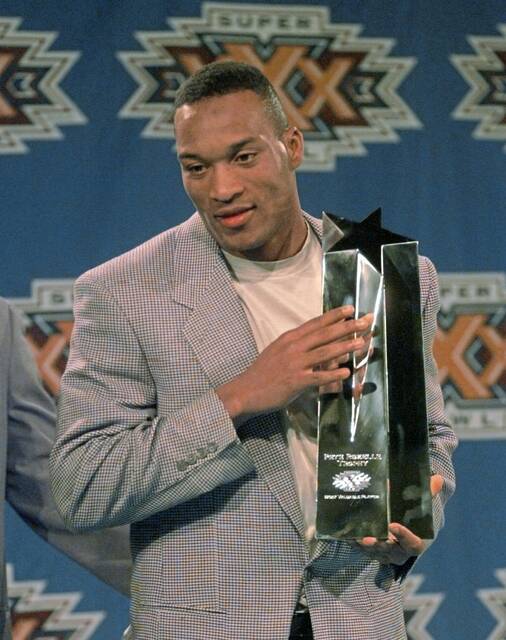
On Jan. 28, 1996, Brown’s “scissorhands” were good enough to shred the hopes of the Pittsburgh Steelers and slice his way to a Super Bowl XXX MVP award.
Thirty years after the Steelers suffered their first Super Bowl defeat in franchise history, TribLive spoke with Brown on the anniversary of him becoming one of the most infamous names in Pittsburgh sports history.
Reason to believe
In the wake of their exhilarating win over the Indianapolis Colts in the 1995-96 AFC Championship game, the Steelers were brimming with confidence heading into Super Bowl Sunday.
That was in spite of the fact that the Dallas Cowboys were 13.5-point favorites and winners of two of the three previous Super Bowls.
“We were made Ford tough,” Steelers linebacker Levon Kirkland said. “We were determined to get there. We made a remarkable run to get to the Super Bowl. … We went through the wars. We knew how to play football down to the last minute.”
Part of the reason the Steelers were enthused despite their underdog status was the looming return of Rod Woodson. The All-Pro cornerback tore his ACL in Week 1 but rehabbed his leg to the point that he could play on Super Sunday in Arizona.
“If (coach) Bill Cowher didn’t have the trust in me to believe in who I am, he would’ve put me on (injured reserve) and I would’ve been done,” Woodson said. “I wouldn’t have had a ‘95 season.”
The game started rough for the Steelers. Dallas jumped out to a 13-0 lead before quarterback Neil O’Donnell hit Yancey Thigpen for a touchdown 17 seconds before halftime.
After the teams swapped punts to open the third quarter, the Steelers faced a third down from the 9-yard line.
That’s when cornerback Larry Brown walked into every household in Western Pennsylvania.
Even three Super Bowl trips later for the Steelers, in a way, he’s never left.
Of all the guys
“Those weren’t my only two picks. Not at all!”
Brown is quick to remind people of that.
“And that wasn’t my only Super Bowl where I got a pick!”
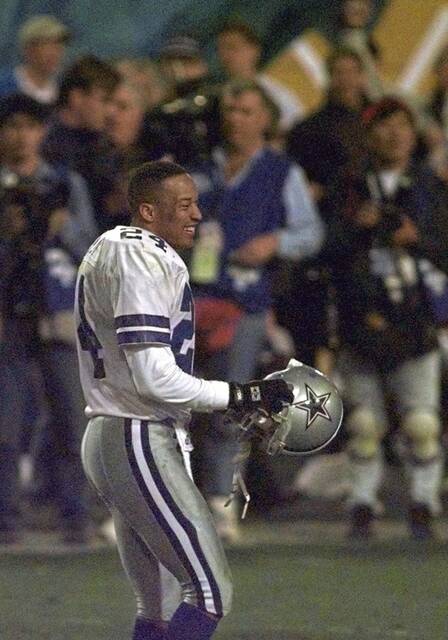
That’s true. Brown won three rings with the Cowboys and had an interception during Super Bowl XXVIII. He also snagged a pass during the NFC Championship game versus Green Bay en route to Super Bowl XXX in Tempe.
However, with Deion Sanders at the other corner position, along with five other Pro Bowlers on the roster that season, Brown wasn’t exactly the most discussed Cowboy heading into Super Bowl XXX.
He sure was coming out of it.
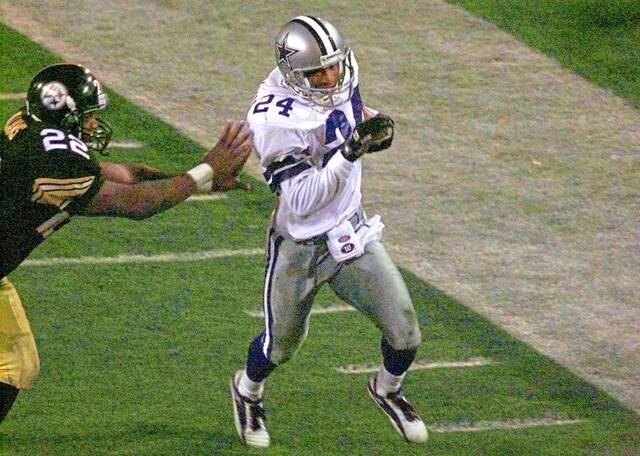
On that third-and-9 throw (after a drop by Kordell Stewart) from his own 48, O’Donnell threw to his right. Two receivers ran in-breaking routes, but O’Donnell threw it outside the hashmarks to a waiting Brown, who was the only player in the frame.
“Some of your easiest balls are the hardest to catch for guys who don’t have great hands. For me, it was that: Just catch it,” Brown said. “Go make a play, get as far as you can. Get as many yards as you can.”
30 Years Ago Today
SUPER BOWL XXX
January 28, 1996#Cowboys 27, #Steelers 17Dallas and Pittsburgh — the only teams to meet three times in a Super Bowl
MVP Larry Brown’s two interceptions lead the #DallasCowboys to their third Super Bowl title in four years, and fifth… pic.twitter.com/5SZFQtsIFI
— Kevin Gallagher (@KevG163) January 28, 2026
Brown said that he felt O’Donnell was influenced by the rush from Chad Hennings, and that O’Donnell’s hand or elbow may have even been grazed on the follow-through. An NFL Films clip (at 13:15) caught O’Donnell saying to Cowher, “I just lost it.”
Brown returned it to the 18-yard line. Smith scored a touchdown two plays later to make the score 20-7.
“Offensively we were running the ball pretty effectively at that time. We couldn’t understand why we weren’t running the ball like we used to,” Hall of Fame center Dermontti Dawson said. “We started passing the ball. I think that was to our detriment. … We should’ve just run the ball that game.”
That said, the Steelers only averaged 3.3 yards per rush on the day against Dallas’ defense.
Momentary redemption
Pittsburgh would pull within 10 points after a Norm Johnson field goal with just under 12 minutes to play in the fourth quarter. That’s when special teams coordinator Bobby April suggested to Cowher that the team try a surprise onside kick that worked.
Deon Figures scooped up Johnson’s kick and the Steelers stole a possession.
January 28, 1996
With just over 11 minutes left in Super Bowl XXX, having just closed Dallas’s lead to 10, #Steelers head coach Bill Cowher calls for a “surprise onside” kick.
Pittsburgh recovers and drives for a TD, trimming the #Cowboys‘ lead to 20-17pic.twitter.com/2iDzejfHtM
— Kevin Gallagher (@KevG163) January 29, 2024
“I’m on the other side. We practiced that play. We were excited,” defensive back Randy Fuller said. “When it worked to perfection, it was one of the greatest joys. When it happens in the game the way you practice it, it’s just beautiful.”
Nine plays later, the Steelers were only trailing 20-17 thanks to a Bam Morris touchdown.
“It’s like, ‘OK. This thing is falling into place right now.’ We are getting everything to go as we need,” safety Darren Perry said. “We’ve got a shot. We had the momentum.”
That’s when Brown struck again. With 4:08 remaining, after a drop by Andre Hastings, O’Donnell was blitzed and, as Cowher described it in his book “Heart and Steel,” threw the ball “early” and misread the play.
The Pro Football Reference play-by-play of that Super Bowl lists Hastings as the target again. But as Cowher went on to write, “It looked like (Brown) was the intended receiver.”
Brown doesn’t quite remember it that way.
“We were coming after them. We were going to zero blitz. We’re bringing everybody. They pretty much ran two plays on their blitz. Check, quick stop with the four outside receivers. Either gonna run a 5-yard stop or slant,” Brown said. “We talked about it. Be aggressive. Don’t just be off and let a guy catch a 5-yard stop or slant and roll over a first down. So I actually jumped the slant and cut the receiver off on that play. People blame Neil for it. It really was more the receiver’s fault because I cut him off and beat him to the spot.”
Yours wins but let’s not forget how bad those passes were that Larry Brown intercepted vs Pitt pic.twitter.com/dKPMvtWdrV
— Mark Hensler (@MarkHensler) January 26, 2026
Either way, Brown nearly ran all the way back for a touchdown. He was bumped out at the Steelers’ 6-yard line. Smith scored again two snaps later.
Sanders told Brown on the sideline “Get one more and they’ll make you mayor of Dallas. I’ll vote for you if you get me a job.”
Brown may have needed a third pick to become the mayor. He didn’t need another to become Super Bowl MVP as the Cowboys won 27-17.
Despite posting a career high six interceptions that season (two for touchdowns), Brown had to overcome the loss of his son, who died just 10 weeks after being prematurely born. As the game broadcast pointed out over a shot of Brown being congratulated on the sideline, the acclaim was a meaningful end to a difficult year off the field.
“It wasn’t about one play or one situation. I had an opportunity. You want to help your team. That’s always the focus. That’s always the goal,” Brown said.
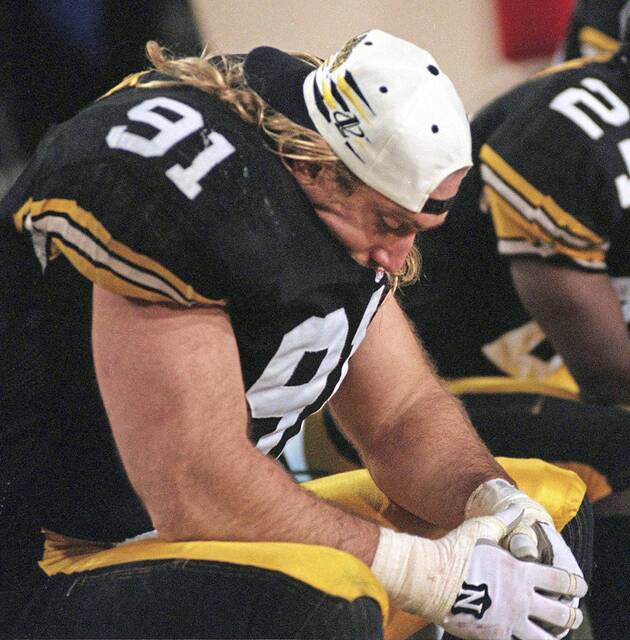
After he was elected to the Hall of Fame in 2016, the late Kevin Greene told me on 105.9 The X that the Super Bowl loss “would haunt” him the rest of his life.
“For that moment in time, we had a chance to achieve greatness. And we didn’t. And we should have,” Greene said four years before his death. “You never let that go. You put everything you have into that. Your heart. Your soul. You’re all in. And you come up short.”
Fellow linebacker Chad Brown vividly remembers how hard Greene took the loss.
“I walked into the locker room, Kevin is on the ground crying. Balling,” Brown said. “There is crying in football. It’s not that kind of crying. There are tears. But you are keeping it together. No. He was heartbroken. Crushed.”
Forever intertwined
Brown and O’Donnell followed similar paths after that. Both players departed their respective teams.
In fact, Perry says he never even saw O’Donnell again after leaving the field.
“Didn’t see him, didn’t hear from him at all. Next thing we knew, Neil was off to the New York Jets,” Perry said.
A month later O’Donnell signed a contract for $25 million with New York. He spent two unsuccessful seasons there before being waived and wound up playing out his career over the next five seasons between Cincinnati and Tennessee.
O’Donnell did not respond to multiple requests for interviews.
“I have not seen Neil in person since that Super Bowl,” Chad Brown told me during an interview last year. “If I were to see him, I certainly would embrace him as a teammate and as a brother. He clearly did not do those (interceptions) on purpose, despite the constant question that still gets asked to this day: ‘Was Neil paid off? Did he throw the game?’ Of course he didn’t. It’s ridiculous.”
Chad Brown refuses to lay the entire loss at the feet of O’Donnell.
“The two interceptions, one could be blamed on a receiver. One could be blamed on Neil,” Brown said. “You can’t expect perfection from your quarterback. The Cowboys, you’ve got to give a tip of the cap. They were a talented defense.”
As for Larry Brown, like O’Donnell, he parlayed his Super Bowl MVP performance into a five-year, $12 million deal with the Los Angeles Raiders.
“I wanted to stay in Dallas. Mr. (Jerry) Jones — of several guys, including myself — he felt that he just could not resign,” Brown insisted. “So it really wasn’t my decision. I never would have left Dallas had it been my choice.”
Similar to O’Donnell, though, things didn’t go well there for Brown, and he was also waived after just two seasons with the Raiders. After a brief stop in Minnesota, Brown played four games back in Dallas again in 1998 prior to retirement.
After the second pick of O’Donnell, Brown registered exactly one more interception the rest of his career.
More sports
• Mark Madden: Mike McCarthy won the press conference, but it’s still a bad hire
• Tim Benz: Mike McCarthy’s first step with Steelers shouldn’t be backward with Aaron Rodgers
• Can Penguins sustain playoff pace? They know they’ve got to prove it daily
Losing the bet
Ten years later, the Steelers were back in the Super Bowl. This time in Detroit against the Seattle Seahawks for Super Bowl XL. The stadium was overwhelmingly populated by Steelers fans. It was practically a home game.
Because it was the 40th anniversary of the big game, the NFL decided to bring back all of the previous Super Bowl MVPs for an on-field ceremony.
Brown, who now does radio and television work with the Cowboys, claims the group was taking bets as to which player was going to get booed the loudest by the partisan Pittsburgh ensemble.
“Ray Lewis got booed louder than I did,” Brown laughed.
You have to blame recency bias for that. Lewis was still an active player for the hated Baltimore Ravens at the time. But there were still plenty of people in that building wearing black and gold who couldn’t forget what Brown had done to their team a decade earlier.
And still do — three decades after it happened.
—-