
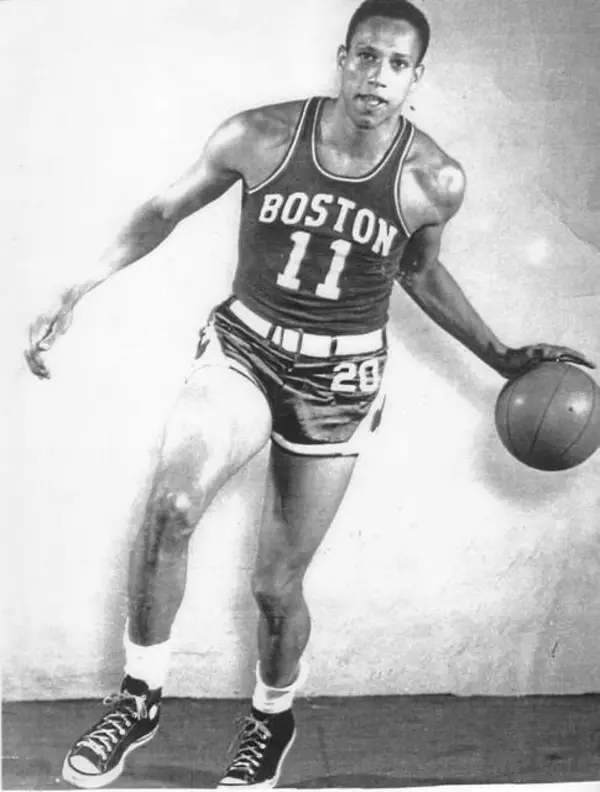
When the legacy of the Boston Celtics is discussed, most often the conversation turns to championships. Behind stars such as Bill Russell, John Havlicek, Larry Bird, Paul Pierce and Jayson Tatum, the Celtics have won 18 titles, more than any other NBA franchise.
That fact is not lost on Dave Hoffman, who has been employed by the Celtics for 16 years. But Hoffman, the team’s senior vice president of community engagement, is just as happy to talk about what he believes is an equally significant part of the team’s legacy.
Social impact.
The Celtics fielded the NBA’s first all-Black starting lineup in 1964. Two years later, Russell became the league’s first Black head coach.
And paving the way for those milestones was an event that occurred more than a decade earlier. In April 1950, Boston drafted Duquesne forward Chuck Cooper with the No. 13 pick, making the Westinghouse grad the first Black player to be drafted by an NBA team.
“It was the zero-time NBA champion Boston Celtics that drafted Chuck Cooper in 1950,” Hoffman told TribLive. “So in a lot of ways, it (social impact) is woven into the fabric of being a Celtic.
“It’s the gift that Chuck’s courage gave us as an identity of the franchise and in sport and one in which we feel strongly about stewarding today.”
Last April marked 75 years since the Celtics made that historic draft pick, and throughout the 2025-26 season, the NBA has been giving special recognition to Cooper and two of the league’s other Black pioneers, Earl Lloyd and Nat “Sweetwater” Clifton. The festivities began in June, when the families of Cooper, Lloyd and Clifton were present on stage for the 13th pick in the NBA Draft.
The celebrations will reach their zenith when the NBA kicks off Black History Month on Sunday with what will be the inaugural “Pioneers Day,” similar to Jackie Robinson Day in Major League Baseball. That day will feature the Pioneers Classic — to be contested this season between Boston and the Milwaukee Bucks — with the winner receiving a trophy.
During NBA All-Star Weekend, the fifth HBCU Classic will be played featuring historically Black schools Hampton and North Carolina A&T. There will be other nods to the three barrier-breaking players throughout the season, including commemorative shootaround shirts.
Also launched this year by the NBA was the Pioneers HBCU Scholarship. West Virginia State — where Cooper began his college career and where Lloyd played his entire college career — and Clifton’s alma mater, Xavier of New Orleans, already have received a combined $150,000 in scholarships.
“Just really thrilled,” said Chuck Cooper III, Cooper’s son. “I’ve really got to thank Adam Silver and the NBA. For the first time, my father’s legacy and the legacy of the other pioneers are going to be woven into the NBA with the annual recognition.”
Amber Scott, the NBA’s director of social impact and inclusion, is spearheading many of the festivities connected with honoring the league’s Black pioneers.
“We’re trying to be really focused on making sure all of our players are educated on the history, educated about the giants whose shoulders they are standing on,” she told TribLive. “We honor Cooper, Lloyd and Clifton because of the risks that they took, because of the courage that they had.
“Because of the barriers they broke, they helped the NBA to trailblaze, to continue to be a league that’s welcoming, to be a league that’s on the forefront of sport and justice and inclusion.”
A historic choice
When the Celtics drafted Cooper in 1950, eyebrows were raised. It was a bold move by the franchise, and one that was subject of scrutiny.
Then-owner Walter Brown famously responded to skeptics by telling them, “I don’t give a damn if he’s striped, plaid or polka dot, as long as he can play great basketball.”
Cooper III said his father later sent Brown a telegram that said, “Thank you for having the courage to offer me a contract in pro basketball. I hope I’ll never give you the chance to regret it.”
The Celtics never did. Over his six-year career — four of which were spent with the Celtics — Cooper (6-foot-5, 208 pounds) played 409 games, averaging 6.7 points and 5.9 rebounds per game.
In college — counting the season he played at West Virginia State before entering the military — Cooper scored more than 1,000 career points.
“People forget that he was a great basketball player,” said Dave Saba, the former long-time sports information director at Duquesne. “He broke the color barrier, but it was because he was a good player.
“He was an All-American at Duquesne. … Sometimes that gets lost in the sauce, that he was a great player.”
Of course, Cooper’s skill couldn’t mask his skin color, and that was an issue even during his time with the Dukes. Duquesne famously canceled a sold-out game against Tennessee at McKeesport High School because the Volunteers wouldn’t play if Cooper was in uniform.
Cooper III said his father didn’t talk much about his experiences in the early NBA. Certainly, Cooper III said, in pre-civil rights America, his father had his share of difficulties.
On the sports landscape, the story of groundbreaking Black athletes in the NBA is less heralded than that of Robinson in baseball or, perhaps, the Black quarterback in the NFL. Cooper III and the NBA want to make sure people realize that the story of the NBA’s Black pioneers is just as significant.
“I really think with the NBA’s 75th anniversary celebration (of the 1950 draft) this season and for (the NBA) to now do the recognition, I think it’s a great opportunity not only to educate the players and the fans and the stakeholders,” Cooper III said. “This is American sports history.”
Added Scott: “This work is near and dear to my heart. On a personal note, I have just been getting excited and really have taken the position of truly being a fan of this project.
“… I think it’s important to honor history, especially for someone as myself who is working in the impact, justice and inclusion space. It’s important to know where we came from.”
Long-lasting impact
Cooper’s social impact didn’t end with his playing days. In his post-basketball life, he became the head of Pittsburgh’s parks and rec department, making him the city’s first Black department head. Later, he became the first Black executive at Pittsburgh National Bank.
“It was just something he was driven to do,” Cooper III said, “to break barriers and open doors for others to follow and lead by example. We’re just so proud of him.”
Cooper’s work is carried on through entities such as the Chuck Cooper Foundation, which, Cooper III said, provides support, scholarships and internship opportunities for underserved and under-resourced students.
The Celtics sponsor the Chuck Cooper Fellow through their Shamrock Foundation. It’s a nine-month program that, Hoffman said, allows the fellowship recipient to “contribute on a day-to-day basis to the Celtics’ social justice work.”
Cooper III has maintained a close relationship with the Celtics, and he often has opportunities to speak to their players — as well as players from across the league — about what his father did for the NBA.
“The more distance you get from that, the more important it is to remind (players) or even educate them,” Hoffman said. “… So it really warms my heart when I see Chuck III making the rounds at various places.
“It’s a real sense of pride when players come here and they’re already well understanding of the championship legacy, but it’s really a sense of pride for them when they learn about the social justice and the social impact legacy of those that have worn this jersey.”
Clifton and Lloyd recognized it. Both were inducted into the Naismith Memorial Basketball Hall of Fame before Cooper, though Lloyd, Saba said, was on record as saying he would not have played had it not been for Cooper being drafted ahead of him. (Lloyd was the first Black player to appear in an NBA game, and Clifton was the second.)
Russell recognized it, too. The owner of 11 NBA titles, Russell was chosen for hall of fame induction in 1975, but he refused to officially accept the honor until Cooper was inducted.
That happened in 2019, when Cooper, who died in 1984, was inducted and Russell, at last, accepted his own hall of fame ring.
“The order that (the Black pioneers) were inducted into the hall of fame was always baffling to me,” said Saba, who attended Cooper’s induction ceremony. “I know that was a priority even when I got to Duquesne was trying to get Chuck in. To see that come to fruition …
“To see the people that were up there on stage to present Chuck, it was a who’s who of NBA greats. I think there were about 15 people up there on stage, everybody from Kareem (Abdul-Jabbar) to Dr. J (Julius Erving) to Larry Bird to Isiah Thomas. They understood.”
Added Cooper III: “Oh my goodness. I still get chills thinking about it. … As years go by, you wonder if this is ever going to happen, and then finally to get the call, it was something I will always cherish the rest of my life.”
Keeping the door open
On the corner of Magee Street and Forbes Avenue in Pittsburgh sits UPMC Cooper Fieldhouse, named, of course, in honor of Chuck Cooper. A nearby sign commemorates his barrier-breaking achievement.
Cooper’s name remains prominent in the Pittsburgh area, and now, through the NBA’s commemorative season, more current players and sports history buffs will learn what he meant to the game.
“Look at the NBA now,” Saba said. “It’s an international sport. You have players from all over the globe. Chuck kind of led that, the opening up of the league to that.”
Said Scott: “We, as a league, are able to continue to build upon a rich legacy.”
Cooper III continues to carry his father’s torch, educating everyone and anyone with whom he comes in contact about the sacrifices his father made. Hoffman said Cooper III has developed a close bond with Jaylen Brown, one of the current Celtics’ more socially conscious players.
And now that the NBA will have an annual recognition of his father and his two contemporaries, Cooper III is excited to watch his father’s story spread further.
“I’m certainly proud that he played that role,” Cooper III said. “One thing about my father and Jackie Robinson and Sweetwater Clifton and those guys, the early Black pioneers, the one thing they didn’t want to do was do something to mess up the opportunity for those coming up behind them.
“In my father’s case, he also did that here in the City of Pittsburgh. … He was cognizant of the fact that he wanted to make sure he kept that door open to follow behind him.”