
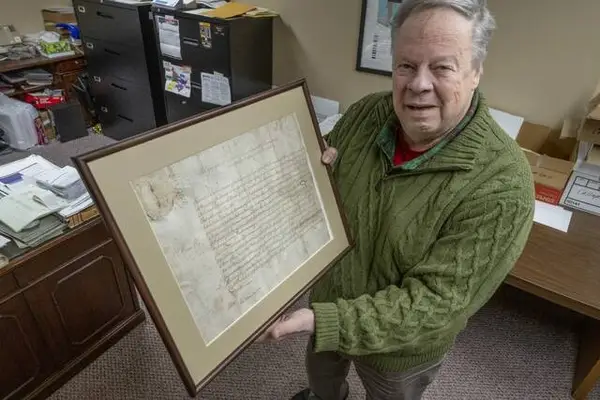
Alle-Kiski Valley historian Ray Rieser knew time was ticking.
With Penn State New Kensington closing next spring, Rieser had something on his mind not too many others knew about — a 1787, Benjamin Franklin-signed land grant that Rieser believed was being stored at the Upper Burrell campus.
Over the years, Rieser would search for the document, sifting area libraries and archives. Calls he put out for information on the centuries-old, increasingly rare document on social media went nowhere. Rieser tapped the Tri-City Historical Society for help, still no luck.
“The timing was very valuable, and was disappearing,” said Rieser, of Lower Burrell. “It needs to be found and it needs to be in a proper location for posterity.”
But the answer wasn’t far away.
Ross G. Walker III, longtime chairman of the Upper Burrell supervisors, located the Revolutionary War-era document framed within the township building — across the road from Penn State New Kensington — within minutes of being asked.
The document was framed and hanging on a wall in the township offices.
“It’s been there as long as I can remember,” said Walker, who got involved with the township in the 1990s.
“It’s quite the conversation piece.”
For the children of Burrell
An Oct. 17, 1983 newspaper article tells part of the story.
That year, siblings John and Ruth Willyard gifted the land grant document to be housed at the Penn State New Kensington, for the children of Burrell.
According to the article, John, who was 83 at the time, said his great-grandfather received 349 acres in what was then Hempfield Township as payment for fighting in the Revolutionary War.
When Franklin signed the document, he was president of the state Supreme Executive Council; essentially today’s equivalent of state governor.
Part of the 349 acres remained as the Willyard farm, situated between Menk and Myers drive, along Greensburg Road.
During a dedication, a picture shows John displaying the document to Michael Capizzi and Paula Klonowski, who were fifth grade students at Upper Burrell Elementary at the time.
“I wanted the children to realize what it was like back then,” John said at the time. “They might never have a chance to see one again.”
He wasn’t too far off.
Land grants signed by Franklin played a significant role in the expansion of American territory, particularly in Western Pennsylvania and Ohio. They were issued to reward soldiers and settlers in hopes of economic growth and prosperity.
As time passes on, they’ve been increasingly harder to find, or locate.
“When we find something like this, we can’t let it slip through our fingers,” Rieser said.
In addition to its historical value, a signed document from Franklin is worth a significant amount of money, Reiser said.
In the 1980s, the Upper Burrell land grant was valued anywhere between $1,500 and $2,000. It’s unknown how much it might be worth today, but recent auction prices of other land grants have been between $8,000 to $12,000. Factors influencing value include historical significance, condition and market demand.
‘Too valuable not to be here’
Rieser said the land grant document doesn’t appear to have any connection to Penn State New Kensington other than it was intended to be stored there in the 1980s.
Walker isn’t exactly sure how the township ended up with the document.
“It shows how much we’re steeped in history in Upper Burrell Township, and good record keeping,” Walker said. “It shows what a historical area this is.”
Rieser thinks the township building is an appropriate place for the piece of history.
“I am just so pleased that it was found,” he said. “I thought for sure someone skedaddled with it.
“It’s too valuable not to be here.”
Anthony Palyszeski, a member of the Tri-City Historical Society, had also been trying to locate the land grant document to no avail.
A 2021 Penn State New Kensington graduate, Palyszeski had contacted former chancellors Kevin Snider, Larry Pollock and Bob Arbuckle; and librarians from the PSNK and Penn State’s University Park libraries.
“There’s no better place for it than here, where it was always meant to be,” Palyszeski said. “I’m happy if it was at Penn State, but happier to know it’s still here.
“It’s been so long since anyone brought attention to it that now, an entire new generation — and generations beyond what the Willyards’ knew — can experience it.”
Palyszeski hopes it can open the younger generations’ eyes to the history around them.
“It’s a really unique piece of history,” he said. “Younger people today don’t really conceptualize this stuff happening in our backyard.”
Reiser agrees.
“It’s something people will talk about at parties,” he said.