
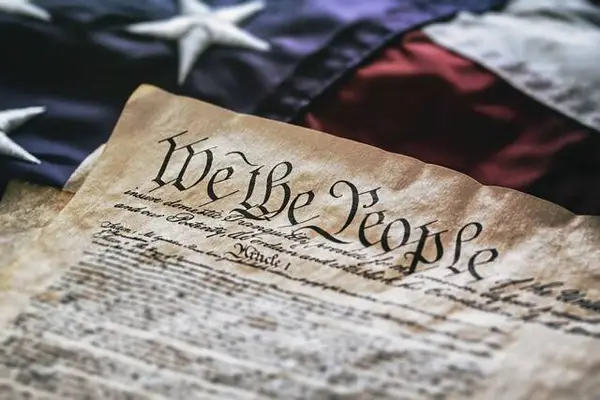
Constitution Under Construction is an ongoing series exploring the history, relevance and importance of amendments to the U.S. Constitution.
The Declaration of Independence was never a system of government. It was a statement of intent. What followed it showed that the Founding Fathers wanted to build something different — and something capable of growing alongside a newborn nation.
Other countries relied on charters or baseline documents, such as Britain’s Magna Carta. The U.S. Constitution was something else entirely: a blueprint for a government still under construction.
It went into effect in 1789, after the short-lived experiment of the Articles of Confederation that followed the Revolutionary War. From the Constitution’s first breath, it represented evolution — an attempt to improve on a system that had proven too fragile.
Within months of becoming the law of the land, its first amendments already were under consideration.
Amending the Constitution was not an afterthought. The ability to adapt and correct was built into the original plan through Article V, alongside the provisions that established federal authority and supremacy.
That means that while the Bill of Rights followed the Constitution by two years, the framework for change was always a feature of the system. It acts like an expansion joint in a construction project — allowing a solid structure to bend with weather, wind or stress rather than crack under the weight of its rigidity.
The Constitution was never meant to be a monument — a Great Pyramid or Parthenon, frozen in time and preserved precisely because it no longer serves a practical purpose. Amendments are not relics meant to be unearthed and admired as antiquities.
They are not an addendum — not an addition tacked on like a deck on a house or a new wing on a museum. The amendment process is the feature that gives the Constitution its lifespan.
But this is not a process meant to be used willy-nilly, with new features tacked on at random. The Constitution has been amended just 27 times. That is a small number when measured against the nearly 12,000 amendments that have been proposed.
Even now, the bar remains high. During the 118th session of Congress alone, 69 constitutional amendments were introduced.
None advanced.
Most proposals never make it that far. Many die in committee or fall short of the votes needed in the House or Senate. Others fail at the next stage, when three-quarters of state legislatures must agree that, yes, this is a change solid enough to become part of the structure.
Even some amendments that clear Congress never cross that final threshold. Six proposed amendments remain in limbo, awaiting ratification that may never come. The oldest has been waiting since 1789. The most recent, which would have granted voting representation in Congress to the District of Columbia, has languished in statehouses since 1978.
When amendments have succeeded, they have not done so casually. Each reflects a moment when the country collectively decided that the existing framework no longer matched the reality of the nation it was meant to serve. The Constitution has not been rewritten repeatedly, but rather recalibrated carefully.
That balance between flexibility and restraint was understood from the beginning. In his Farewell Address, George Washington framed it plainly: “The basis of our political systems is the right of the people to make and to alter their constitutions of government. But the Constitution which at any time exists, until changed by an explicit and authentic act of the whole people, is sacredly obligatory upon all.”
The framers left behind more than a document. They left a process — one that assumes disagreement, demands patience and requires collective responsibility.
The Constitution has survived for more than two centuries not because it was revered as untouchable but because it was treated as usable. Its endurance has never depended on perfection, only on a willingness to maintain what was built.