
Here we go again.
Pennsylvania’s latest budget impasse, which dragged on for 135 days, just ended in mid-November. Now, less than three months later, state government leaders are preparing to begin the often-tortured process of trying to hammer out a budget for the coming fiscal year.
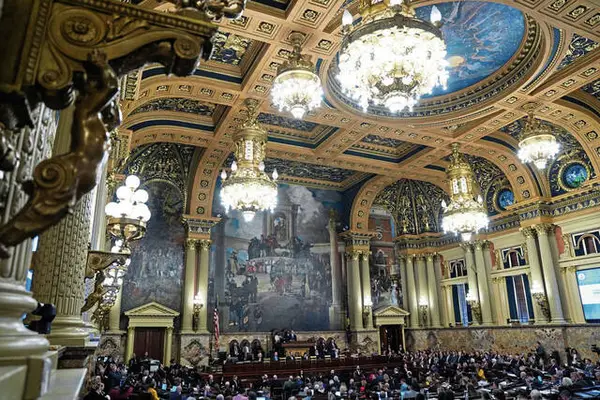
The budget process formally gets underway Tuesday when Gov. Josh Shapiro unveils his proposed budget to a joint session of the House and Senate.
Shapiro’s office did not provide any specifics on what will be included in the governor’s budget proposal.
Lawmakers have missed their June 30 deadline to pass a budget in 14 of the past 22 years, including each of the past four.
Last year’s impasse, the longest since a record nine-month budget standoff in 2015-16, stopped billions of dollars in state funding from flowing to schools, counties and nonprofits across Pennsylvania. As the impasse dragged on, some were forced to lay off workers, cut services or borrow money to stay afloat.
While money started flowing again after the governor signed the budget into law, in some cases permanent damage was already done. Westmoreland County officials said last month they are permanently eliminating the jobs of a dozen employees who were laid off during the impasse.
“Last year’s process was painful for everybody,” said Senate Majority Leader Joe Pittman, R-Indiana, one of the key players in the budget negotiations along with House Majority Leader Matt Bradford and Shapiro.
“It’s certainly not something I enjoyed personally or professionally. But at the end of the day, we got it right, particularly in the context of our divided government,” Pittman added, alluding to the fact that Republicans held a majority in the state Senate while Democrats occupied the governor’s mansion and controlled the state House.
Last year, Shapiro proposed $51.5 billion in spending during his third budget address. Nearly nine months later, after contentious negotiations on a number of issues, lawmakers passed a $50.1 billion budget that was balanced using nearly $4 billion in reserves.
Lawmakers on both sides of the aisle claimed victories.
Republicans celebrated Pennsylvania’s withdrawal from the Regional Greenhouse Gas Initiative, which capped companies’ carbon emissions, while Democrats touted more than $500 million in new funding for the state’s poorest school districts.
The final budget was smaller than what Shapiro initially proposed but larger than multiple Republican counterproposals.
The biggest allocations included $20.2 billion for human services, up 5.7% or $1.1 billion from the year before; $18.5 billion for K-12 education, up 5% or $872 million from the year before; $3.2 billion for corrections; $1.9 billion for higher education; and $1.2 billion for state police.
Among other major expenditures, the state also allocated $514 million for community and economic development, $453 million for the judiciary and $414 million for the Legislature.
Overall, the budget was 4.7% larger than the previous year’s spending plan.
Bradford said top priorities for his caucus going into the new budget talks include increasing funding for education and public transit.
Transit funding became a point of contention last year. After the Legislature failed to strike a deal, Shapiro approved requests from the state’s two largest — and most cash-strapped — transit agencies to use money earmarked for capital improvements to cover operating costs and stave off steep job and service cuts for the next two years.
The Southeastern Pennsylvania Transportation Authority, or SEPTA, received approval to use $394 million. Pittsburgh Regional Transit received more than $100 million.
“That was necessary and appropriate,” Bradford said. “But it wasn’t a long-term solution, and the Legislature has an obligation to deal with a long-term transportation and transit funding solution.”
Top priority for Republicans will be looking to “restrain spending at all levels” and moving away from a reliance on using reserves to balance the state’s budget, Pittman said.
“We believe there’s more that can be brought out of the couch cushions of bureaucracy,” Pittman said.
Pittman said finalizing a budget last year was complicated by Shapiro’s revenue projections.
“He built his budget based on revenue assumptions that were not guaranteed to occur, and it proved that in both circumstances, namely in gaming reform and marijuana, that neither one of those revenue sources materialized,” Pittman said.
Last year, Shapiro proposed a 52% tax on the gross revenue of unregulated skill games that have become ubiquitous at bars, convenience stores, fraternal clubs and elsewhere, projecting it could bring in nearly $400 million a year in new revenue. The governor also projected that legalizing marijuana for recreational use could generate $1.3 billion in new tax revenue over the first five years.
Lawmakers failed to come to an agreement on either issue. It’s unclear whether one or both will again be part of Shapiro’s budget address.
It also remains to be seen whether Pennsylvania is headed toward another impasse.
In the past, lengthy impasses were less common because the effects of failing to pass a budget on time were felt more immediately, according to political observers. In 2009, however, the state Supreme Court ruled that state government employees, including legislators, must continue to be paid during an impasse.
“That really took away the urgency of meeting the budget deadline,” said Dan Mallinson, associate professor of public policy and administration at Penn State Harrisburg.
Political observers think another impasse — at least, one dragging on for months — is less likely this year, in part, because of the pivotal midterm elections. Shapiro is up for reelection, as are all 203 members of the state House and half of the Senate’s 50 members.
“That’s probably motivation to get a budget done instead of campaigning on why you didn’t,” said Berwood Yost, director of the Center for Opinion Research at Franklin & Marshall College in Lancaster.