
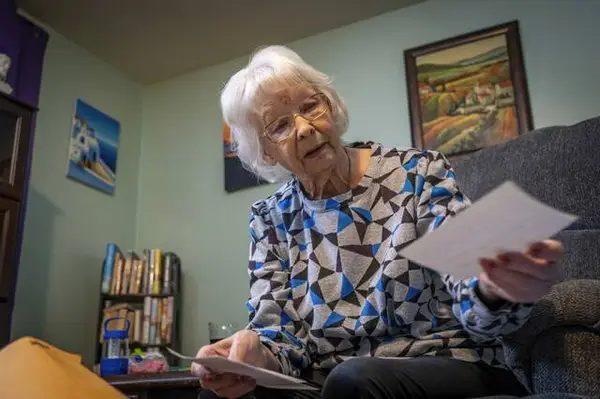
Tucked away at Kathe Gross’ house is a turquoise plastic tote filled with the memories of heartbreak.
There are note cards and scraps of paper bearing names and phone numbers, handwritten notes Gross compiled on anything she could find as phone calls and information poured in after the 2018 disappearance of her daughter, Cassandra Gross. Dozens of photos taken during fruitless searches for Cassandra and sheets of paper filled with her own research are reminders of a fraught time almost eight years ago.
But there are still things the Derry Township woman doesn’t know about the mystery surrounding her daughter’s disappearance and the state police investigation.
She’s hoping to get those answers in the coming days as testimony in the homicide trial for the man accused of killing Cassandra gets underway.
“They already told me I was going to hear things I wouldn’t want to hear, but I feel like that’s my daughter. I’ve got to,” Gross said.
A jury has been seated and attorneys are scheduled to present opening statements Wednesday morning in the case against Thomas G. Stanko, 55, of Unity. He is charged with homicide and reckless burning.
There is an unusual twist to the trial: investigators have never found Cassandra Gross.
That leaves prosecutors to rely on other evidence in an effort to convince 12 jurors she is dead and that Stanko is responsible for killing her. It’s not an insurmountable task, said John Driscoll, retired Westmoreland County judge. When he was district attorney in the 1980s, a prosecutor in his office handled a similar case from a slaying in Vandergrift.
“It’s rare but not unprecedented,” he said.
The trial is scheduled to take two weeks.
• • •
After having lunch with a friend in Southwest Greensburg on April 7, 2018, Cassandra Gross, 51, called her mother on the way back to her Unity apartment.
It was the last time anyone heard from her.
Cassandra was reported missing by her parents April 9, 2018. In the days after her disappearance, her blind and diabetic dog, Baxter, was found alone and covered in mud in the Beatty Crossroads area.
The next day, Cassandra’s Mitsubishi Outlander was found along a rail line near Twin Lakes Park. It had been burned nearly beyond recognition.
Kathe Gross immediately gave state police Stanko’s name — alleging he had dated her daughter and stalked, harassed and abused Cassandra.
Troopers narrowed in on him quickly, searching at least two properties in Unity. They arrested him April 13, 2018, on unrelated charges that were later withdrawn. Stanko has been in jail since then and is serving a federal sentence on gun charges.
State police conducted numerous searches through the rest of the year. Cassandra Gross was declared dead in January 2019 by a judge who ruled she was the victim of a homicide. According to testimony at that hearing, she hadn’t used her credit card since her disappearance and there hadn’t been any withdrawals from her bank account other than automatic transactions.
Months turned into years as Kathe Gross, now 77, waited for the mystery to be solved. Police eventually classified the case as a homicide.
She did her own searches — 128 by her count — while state police did theirs. Troopers in May 2020, after a two-day search on property where Stanko’s mother lived in Unity, reported finding “several items of interest” that were sent to a lab for testing.
But it wasn’t until Oct, 27, 2022, that Stanko was charged with homicide.
Phone records indicate Cassandra Gross and Stanko talked throughout the day April 7, 2018, discussing grocery items and the possibility of getting together in the evening, according to court papers.
Police said they recovered several “partially destroyed items” believed to have belonged to Gross from a burn barrel at Stanko’s Macey Road home, including Coach eyeglass stems, a Michael Kors clothing tag and a broken medication bottle that might have contained insulin for Baxter.
Stanko appeared to have burn injuries to his face on April 12, 2018, when state police interviewed him at the Greensburg station. As troopers attempted to arrest him for an unrelated matter the next day, Stanko ripped open a plastic bag as he ran from police, flapping his arms “as if to empty the ripped bag of its contents,” according to the complaint. Investigators recovered more than 40 burned items they did not detail in the complaint.
Stanko has maintained his innocence. A conviction of first- or second-degree murder carries a mandatory sentence of life in prison.
• • •
The case reminds retired Westmoreland County detective Michael Brajdich of one he investigated 40 years ago.
It was Feb. 28, 1982, when Jacqueline Simpson, 44, didn’t return to her daughter’s apartment after tending bar at the former Magic Lamp Bar and Grill in Vandergrift. Despite numerous searches, including some at landfills, her body was never found.
“It seemed like every other day we were searching places,” said Brajdich, who teamed up with borough and state police on the case.
Simpson had dated Gary R. Kunish, the bar’s owner, but broke off their relationship in late 1981. On April 6, 1982, then 43 and living in Allegheny Township, Kunish was charged with homicide in her death. His trial ended after 21 days when the jury convicted him in September 1982 of voluntary manslaughter, according to newspaper archives and court records.
“That was the question — could we convict him?” Brajdich said. “We’re positive he did this through the other information we obtained, but we didn’t have a body.”
The location of a victim’s body isn’t an absolute necessity for a homicide conviction, Driscoll said.
“Circumstantial evidence appeals to logic, reason and human experience,” he said.
Prosecutors have to show a death happened in an effort to secure a homicide conviction, said Bruce Antkowiak, law professor at Saint Vincent College. That proof can include evidence of a violent crime or that the victim hasn’t kept normal commitments or contacted family and friends, he said.
“The fact of death has to be proven, and you can prove it circumstantially,” he said.
The defense could contest that, without a victim’s body being found, they might be alive, or point to another possible suspect altogether, Antkowiak said.
“A lot of it is going to depend on the theory of the defense,” he said.
Stanko’s attorney declined to comment.
Kunish was sentenced to 3½ to seven years in a state prison and was released in 1988, according to court records. Driscoll recalled Kunish’s intoxication at the time of the slaying being a factor, which affected his ability to form the intent to kill, leading to the lesser conviction.
Kunish died in 1996 at 57.
• • •
In the days leading up to Stanko’s trial, Kathe Gross said she was feeling relieved, yet anxious. She plans to attend the trial daily and will testify.
On one side of the recliner in her living room is a ball of yarn and a partially crocheted blanket destined for a great-grandchild. She uses the activity as a way to keep her hands, and mind, busy.
On the other side is a small table where, among other things, she keeps two small pieces of neon-colored paper with handwritten notes. It’s what she contemplates about her daughter’s case, racking her brain to fill in the pieces.
“This is some of the stuff I sit and think about,” she said. “It’s an everyday thing.”