
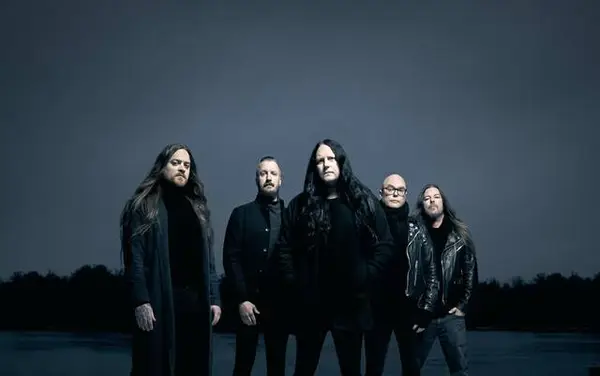
With the 2025 departure of co-founder Anders Nystrom after more than 30 years in the band, it feels like a new era for Katatonia, according to singer Jonas Renkse.
Renkse, who co-founded Katatonia in 1991, said the Swedish melancholic metal band is moving forward.
“Those things happen all the time,” Renkse said. “You can never say for certain that a band’s gonna stay in a certain way forever, so we just try to adapt to the situation, make the best out of it, and I think the feeling within the band is great, and I think we have a really nice new album on our hands, so it’s all good.”
Katatonia is getting ready to hit the road in support of “Nightmares As Extensions of the Waking State,” last year’s album released on Napalm Records. They’ll be supporting fellow Swedish progressive metal band Opeth before a headline trek begins Feb. 27. But they’ll sneak in one headline show during the Opeth tour, playing Feb. 9 at Thunderbird Music Hall in Pittsburgh’s Lawrenceville neighborhood.
“We’re going to play a shorter set with the Opeth run that we’re doing,” Renkse said. “But that’s also sometimes nice to have a little bit of a break after you play before you head to the next place. But I think it’s a good, nice thing to actually have one of the longer sets again, just get the feeling because we do three weeks with Opeth and then we do three weeks on our own. And the Pittsburgh show is going to be in between, so it’s good to get a little bit of practice on the longer set.”
In a Zoom conversation last week from Stockholm, Sweden, Renkse spoke with TribLive about the new album, the band’s evolution, pre-show music and more. Find a transcript of the conversation, edited for clarity and length, below.
As someone with an outsider’s perspective, what’s your view of what’s going on in the United States right now?
For me, as you say, it’s an outsider perspective. And it feels a little bit unstable, I have to say. There’s a lot of things going on that that’s very different from before.
Last year saw the departure of Anders Nystrom after more than 30 years. How’s the adjustment gone to the new lineup?
It’s been pretty smooth, I have to say, because one of the guitar players, Nico (Elgstrand), he’s been playing with the band already for some time. He was stepping in for Anders already in 2023. And then we have Sebastian (Svalland), the other new guitar player came in one and a half years ago roughly. So we’ve definitely settled in really, really well. We just did six weeks of touring in Europe during November and December. So that’s a lot of good practice right there. So it feels very nice. Everyone is adapting very well to whatever’s going on, so it’s nice.
How do you think that album, “Nightmares as Extensions of the Waking State,” moves the band forward then?
It’s another chapter in the Katatonia history and the discography. We always try to outdo ourselves and add some new stuff while also trying to stay true to the foundation of our music that we have built everything on. So I usually think that a new album is it’s a set of new songs that we haven’t played before, and we try to do as much with them as we can and just make sure they get the flavor that they deserve when everybody comes in and does their part – drums, bass, guitar, everything – when it sort of glues together, that’s when we have an album.
With your music and with concerts, do you feel like you’re more focused on the present rather than looking too far back in the past with some of the songs that you play?
Yeah, I mean, the present style is what we do and it’s what we want to represent. Of course, there’s always going to be nods to what we’ve done in the past. I think some of the songs on the new album are kind of heavy, so it’s a little bit of a nod to what got this band started in the early days. But I always want to make sure everything feels fresh and exciting for myself and for the band and also for the audience.
When it comes to the songs lyrically, do you prefer to leave the songs open to interpretation?
Yeah, definitely. That’s what I always say. Because it’s hard to explain, and I don’t want to explain too much because it might ruin the perception of the song for someone. I am like that myself in cases where I have heard an explanation of a favorite song or favorite lyric. It just turns a little bit dull for me because it isn’t always about what you want it to be about. And I think that every person’s own interpretation of it is much more important than what I intended when I wrote it, so to speak.
How important is it for you for the band’s sound to keep evolving? Has that been like a pretty important thing for you?
Yeah, it’s been a key thing ever since we started, even though we did some really primitive stuff in the beginning, but it always wanted to get to the next level and try to expand the sound as much as possible. We early on did experiment – we came from a death metal background – but we took a lot of inspiration from bands like The Cure and more goth bands and tried to adapt their more sort of atmospheric sound into what we were doing. So that’s a key thing that we always did and always try to find new ways to present our music in an exciting way. But it’s a constant evolution.
How do you view the band’s sound? Do you consider yourself a metal band, just a rock band, if you had to put a label? Or is that something that you don’t even worry about?
I don’t really worry about it, but I would say we’re still a metal band, but we’ve tested the boundaries many times with different stuff. But I think, given our background and it’s also the music that we still sort of feel attached to, I would say we’re a metal band.
The band’s latest single is a cover of Kiss’ “A World Without Heroes.” What’s your approach when it comes to tackling a cover?
With this one, we actually wanted it to be sort of true to the original because I think the original song has something that you can’t really take away from it. It’s a lovely song, and we just wanted to do something with it. It does sound like Katatonia because we’re performing it, but other times we’ve done a few covers where we try to move the sound a little bit to make it a little bit different. So I would say it’s different from time to time.
I’ve read that that song is in your pre-show mix in the dressing room. What else are you listening to before a show?
Oh, we have a long list of songs. We just keep adding stuff, but it’s a lot of old heavy metal stuff that we grew up listening to like classic Kiss, Iron Maiden, Judas Priest, a lot of that, because it’s upbeat and it’s energetic, so it’s that kind of stuff. But also some AOR (adult oriented rock) kind of stuff (laughs) just to get in a nice mood. If we just listen to depressive stuff, it’s too much. So we try to get in a jolly mood before the show, and then we can get depressed again while listening to our own music during the gig. (laughs)