
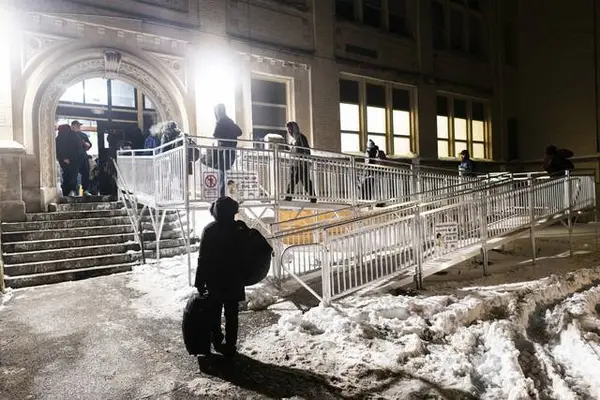
A Greyhound bus dropped Drezon “Dre” Pankey in Downtown Pittsburgh two weeks before a winter storm shut down the city with 14 inches of snow.
Born in Ohio and raised in Florida, the former high school football running back knew no one here. He carried everything he owned, including a prized red sketchbook, in a single, weathered backpack.
Pankey, 31, says he’s homeless — but not helpless.
When snow pummelled the Pittsburgh region Jan. 25, followed by a stubborn, weeklong cold snap, Pankey found space — and solace — in a shelter run out of a former school on the city’s North Side.
“The only hard part has been the cold,” Pankey told TribLive as he sat Friday night near a gym offering 140 cots and a respite from frigid temperatures. “It’s what you make of it, man. If you have a (bad) attitude, it’s just going to make it worse.”
A total of 120 men and women slept on carefully aligned rows of black and blue cots that night in the former McNaugher School, a stately, century-old structure in the Perry South neighborhood. By Sunday night, officials added more cots as the number of those seeking shelter swelled to 146.
Officials say the recent storm provided a real-world test for the winter shelter, which Allegheny County is in its second year of running.
“There’s a lot of turnover, when it comes to folks experiencing homelessness,” said Andy Halfhill, administrator of homeless services for Allegheny County’s Department of Human Services. “But people, I think, feel it’s accessible and it has low barriers. People are able to come as they are and not get turned away.”
Efforts to dismantle Pittsburgh-area encampments and bolster the region’s affordable-housing stock have improved services in Allegheny County for homeless people, officials say. Housing opportunities are growing, they said, and the county now boasts 630 shelter beds at 13 locations, up from about 500 a few years ago.
Their peers in Westmoreland County, however, say they continue to grapple with tight resources.
Beds are full at numerous shelters; their numbers often are dwarfed by need. The recent snowfall only exacerbated the struggles. In January, the nonprofit Greensburg group Feeding the Spirit paid for dozens of people who couldn’t find shelter beds to stay in area hotels.
“There’s a real big gap that’s not going away,” said Deb Thackrah, 65, of Greensburg, founder and executive director of Feeding the Spirit. “There’s not enough beds to go around.”
“We have a big increase in need and a big reduction in resources,” added Tim Phillips, community relations and prevention director for the Westmoreland County Department of Human Services. “And that’s just a snapshot of what we’re dealing with.”
Better positioned
As Allegheny County’s homeless population doubled since the height of the pandemic, efforts to move unsheltered people from tents and encampments to shelters and transitional housing gained traction.
Officials said about 1,130 Allegheny County residents were homeless last year. In 2021, the total was 574.
Pittsburgh started clearing tents at homeless encampments and relocating those who were staying there shortly after Mayor Ed Gainey took office in 2022.
The city dismantled an encampment under Downtown’s 10th Street Bypass in 2022. A year later, it cleared clusters of tents on First Avenue, and did the same in July 2025 on a riverfront trail in Pittsburgh’s South Side neighborhood.
Erin Dalton, director of Allegheny County’s Department of Human Services, sees connections between policy and practice: no deaths were reported in Pittsburgh’s few remaining encampments due to recent snowfall or subzero windchills.
“The shelters are working really well (and) we’re in a better position than we were even a few years ago,” Dalton said.
That “better position” was fueled in part by Allegheny County Executive Sara Innamorato, whose initiative to place homeless residents in 500 affordable-housing units in 500 days exceeded benchmarks last year. The number of homeless people exiting shelters for rental units also spiked.
“Nobody wants a shelter — not the people staying in it and not the community around the shelter,” Dalton said. “What people want is housing, affordable housing.”
Nonprofits step up
Some have adapted to the growing ranks of homeless Pittsburghers.
Pittsburgh Mercy expanded services from seven hours a day to 12 at its Second Avenue Commons shelter, which offers housing assistance, computer access, meals and shower facilities, said Jaime C. Dircksen, president and CEO of Pittsburgh Mercy. The nonprofit also increased medical outreach with street teams.
In the past five years, Light of Life Rescue Mission has doubled its staff to about 80 people, spokeswoman Annie Cairns said.
The group had outgrown its former home near Allegheny General Hospital. So, in 2021, it opened a new emergency shelter elsewhere on Pittsburgh’s North Side, whose capacity is four times larger than its predecessor’s.
Two years later, Light of Life renovated a former school building into a center designed for long-term addiction recovery and transitional housing.
“We try to get to the root of people’s issues on an individual basis — everyone’s story is different,” Cairns said. “We could help with transitional housing or mental-health services … sometimes it could be a shower.”
The nonprofit said it served more than a half-million pounds of food at its shelter last year — and the numbers keep growing.
Its shelter is full and the number of people Light of Life served in January roughly doubled, compared to 2025 counts. Meals for those who secured shelter beds jumped 20%.
“It just plays into the fact that so many people are living paycheck to paycheck,” Cairns said.
Westmoreland County’s crisis
Westmoreland County is facing a different homelessness crisis.
Though the county’s homeless population is relatively small — about 25 people, officials say — its shelters are filling up with nontraditional groups: elderly residents, and families grappling with utility problems and winter headaches.
“I’m seeing an explosion of those older generations that come in — and a few people (in January) who didn’t have heat, a few who didn’t have gas,” said Tracy Scott, 54, of South Greensburg, the housing supervisor at Welcome Home Shelter, Westmoreland County’s only family shelter.
Union Mission in Latrobe has grown with area needs. When Dan Carney, the shelter’s executive director, started there 22 years ago, a skeleton crew of two staffers operated 10 beds in an old house.
In 2019, Union Mission constructed its current shelter — 24 beds and a dozen units for transitional housing. It quickly filled, he said.
Westmoreland County has different problems than its urban counterparts.
“In Pittsburgh, there are only so many places folks can go and not be seen,” said Carney, 42, of Derry Township. “Here, there’s a vast amount of land. So, it’s hard to get a handle on the number of people out there.”
When Union Mission helps an individual, it tends to stick, Carney said. Nine out of every 10 people the shelter places in transitional housing don’t return to homelessness within the two years the group monitors them.
Hotel stays
Statistics also speak to success for Feeding the Spirit. But the group realizes a lot of work remains to be done.
Feeding the Spirit started more than a decade ago when Thackrah and some fellow volunteers served 35 guests a free meal at Otterbein United Methodist Church in Greensburg. The group has served more than 100,000 meals since then.
Today, it also helps families pay their rent. Last year, the group paid landlords more than $90,000 — about half of the nonprofit’s annual spending.
When people can’t find beds or shelter, Feeding the Spirit pays for them to stay in a local hotel.
The group has arrangements with four hotels — two in Greensburg, and one each in New Stanton and Belle Vernon, Thackrah said. In January, it paid more than $6,000 for 78 people to sleep in hotel beds.
“The need has grown,” Thackrah said. “And everything’s higher. Rent is higher. So, they cut back on food. Sadly, it’s expensive to be a human being these days.”
‘I feel their needs’
There was no chaos at the North Side winter shelter when its team of 10 staffers opened its front doors at 7 p.m. Friday. People, most cloaked in heavy coats, entered quietly in single file. Security guards screened each person for weapons and drugs.
Around 7:15 p.m., a man with gray hair shuffled into a shelter hallway as he carried a sack filled with blue jeans. Another entered with his lanky pet dog. A third carried a Marshalls plastic shopping bag stuffed haphazardly with his belongings.
Later, as temperatures plunged to 7 degrees, a woman joined the queue. Her boots were the same tint of weather-worn brown as her winter coat. She wore three or four layers of clothing; a red hooded sweatshirt and black outerwear vest peeked out above her coat collar. In a backpack, she carried a stuffed pink unicorn accented with splotches of fluorescent green.
Ky-Asia Colter, the shelter’s director, sat at a desk as she collected guests’ names and ages. Sometimes she glided through the building’s locker-framed hallways like a mother hen.
“I came from the foster care system — I was born on the other side of it,” Colter, 35, said. “I feel their needs.”
Pankey, the recent arrival, didn’t resemble the stereotype of a homeless man. Though his black beard was growing thick, his hair was neatly trimmed. He wore a Puma-brand hoodie, unscuffed boots, a new watch — and still-shining studs in each ear.
He calmed himself by drawing in his sketchbook.
“I was the odd kid who did art,” Pankey said. “I’ve always just been myself — and I came to Pittsburgh to build on my own.”
Melissa
On Friday, Melissa Bird just wanted a warm place to sleep.
It had been three months since the Washington County mother kicked an addiction to tranq, a veterinary sedative often used as a cutting agent for heroin and fentanyl.
After spending time in jail and a UPMC Shadyside hospital intensive-care unit, she had found a home at the winter shelter. She’s been sleeping there for about a month now.
“I’m very grateful to come here at night. And for the snowstorm, they were great — it was surprising,” said Bird, who turns 52 on Friday.
Wearing thick black eyeliner and pink lipstick, Bird said she takes pride in her appearance. She clutched a fashionable purse. Her right hand was stamped with a faded tattoo — the word “Italian” in an ornate font. She had five roses tattooed on her right leg, one for each of her adult children.
As she discussed her children, Bird’s voice slowed and became raspy. Her shoulders slumped slightly. And, despite efforts to hold it back, she wept.
“I didn’t have enough courage to call them, my kids, when I got clean,” Bird said.
“I was just tired, tired of being tired. It’s just no life.”