
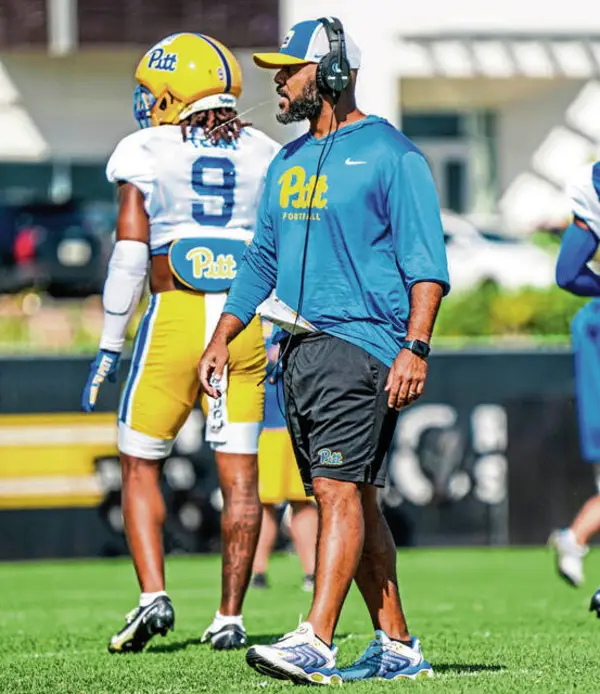
More so than the exact moment he was informed by coach Pat Narduzzi that he’d be Pitt’s new defensive coordinator, Cory Sanders recalled the feeling.
Sanders, who coached in Pitt’s secondary for eight prior years beginning in 2018, was named Dec. 28 as successor to Randy Bates, who retired following the Military Bowl.
“At that moment, it is an overwhelming feeling,” Sanders said Wednesday at UPMC Rooney Sports Complex. “You’re happy, but, at the same time, your mind kind of resets to like, ‘OK, this is what we’ve got to do here moving forward.’
“Now you’re thinking about the team or whatever it is moving forward, what that team looks like in 2026 and now you’re expanding how you look at everything compared to just your room. I always had a bigger-picture perspective, but now it’s acting on that bigger-picture perspective.”
The Pitt defense Sanders inherits from Bates features continuity from years’ past as well as new faces on the roster and coaching staff.
For starters, linebackers coach Ryan Manalac is gone, having accepted the defensive coordinator position at UConn, with Joe Bowen, formerly Buffalo’s coordinator, taking his spot on top of assuming run game coordinator duties.
Pitt also brought in Harlon Barnett, who takes over Sanders’ prior role overseeing safeties as well as assistant head coach, from Northwestern.
Losses on defense for the Panthers include star linebacker Rasheem Biles, who transferred to Texas, and defensive lineman Francis Brewu (Notre Dame).
But linebackers such as Cameron Lindsey and Braylan Lovelace return, as do defensive linemen Sean FitzSimmons, Isaiah Neal, Jimmy Scott and Nick James.
So do defensive backs Cruce Brookins and Shawn Lee.
Plus, Pitt brought in a total of six defensive players from the transfer portal: two linebackers, two defensive backs and two linemen.
Together, Sanders, his new assistants and returning staff — such as Archie Collins (corners) and Tim Daoust (defensive line) — have begun planning how Pitt will approach all aspects of defense.
“It’s been great,” Sanders said. “Joe Bowen has been a defensive coordinator at Buffalo. You look at coach Barnett who’s been a defensive coordinator at Michigan State, as well as Florida State, and you got a lot of great experience there from those guys.
“Bringing new guys in, they’ve been a part of the system, but they’ve also been outside of it, as well. You hear different perspectives and different ways to do things or techniques, coverages, fits, whatever it may be. It makes great conversation.”
How exactly Sanders puts his own stamp on Pitt’s defense beginning this fall remains to be seen.
But fans and players can expect at least some similarities to how Bates called the shots.
“Coach Bates has had a lot of impact,” Sanders said. “I’ve sat next to him in the box. From the moment I stepped foot here, we coached 103 games together. We keep track of that, every single game. … From the standpoint of how he breaks down field zones, his approach statistics-wise, looking at it from there (and) from the mental aspect, there’s things I’ve gained from him.”
Bates and Narduzzi, a former defensive coordinator himself, emphasized stopping the run first and foremost.
Last year, the Panthers finished eighth nationally in rushing defense, letting up an average of 95.1 yards per game. In total, Pitt boasted the country’s No. 32 total defense (330.4 yards per game).
Looking at sacks generated, Pitt ranked tied for 36th (31 total; 2.38 per game), while the Panthers’ 21 turnovers was tied for 26th.
The weakest defensive link for Pitt in 2025 was through the air, as opposing offenses averaged 235.3 yards per game(99th in the country).
The principles that Bates adhered to and objectives he strove to achieve will remain unchanged.
“I think over the years, we’ve taken great pride in being an attack-style defense,” Sanders said. “We get after offenses, we press and we’re in your face. Those things don’t change who we are. When you look at it, the thing that changes is just the approach of how we go about them. That’s the day-to-day, if that’s in the meeting room, the field and just coming from me.
“There’s things from a philosophical standpoint, like, we stop the run. That’s what we do. We attack the football, and we want to take the ball away. Those are things that are how we’re measured, and those are things we still want to do at a high rate that’ll make us a successful defense.”
With a coaching career that dates to 2007, Sanders now takes the helm of a Power Four, ACC defense.
One of his early stops in 2010 was at his alma mater, St. Joseph’s (Ind.), as defensive coordinator, before serving as head coach there for four seasons.
Leading into Pitt’s season-opener Sept. 5 against Miami (Ohio), perhaps Sanders will draw on that experience of calling plays.
Maybe Bates’ phone will ring some time that week, with a former pupil seeking some last-minute advice.
Either way, it’s now Sanders’ show. His first test is coming up in about seven months.
“Fortunate to be in a position for the last eight years, learning from coach Bates and what we’ve been able to do,” Sanders said. “Now, we’re going to try to grow on that foundation that’s been laid so strong over those years and take it to another level.”