
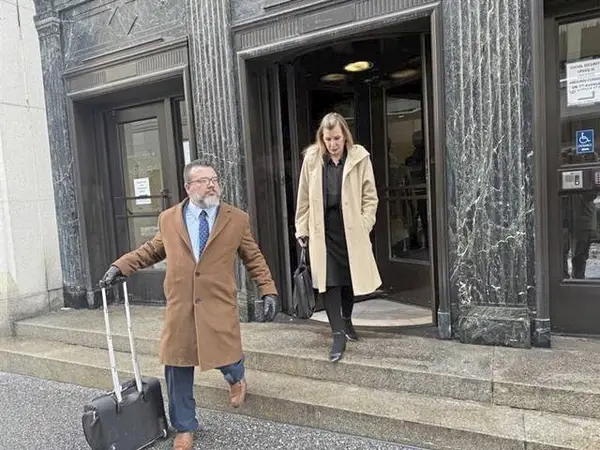
Six years ago, security officers at Pittsburgh International Airport seized $82,000 from Rebecca Brown’s carry-on luggage as she tried to fly home to Boston to set up a bank account for her father.
What began as a daughter trying to help her father, spiraled into a legal battle with the Transportation Security Administration (TSA) and Drug Enforcement Administration (DEA).
On Thursday, Brown, who lives in Boston, appeared in federal court as one of four plaintiffs represented by the Institute for Justice, a Washington, D.C.–based nonprofit legal group. The hearing considered class-action claims against the TSA over alleged illegal and unconstitutional seizures involving travelers carrying large amounts of cash.
The plaintiffs are seeking to end TSA and DEA policies or practices that allow the agencies to seize large sums of money from travelers based on a presumption of criminality.
In front of Magistrate Judge Kezia O.L. Taylor, Institute for Justice attorney Dan Alban argued that Congress authorized the TSA only to search for and seize items that pose a threat to airline security. He said the agency’s secret operating policies go beyond that authority by directing TSA employees to take extra steps when they encounter large amounts of cash.
Alban said these procedures included assessing whether it might be related to criminal activity, demanding travel documents and reporting the cash to law enforcement.
“TSA screeners are not law enforcement officers and the TSA is not authorized to conduct general criminal investigation,” he said.
In August 2019, Brown’s father, the late Terry Rolin, a resident of the South Fayette village of Morgan, had entrusted her with his life savings while she visited him in Pittsburgh for a weekend family wedding.
Brown said her father, who had squirreled away cash for years in hiding places at his home, asked her to open a joint account and help him manage his savings.
Even though it is legal to fly domestically with any amount of cash, Brown was stopped by security and questioned by Pennsylvania State Police and the DEA. The DEA agent took the money without charging Brown with a crime or arresting her.
Brown and Rolin filed a lawsuit in January 2020 and were able to get the money back.
“Luckily, I was able to get the cash back and my dad was able to enjoy it before he passed. I do think that this was unconstitutional what TSA did to me… I was stopped from free travel that morning,” Brown said, of the incident which took place more than five years earlier.
Attorneys argued that while Brown and Rolin eventually retrieved the money, their story highlighted a pattern of behavior by the TSA and DEA.
“I fear for the people that have to go through this,” Brown said.
While Brown was the only plaintiff able to attend Thursday’s hearing in-person, Alban talked about Stacy Jones-Nasr and Matthew Berger, who also alleged that their personal items, including cash, were seized a during TSA screening.
Jones-Nasr and her husband were returning from a trip to North Carolina in May 2020 when they were stopped by TSA and DEA. They were traveling with approximately $38,000 sealed in a clear plastic FoodSaver bag in Jones-Nasr’s carry-on luggage.
According to court documents, TSA turned over custody of their carry-on luggage and their cash to the sheriff’s deputy. Jones-Nasr and her husband were questioned by the sheriff’s deputy about the source and purpose of the cash.
Jones-Nasr said the money came from a trip to the casino and from the sale of a friend’s car. The police did not believe their story.
DEA agents seized all of the cash in Stacy’s carry-on luggage, Alban said during the hearing.
In November 2015, Berger was flying from Las Vegas, Nevada to Newark, N.J. to inspect and potentially purchase a pre-owned commercial tour bus in New York.
He was traveling with $55,000 in hundred-dollar banded bills in a bank-issued envelope and had paperwork and electronic communications with the seller regarding the potential business purchase inside his carry-on luggage, according to court documents.
TSA pulled the money out of his bag and a TSA supervisor began photographing Berger’s cash, his driver’s license and his boarding pass.
They seized Berger’s cash for civil forfeiture, Alban said.
Jones-Nasr and Berger were added to the Institute for Justice’s lawsuit following Rolin’s death.
During Thursday’s hearing, Alban said that both Jones-Nasr and Berger now avoid flying with cash and instead rely on other forms of transportation or wire money.
Defense Attorney Sarah Suwanda argued that Brown, Jones-Nasr and Berger’s stories did not establish threat based on the TSA’s past conduct.
Following the hearing, Taylor will issue a report and recommendation for District Court Judge Marilyn Horan.
Taylor declined to provide a timeline on her recommendation during the hearing.
Horan will then review the recommendation and decide whether either party’s motion for the court to rule without a trial will be granted.