
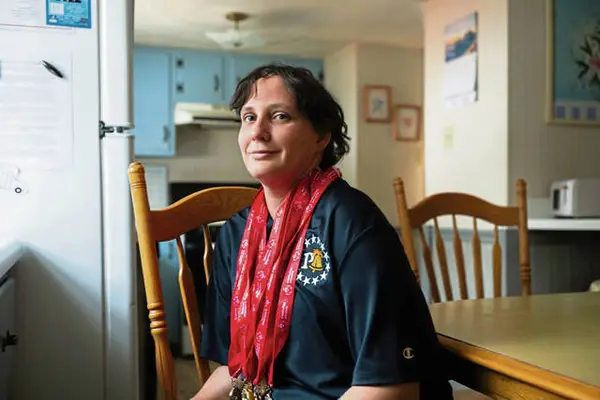
When Sheena Black found out she would be competing in track and field at the Special Olympics USA Games this June in Minneapolis, she couldn’t contain her excitement.
After 34 years as a Special Olympics athlete and earning 259 medals, she will have her first chance at running on the national stage — competing in the 800 meters, 1500 meters and shot put.
“I was like, ‘What?’” said Black, 42, of East Franklin of the moment she found out she’d be going. “I have never been in Minnesota before, and this’ll be my first time ever going.”
Black, who grew up in the Alle-Kiski Valley, was initially diagnosed with mild cerebral palsy and mild intellectual disability, according to her mother, Robin Bartel. She also has genetic scoliosis.
“She had problems with her gait, which has to do with walking, running. It seems with her competing in Special Olympics and the practicing, it seemed to have worked — that it did help her to better control her gait or her running ability,” said Bartel, 68, of Kiski Township.
Reaching the national stage
Black started competing in Special Olympics for Team Armstrong/Indiana when she was in second grade in 1992, after her life skills teachers encouraged her to try it out.
She attended school in the Kiski Area School District and then moved to the Apollo-Ridge School District. She also briefly attended classes in Burrell School District.
Throughout her 34 years in the Special Olympics, Black has not only competed in running, but also bowling, snowshoeing, bocce and more.
Bartel said her daughter started with ice skating when she was little, as well.
“I really like how I do with Special Olympics and all my coaches I have now,” Black said. “I do a lot of different sports.”
Though she’s currently in her offseason, starting in mid-March, Black will have training every day for her track and field events.
“Whenever they have us scheduled for training, they let us know, and we go for trials,” she said.
Most recently, Black competed in a bowling tournament where she scored 198, good for first place.
“If I keep proving how good I can do it — I can do it real quickly and stuff — I’m capable to do it,” she said.
Black has previously traveled to places including Penn State, Villanova, Slippery Rock and Seven Springs for Special Olympics competitions.
It was at a competition at Seven Springs when she learned she would be going to the Special Olympics USA Games.
“I got a phone call from her so excited and a picture of her holding her ticket to go on the plane to go to Minneapolis, and we were very excited for her,” Bartel said.
“She kept saying, ‘Someday, someday… .’ She got chosen; she was so excited, so very excited, and so were we for her.”
The Special Olympics USA Games is scheduled to take place from June 20-26 at the University of Minnesota Twin Cities & National Sports Center. More than 3,000 athletes, 1,500 coaches, 10,000 volunteers and 75,000 fans are expected to attend from all 50 states, according to the games’ website.
Black’s preparation for the national games is ongoing, as she has yet to figure out how transportation and flights will work for the event.
“We’re hoping that things are going to calm down in Minnesota,” Bartel said, so that her daughter is able to compete. Adding to the uncertainty is the ongoing ICE-related unrest in Minneapolis.
She said she’s hoping to attend the event to support her daughter.
“She loves to run … she does really, really well,” Bartel said. “She loves people — she loves being around people — but she especially loves her Special Olympics.”
Overcoming diagnoses
Special Olympics keeps Black happy, Bartel said, which makes her happy as a mother.
“She’s quite the little socialite. When I was raising her, for (many) years of her life, I was a single mother,” Bartel said. “During that period and everything that she was competing, I went to quite a lot of her events and everything and actually volunteered.”
Outside of raising her daughter, Bartel said she has work experience with people who have challenges and disabilities. She wanted to make sure Black was able to “blossom into a beautiful woman” despite setbacks.
“I tried to raise her that there wasn’t anything that she couldn’t do and always tried to make sure that she knew that she had to do her best because she was challenged,” Bartel said. “I wanted her to not be in a situation where she would become dependent on someone.”
Today, Black lives in a group home in East Franklin that provides disability services for intellectually and physically challenged people. There, Black is able to get her medication and be supervised, as well as receive assistance on shopping trips and similar outings.
Black is high-functioning and able to hold a job at McDonald’s — and hopes to become even more independent and have minimal supervision, Bartel said.
“She still has the challenges. She seems to be doing quite well with everything,” Bartel said. “ I call her my little burger flipper because she does the burgers and stuff at McDonald’s. She does dishes, she does a lot of things when she’s working.”
Bartel wishes Special Olympics athletes received more recognition for their hard work and accomplishments.
“We just want to see her be all that she can be. … These young people and these adults go through a very rigorous training in itself,” Bartel said.
“It takes more for them to get where they’re going, but they get there; and they deserve to have more recognition for everything that they do.”