
This story first appeared in PA Local, a weekly newsletter by Spotlight PA taking a fresh, positive look at the incredible people, beautiful places, and delicious food of Pennsylvania. Sign up for free here.
PHILADELPHIA — If you’ve got coins in your pocket, purse, or wallet, you’re likely carrying around Pennsylvania-created art.
The U.S. Mint produces coins in four cities: Denver, Philadelphia, San Francisco, and West Point, New York. But the Philly location — located just a few blocks north of Independence Hall — is the Mint’s hub for engraving, and employs a team of medallic artists who sculpt all the new designs for circulating coins, Congressional medals, and collectible pieces.
Yes, sculpts. The images in coins are three-dimensional and extremely detailed despite being only slightly raised.
“There’s a great challenge in making something in relief like this,” said Phebe Hemphill, a medallic artist who’s worked at the Mint since 2006. “It’s kind of a weird, fascinating challenge to fit everything into that very, very low space we’re allowed to sculpt.”
Hemphill, a Pennsylvania Academy of the Fine Arts alumnus originally from West Chester, got some early experience working at the Franklin Mint, a private Delaware County-based company that produces coins and other collectibles. Her design and sculpting credits over her two decades at the U.S. Mint number in the dozens, from a Congressional Gold Medal presented to Tuskegee Airmen to a quarter depicting the Cuban American singer Celia Cruz.
The coin sculpting process requires many “small technical nuances” to create “the illusion of depth,” said Eric David Custer, another medallic artist at the Mint. While medals allow for a bit more “freedom” because they’re larger, he said, coins like quarters are trickier. The sculpted image ends up being about as thick as “two or three human hairs” stacked on top of one another.
Custer, who grew up in Independence Township in western Pennsylvania, did some of his early engraving work at Wendell August Forge, a Pennsylvania-based artisan metalware company. An alumnus of the Art Institute of Pittsburgh with a degree in industrial design, he joined the Mint in 2008 as a product designer and became a medallic artist in 2021.
Custer and Hemphill are part of a small team of medallic artists that span a range of backgrounds and skillsets. One previously designed dinnerware and pottery, while another founded a community sculpture studio.
“Everyone that’s arrived here has come from different avenues in art, sculpture, and manufacturing,” said Custer.
Since the first U.S. Mint was established in Philadelphia in 1792, the city has been the country’s center for coin engraving, according to spokesperson Tim Grant. The Mint’s headquarters moved to Washington, D.C., in the 1870s, but its engraving operation remained in Philly.
Some notable names in sculpture, such as Augustus Saint-Gaudens, have designed coins for the Mint over the years — a history that isn’t lost on the artists that work there now.
“A perk of this job and to have this position is that you know that the greats went before you here,” Hemphill said.
How coins are made
The making of new coins and medals generally starts in Congress, which passes laws to authorize their creation.
The Mint then outlines design standards, and taps staff artists and its pool of over two dozen freelancers from around the country to submit line drawings for consideration. The designs go through a robust revision and review process before one gets final approval from the U.S. Treasury secretary.
From there, the in-house medallic artists take the selected line art drawing and sculpt it into three dimensions, which can involve adding more detail than what’s in the sketch.
“The sculptor has to make some decisions,” Hemphill said. “They can’t just solely take a design and, you know, make it look good as a coin. You have to enhance certain things.”
The completed artwork is then machine-engraved onto steel hubs, which are used to stamp dies that get used to strike coins. And once they enter circulation, the coins make their way to our pockets, jars, and couch crevices.
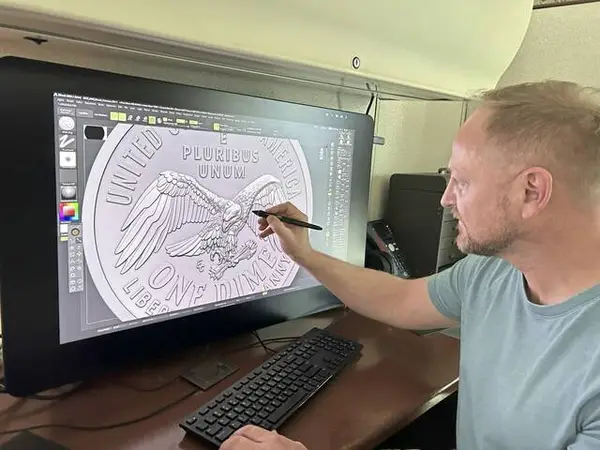
Some medallic artists prefer to sculpt the designs by hand with clay or plaster on rounds that are about eight or nine inches in diameter, while others use software, Hemphill explained. She prefers to work by hand initially, then scan her work to make finishing touches digitally.
The traditional approach “really allows the sculptor to gauge the depth properly using your own binocular vision,” Hemphill said, while digital tools make some “cool tricks” possible that “you wouldn’t even imagine you could do in traditional.”
Regardless of the methods used, the artistic process involves lots of constraints and “hard limits,” Hemphill said.
First, designs have to comply with the legislation that authorized them, which outlines required elements like the type of people or symbols the coins must depict, as well as phrases to include.
In some cases, stakeholders named in the law that authorized a coin — which can mean governors, museums, or organizations relevant to the design — have to be consulted.
Time is a factor too. After a design is approved, things can move pretty quickly to meet production schedules, with artists getting around 16 business days to translate a line drawing into a sculpture, according to Hemphill and Custer.
And then there are medium-specific musts: Artists have to create designs that fit coins and medals. For example, certain angles don’t work well in coin art, Custer said, and nickels, dimes, and quarters each have specific font size requirements.
Production design staff also have to provide feedback to artists to make sure an image will be “strikable” and won’t result in manufacturing errors or inconsistencies, Custer explained.
“Designing and sculpting — they’re both problem-solving processes as much as they are art,” he said.
Sculpting stories
A medallic artist’s job ultimately boils down to finding a way to translate iconic moments or people in history into pocket-sized art.
In Philadelphia, one of the country’s oldest and most storied cities, that history can be pretty accessible. When working on a new series of coins meant to honor the nation’s 250th birthday, for instance, Custer drew on resources that are practically in the Mint’s backyard.
His background research for the new “Emerging Liberty” semiquincentennial dime led him to the Museum of the American Revolution, a 10-minute walk from the Mint.
Custer’s design for the tails side of the coin — which features an eagle with one empty claw and one claw holding 13 arrows — won out in the selection process.
The image takes inspiration from the Great Seal of the United States, and represents the colonists before and during the American Revolution, Custer explained. While he included the arrows from the seal, he left out the olive branch to symbolize the fact that the colonies hadn’t yet reached peace — but left the claw open to demonstrate that they were waiting for it.
Hemphill also used the neighborhood to her advantage while working on the series. She sculpted the back of the “U.S. Constitution Quarter,” a design by Donna Weaver that features an image of Independence Hall.
When translating a line drawing of a building to a three-dimensional coin, sculptors benefit from having additional visual context like a photograph to get the details right, Hemphill said. In this case, though, she didn’t need a photo.
“I had a nice little walk down the street to really get a good gauge of how to do that one.”