
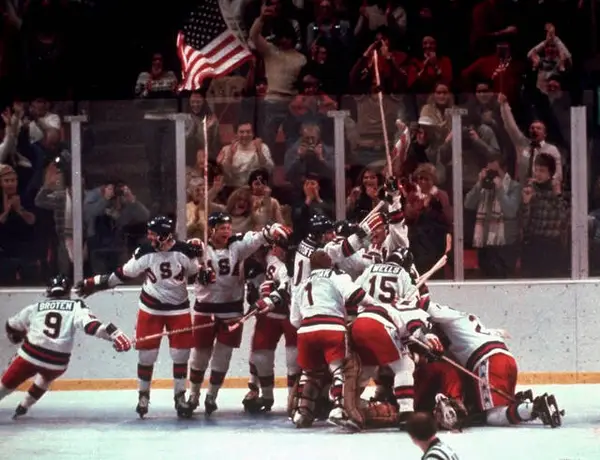
“Miracle: The Boys of ’80” is a Netflix documentary about the U.S. hockey team conquering impossible odds to win gold at the 1980 Lake Placid Winter Olympics. It brought surviving members of that team back to Lake Placid to watch highlights, talk and relive the moment. It’s strong and heartfelt.
The documentary is the latest in a long series of work chronicling the “Miracle on Ice,” the most notable being the 2004 film “Miracle” that starred Kurt Russell as U.S. coach Herb Brooks.
If it seems like overkill, it’s not.
What happened at Lake Placid is the biggest upset in the history of sports, the greatest story. It can never be retold too much. It was once in a lifetime, and probably much longer than that.
Some foolishly tried to parallel Indiana winning the national college football championship. Not even close. Indiana would have to have beaten the ’85 Chicago Bears.
The Netflix documentary got across the enormity of the task: The Soviets of that era were the best hockey team ever. That’s easy to say, hard to fathom unless you saw them.
The Soviets beat the NHL All-Stars in a best-of-three series in 1979, winning the deciding game 6-0. They beat the U.S. team 10-3 in an exhibition game just before Lake Placid. They were a precise, merciless, state-sponsored juggernaut who prepared year-round to do one thing: Win Olympic gold.
But the U.S. collegians upset them 4-3 at Lake Placid, essentially beating them at their own game: Speed and conditioning.
The Soviets were panicked in the last 10 minutes. That was a first, and a last.
Chemistry and leadership are overrated, mostly fictional, assigned after the fact. You never hear about a good team with bad leadership and chemistry, or a bad team with good leadership and chemistry.
Mark Messier is supposed to be the greatest leader in hockey history. The NHL’s leadership award is named after him.
Messier’s teams missed the playoffs in his last seven seasons. Did he forget how to lead?
But that U.S. team was an exception.
A lot of it was Brooks, between his unmatchable hockey nous and psychological brilliance, galvanizing a group that initially hated each other because of collegiate rivalries by making himself the common enemy.
But it wasn’t just Brooks.
That group was special, becoming so much greater than the sum of the parts. No team has ever come together and maximized like that one. Not in any sport, not at any time.
But Brooks was a genius.
He had the guts to mimic how the Soviets played, to attack instead of cringing before their might. To imbue confidence that logically shouldn’t have existed. Brooks and his team twisted the Soviets into a pretzel. At the end, the Soviets didn’t know what to do. They forgot to pull the goalie.
What makes the Netflix documentary unique, and great, is the regrouping of the players at Lake Placid 45 years later. Witnessing their camaraderie and emotion, not least when video of their parents at the Games got shown. Seeing what the wisdom of age has added to their experience.
Former Penguins GM Craig Patrick was Brooks’ assistant. It was great to see Patrick interviewed by Netflix. He’s occasionally been reticent about 1980: He declined to be consulted for the 2004 movie, for example.
But since Brooks passed in 2003, Patrick is the only one left who can tell the story from Brooks’ perspective. Brooks was isolated from that team, not at all their friend, not then and really not ever. Patrick was the bridge, the go-between. He knows what happened, and why.
Patrick recently suffered a stroke. Here’s praying for a full recovery. He’s one of his era’s most important hockey people. Irreplaceable at Lake Placid, irreplaceable in Pittsburgh. A thoroughly good man.
I got to know Brooks after he became a scout for the Penguins in 1993. (As Olympian Rob McClanahan said on my radio show, “You knew nice, old Herb. You skipped the hard part.”) Brooks was my coach, too. He was everybody’s coach. I’m honored that he was my friend, and I miss him every day.
In the Netflix documentary. U.S. captain Mike Eruzione said, “We could use a 1980 now.”
We sure could.
But it’s impossible.
NHL players are in the Milan Winter Olympics.
The Soviet hockey dynasty crumbled with the Soviet bloc. The Russians aren’t in these Olympics, excluded because of the war with Ukraine. (Wrongly so. Don’t mix sport and politics. Brooks didn’t. To Brooks, 1980 was “a hockey tournament” first and foremost. Not a “morality play on ice,” as was famously said.)
U.S. collegians won’t ever again skate against an evil empire. (If there’s an evil empire now, it might be us.)
But let’s say the circumstances of the “Miracle on Ice” could be exactly duplicated now.
We’d screw it up.
We’d want to know which players were red and which were blue. The president would say something abjectly stupid. Today’s America would find a way to inject hate and doubt, with the usual suspects reaping benefit. We would take something pure and make it dirty.
The “Miracle on Ice” solved what then-president Jimmy Carter called “a crisis of confidence.”
But today, an identical “Miracle” would solve nothing.
We’re not those people anymore.