
It was always going to be a challenge for AMC’s “Dark Winds” to top its third season, the series’ best so far.
Although the new fourth season lacks a defining episode like season three’s sixth episode, “Abidooniidee (What We Had Been Told),” featuring lead character Joe Leaphorn on an emotional, hallucinatory journey, season four manages to advance all its characters’ stories, even as they spend more time than ever off the reservation.
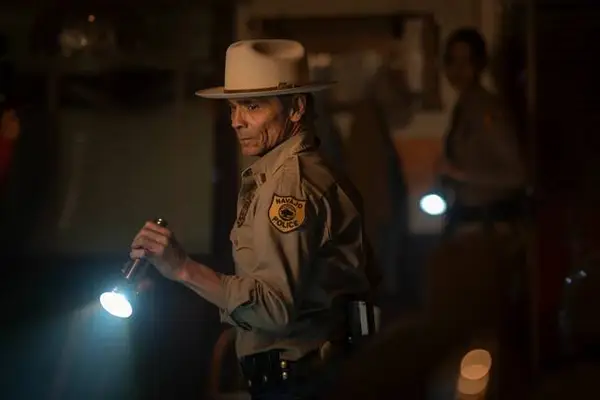
Set in the 1970s in Arizona’s Navajo Nation and focused on Tribal Police Lt. Joe Leaphorn (Zahn McClarnon), “Dark Winds” has long embraced the culture of its setting, particularly in season three’s blend of mythology and memory.
For the fourth season, premiering the first of eight episodes at 9 p.m. Feb. 15 (AMC, AMC ), producers opt to go in a different direction, sending the characters on a road trip when the case of a missing Navajo teen takes them to Los Angeles. That relocation highlights the backstory of Tribal cop Jim Chee (Kiowa Gordon) and gives the show’s women — Joe’s heir apparent, Bernadette (Jessica Matten) and Joe’s estranged wife, Emma (Deanna Allison) — more agency than ever.
The primary villain is a seemingly crazy German blond (Franka Potente) who’s doing the bidding of an imprisoned L.A. crime boss (Titus Welliver, “Bosch”).
Through much of the season the emotional stakes are tied to Joe and Emma and whether they’ll get back together, with some signs that this season could be the show’s last. But “Dark Winds” ultimately avoids tying everything up in a bow even as the season-ender points toward resolution for some relationships. A final scene leaves no mystery about what the plot will be for the show’s already-ordered fifth season.
In a Zoom interview earlier this month, McClarnon, who’s also an executive producer on “Dark Winds,” said the cast and producers didn’t know when filming season four that the show would get a fifth season.
“To be honest, we have different options for the end of seasons because we really dont know. It’s just how television works,” he said. “We shot a couple different ways, but it came down to what we wanted to put in there and the editing, for sure.”
McClarnon said in season four Leaphorn continues to walk a fine line between his culture and being a cop.
“It’s [about] how that affects him and his relationships,” McClarnon said. “Joe was changed in his search for a spiritual connection [in season three]. The Navajo people call it hózhó, which is a concept of finding balance and beauty, peace of mind, harmony with one’s existence. This season, he does lean into his ceremonies, his cultural ways, to achieve that understanding the accountability of how his life has been going.”
That leads to Leaphorn’s personal challenge of season four outside his police work.
“Joe definitely finds himself at a crossroads,” McClarnon said. “It’s a self-understanding, I think. He’s constantly confronted with his age and his mortality, life without Emma, possibly. Why did she leave? Is he at fault? It’s about the exploration of himself.”
McClarnon said Emma is the love of Joe’s life and their relationship is “the heart and soul of ‘Dark Winds.’
“Season three was when I realized that Joe was madly in love with his wife, Emma,” McClarnon said. “I can’t see anything getting in the way of that. Even though they’re taking a break in season four, it’s a big part of Joe’s identity, as well as his being a cop. It’s consumed his life. What would Joe be if he was no longer married to Emma?”
In season four, it seems like Leaphorn may have to choose between his career and his relationship, which is a challenge when his identity is wrapped up in both.
“Is he doing it for Emma? Is he doing it for himself?” McClarnon asked about Leaphorn’s season four suggestion he will retire.
While season four takes the characters off the reservation, “Dark Winds” doesn’t abandon its cultural roots, exploring life as a Native American in Los Angeles in the 1970s visits to a Native community center. “Dark Winds” also uses that L.A. trip to unearth Jim Chee’s backstory.
“We’re able to explore things like the Relocation Act of ’56, a government act that was passed to encourage Natives to leave their homes for cities for vocational training and jobs, and it’s another way of assimilating Natives into the predominant culture,” McClarnon said. “It did lead to some negative aspects, like poverty and discrimination, but also there [were] positive aspects as well.”
“Dark Winds” explores the question of what happens when someone’s displaced from their roots and culture? How does that affect a person?
“We don’t beat the audience over the head with this stuff, but if people learn things about the culture, it’s a very positive thing for me,” McClarnon said. “’Dark Winds’ has a cultural lean, a perspective that a lot of people have never really seen on shows.”