
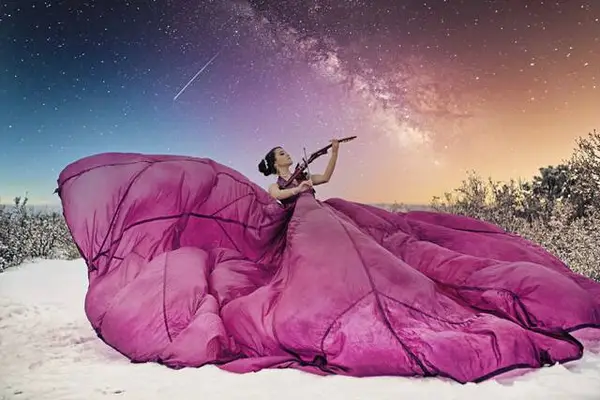
Electric violinist Mia Asano is no stranger to going viral on the internet, with dozens of her TikTok clips garnering views in the millions.
Those covers, which range from Guns N’ Roses to Papa Roach to the 1990s X-Men cartoon theme song, could be on tap when Asano plays her first solo headlining show in Pittsburgh. Her spring tour, which kicks off Feb. 28 in Los Angeles, will visit Crafthouse in Whitehall on March 13, with DragonForce guitarist Billy Wilkins opening.
“I’m debuting music from my upcoming solo album, but I’m also playing a bunch of covers that are people’s favorite viral videos from online — but instead of 15 seconds, you get a full cover of it,” Asano said. “So there’ll be definitely some nerdy music like ‘Power Rangers,’ ‘X-Men’ and ‘Pirates of the Caribbean.’ There’s gonna be some classic rock and rock music, and I’ll rap ‘The Devil Went Down to Georgia,’ and then a lot of my original stuff that’s never been heard before. So it’s gonna be a really fun night.”
Slated for release later in the year, “Lore” is a concept album about “cryptids and monsters and creepy stuff,” she said.
“Every song on the album is named after a different creature that I’m obsessed with — like Mothman, Loch Ness Monster, dragons, Kraken — so it’s a fun mix of different explorations into these different folklore vibes,” she said. “I’m also collaborating with a bunch of different artists because I’m not an expert in Mongolian music. So for the Mongolian Death Worm song, I have an amazing Mongolian folk singer friend who’s on that. For the Loch Ness Monster song, I’m collaborating with a Scottish band. It’s a really fun exploration for me to try all these new styles and then make them all fit into the realm of symphonic metal, which is the vibe of the album.”
The concept for the new album came before the music, although Asano said she knew she wanted to explore cinematic and symphonic metal this time.
“I also wanted it to be accessible enough that it doesn’t confuse your brain when you hear it. There’s still a catchy melody. So I knew that was the vibe that I wanted and then I just got really into Mothman a couple years ago,” she said with a laugh, “and I was like, I need to write songs about this. To do a concept album, it allows me to tell a story through it, which is my favorite thing to do and then to explore a bunch of different cultures and music styles is also my favorite thing. So the concept came first and then the music flowed pretty naturally after that because I already knew what I wanted it to sound like.”
In a Zoom call last month from Los Angeles, Asano spoke with TribLive about the benefits of the electric violin, her animated performances, social media and more. Find a transcript of the conversation, edited for clarity and length, below.
What can you say about the Mothman song because that’s from around here in West Virginia?
I actually played at a venue in West Virginia, and they had Mothman murals everywhere, and I was in this Mothman onesie that I have. It was so awesome. So that song is really cool because I basically was like, I wanna just mix all of my favorite things in the world. So my favorite time signature, which is 6/8, my favorite genres, which are metal but then EDM and then violins. So it starts as an electronic-sounding situation and then it turns into this full-on metal breakdown. I will be playing it at the show, and I’m so excited. It’s gonna be really fun.
With all these songs, what do you think would be the most surprising to people?
The most surprising thing, I think, there’s no vocals. There’s a little bit of vocals, but it’s mostly instrumental, like the violin replaces the lead vocal. People might think, wow, that doesn’t sound interesting to me, I want to hear someone singing. But I think what people are surprised by is the violin sounds very similar to the human voice. But I can make it sound like a vocalist. I can make it sound like an electric guitar, and I can make it sound like a classical violinist. I think it doesn’t detract from the music. In fact, actually I think it adds to it, the fact that the violin can be so diverse. So I think that’ll be the biggest surprise. And I think also people hearing me rap “The Devil Went Down to Georgia.” It won’t be a surprise – the real ones know – but I’m the last person you’d expect to be singing that song.
When it comes to your music, do you think people would be surprised by the versatility of the electric violin?
Yeah, I think so because people just see an electric violin and they’re like, OK, it looks cool, but it probably sounds bad. It doesn’t project like an acoustic violin does because it’s not a hollow-bodied instrument. And so I think what people are surprised by is I’m running it through a cello impulse response, actually. So it sounds as close to an acoustic instrument as you can possibly get it to sound. And then I can also run it through electric guitar effects so then it sounds exactly like an electric guitar. So there’s definitely diversity in the abilities that I have with the instrument. That’s my favorite thing because I don’t want to listen to an hour and a half of the same exact sounding thing. I want surprises. I want ups and downs. I want to go on a journey. And so the electric violin really allows me to do that, and that’s fun.
You play a Viper, right?
I do play a Viper. It is a seven-string fretted Viper. It has a support system, so this props up on me and this guitar strap straps around me, so it’s self-supported, which is why I could headbang and backbend and hair flip and do all that fun stuff without it affecting my playing at all. And the seven strings allow me to have extended range, so I don’t have to transpose a guitar solo up an octave or anything. I can just play the full range of the guitar solo, I can play cello parts, I can play bass parts, and it has normal violin strings, too. So it’s like the whole orchestra in one instrument, and it looks really cool.
Is it more comfortable to play than a classical violin?
Yes, because I still play my classical violin, but you’ll notice any violinist, they have a mark here We call it a violin hickey, and it’s really uncomfortable. I was just playing my acoustic the other day, and now it really hurts here. But for this one, I don’t use my chin so, one, I don’t get double chin when I play. Two, it doesn’t affect me like this. Three, a lot of violinists I know have neck and shoulder pain. I get a little bit of neck and shoulder pain because this is so heavy because it’s seven strings. But I have a five-string one that’s super light so it’s really kind of a painless situation because it just hangs there and I don’t need to really use any exertion to play it other than putting my fingers down so I really love the design of this instrument. When I’m playing in Cleveland later on the tour, I’m gonna be touring the shop where they build these and I’m really excited. They just relocated to Cleveland so I’m excited to to see the new spot
You had mentioned about the head banging. when you think about violinists, you don’t really hear about them being as animated as you. Did that take a while to get comfortable like bringing that aspect out?
Yes, it took a long time and I feel really grateful because I started playing violin when I was five and then around age 15, I got an electric violin. I was in Colorado at the time so I started playing at a lot of fashion shows and events like that. Basically while I was still in high school, I was troubleshooting the career that I now have because I had time to just kind of suck and make mistakes and not know things. And it was fine because one, I was a kid and two, everyone in the fashion scene was really supportive of me, and they just wanted to help me out and see me grow. I had a chance to really dial that in so by the time I had millions of eyes on me, which kind of happened overnight, the viral videos and stuff, I didn’t have to suddenly learn how to perform because I’d already been doing it for so long. And then I’m making videos every single day. I translate that into live touring and then I was able to hone it even further and slowly over time, it started with a hair flip here and there, and then it started with more hair flip and then it turned into head banging and then it turned into jumping around, and the more I got to practice it, the more I was able to kind of fine-tune it over time. But I’m very grateful that I started so young because I know people that go viral overnight and have never played a show before and then suddenly their first show is for thousands of people and that’s really nerve-wracking. I’ve been comfortable in front of an audience since I was really young and I’m so grateful for that because it’s helped me a lot in my career.
With your classical training, did you receive any pushback over doing metal stuff?
Yes, every day on the internet I get comments from people that are so angry about what I’m doing. But my teachers in school were really supportive, both in high school, even my classical teacher, he understood what this was and what I’m trying to do here and that I wanted to be the best violinist I could possibly be, but that my goal was very different than all of his other students. He always understood. I walked into his lesson studio for the first time with my head shaved and dyed leopard print. He knew that he was not in for a traditional experience with me. And then my orchestra in high school, they were really supportive. Our director would even bring in modern or rock music for us to play and let me do the solos. So I was really lucky. Other people in the classical community do get mad at me sometimes because they think what I do is really easy. All I have to say to that is I know what it’s like to practice eight hours a day for classical music. I still do that but just with music that I love. I think there’s space for everyone because if there’s a classical gig, I have 10 violinists who I recommend for that gig who are excellent at what they do. I just choose to work really hard at a different thing, and that’s OK because there’s room for everyone. So when I get hate comments on the internet that are like, oh, you’re just playing the vocal melody, that’s so easy. I’m like, well, no it’s not because you don’t know everything that goes into it. What I do is very technically difficult, just in a different way. I have so much respect for the classical world and what they do, and I did that for the first 16 years of my life and I still play classical music. So I love it deeply and it’s just not what I’m meant to be doing, and that’s OK.
You’d mentioned about social media being important. Is it hard to balance ‘I have to do social media, I have to feed the beast’ while also wanting to do music too?
It’s definitely difficult. Feed the beast is a good way to describe it. Thank you for putting it in terms that I like. But it’s interesting because I know a lot of musicians. I give a lot of social media consultations to people, to musicians. And the hardest thing in the world for them is to make one video because we have imposter syndrome, we have perfectionism, we have all these things that hold us back, that I had to overcome as well. The hardest thing is for them to make one video. I put out a video every single day. So my baseline is five videos a week. And that’s normal for me. And so on top of that, then I get to do the rest of my career. But at minimum, I’m doing a video every single day. I’m definitely taking a little break from that right now to focus on tour prep. But at my maximum capacity, the minimum is a video every day. So then I also have to do the contracts and the album and the tour prep and the gigs and teaching and writing and doing all these things. So it’s definitely a lot more than I think I realize it is, because to me, it’s normal to be making videos constantly. But I think to other musicians, even one seems like a really daunting task. But for me, I really got over the perfectionism/imposter syndrome thing. That allowed me to just churn out content because I don’t hold myself back by making every single little detail perfect anymore. And that’s OK, and that has given me a lot of freedom.
The perfectionism does make sense with musicians because they’re releasing songs and they’re crafting it, so to have to bring that standard to a different standard to do these social media things, it’s probably very hard.
Yeah, and I just have to remind myself, one, the video is short, two, people are going to see it on their screen and then scroll and forget about it. So it has to be good. It can’t suck because you never know what goes viral. And it’s always the video that I wish I’d spent another 20 minutes working on it that goes viral. So I do make sure they’re good, or at least up to my standards. But also I learned, I have a good friend who once told me only put 80% into stuff, because oftentimes, if you’re a perfectionist, your 80% is the same as someone else’s 100%, so I’ll put 150% into things like my original music, my performing, my personal life. But then when it comes to a social media video, usually 80% is more than good enough. As long as I play in tune and in time, and I don’t look too stupid, then I’ll post it. But if something like my clothing is kind of messed up, or my hair is a little messed up, or I make a weird face, I’ll just leave that in and I don’t really care. It’s fine. And usually when there’s mistakes, people actually like it more because it makes you seem more human. There’s so much content of me on the internet and there’s so many pictures of me looking bad, I don’t really care anymore if it’s not absolutely perfect.