
The Pittsburgh accent is one of those “if you know, you know” things. Lifelong denizens of the 412 can recognize it in others immediately, but outsiders can struggle to pick it out — or pick it up.
“Growing up in Pittsburgh, I didn’t know there was anything particular about it until people from out of state would point it out to me,” said Brian Butko, director of publications at the Heinz History Center. He contributed to the History Center’s 2016 publication “Pittsburghese: From Ahrn to Yinz.”
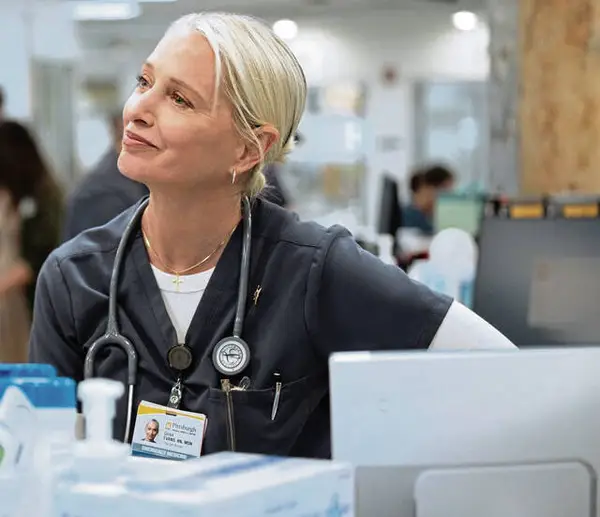
So it goes with hit HBO Max series “The Pitt,” which takes place in the fictional Pittsburgh Trauma Medical Center. The show follows a cadre of doctors, nurses and patients hour-by-hour through a shift in the hospital’s emergency department.
Despite its fanfare, local viewers have noted it’s surprisingly light on Yinzers for a Pittsburgh-set show.
Between seasons 1 and 2, actress Katherine LaNasa, who plays charge nurse Dana Evans, worked with Pennsylvania dialect coach Suzanne Sulby to deepen her character’s accent, she told the “Today” show.
“A lot of tears, Savannah,” LaNasa told host Savannah Guthrie when asked how she achieved the accent. “I don’t know if I’m nailing it, but I’m trying.”
LaNasa’s character is identified as a Pittsburgh native, as she states in a first-season episode that she was born at Pittsburgh Trauma Medical Center and worked as a candy-striper in the hospital as a teenager.
LaNasa won the Emmy Award for Outstanding Supporting Actress in a Drama Series for her first season performance.
Reviews from Pittsburghers on social media have been mixed since the start of the new season. Some say that the dialect sounds closer to those found in Philadelphia or New York City.
“I live in Pittsburgh and much of my family are born and bred Yinzers. Her accent is definitely not a Yinzer accent, it’s very eastern PA,” one Reddit user said in a subreddit dedicated to the show.
“As a native Pittsburgher who isn’t very fond of our accent at all, I agree that this isn’t even close to a Pittsburgh accent. I don’t think last season was, either, but this season definitely sounds over the top. I am not quite sure what regional accent that is being emulated, perhaps a mishmash of several,” one Facebook user commented in a fan group for “The Pitt.”
Some native ‘Burghers online, however, think the actress is doing a good job and her way of speaking may have been influenced by education or even trauma.
“I’m from Pittsburgh, born and raised — her accent is right on, and utterly typical from a working-class Pittsburgh native. The actress seems to be going for a working-class Pittsburgh native accent slightly tempered by higher education / her years as a nurse,” another Reddit user commented.
The professional view
Don Wadsworth is an actor and dialect coach who is also professor emeritus at Carnegie Mellon University’s School of Drama, where he taught voice and speech techniques for more than 20 years. He’s also worked on several film and television projects where he coached actors on Pittsburgh dialect, including the 2009 film “Adventureland” and 2018 CBS All Access series “One Dollar.”
He said some actors can slip into the Pittsburgh accent, but it poses a big challenge for lots of non-native speakers. “When I would show them, they would go, ‘What in God’s name are you doing? What is that sound?’ ”
During his own education, the Pittsburgh native had a dialect coach who taught him to crack the code on learning any way of speaking.
“We had a working knowledge of phonetics, which is really quite important to figuring that sort of thing out,” he said. “And then, there also was a kind of musicality that you could name for almost any accent or dialect that you would be doing.”
Wadsworth said he “adores” “The Pitt,” but that he’s surprised at the lack of Pittsburgh accents among the characters. “If you put an ‘ER’ type program in Brooklyn or Atlanta, you would hear some people sound like that,” he said.
While it makes sense that not all of the doctors or nurses on “The Pitt” would be from the area, the lack of regional accents from the patients is less realistic, he said.
He also said he wasn’t quite sure what LaNasa’s character’s accent is.
“I think she’s wonderful,” he said, “I really tried to pay attention to what she’s going for there. They might have the idea that that’s a Pittsburgh dialect. It is kind of messy and blue-collar-y, and maybe that’s all they need.”
So what is a Pittsburgh accent and what makes it difficult to emulate?
“It’s a combination of Scots-Irish and German and Polish and all this kind of stuff, you know?” Wadsworth said.
In the introduction to the Heinz History Center publication, Lauren Uhl wrote, “Poles, Slavs, Czechs and others were in their own way just like the Scots-Irish. They banded together in neighborhoods, established their own churches and beneficial societies, and built their own schools to maintain their language and culture and pass it on to the next generation.
“Their young children, however, more adept at learning a new language and eager to fit in with their American peers, learned English in the street, not in school, and so picked up the prevailing Pittsburgh version of English.”
Butko said the accent is hard to copy because it doesn’t have a lot of distinctive notes. “Unless people are exaggerating it,” he said. “And then it doesn’t sound right.”
Much of the Pittsburgh accent is found in the vowel sounds, where the rounded note of an “ou” or “ow” turn into a flatter ah sound, so “downtown” turns into dahntahn and “about” becomes abaht. There’s also the classic example of “iron,” which shifts into ahrn in the mouths of Southwestern Pennsylvanians.
Wadsworth said when he’s coached actors into the accent in the past, he tries to keep it subtle, emphasizing the change in those sounds. “So a lot of Americans say ‘cotton’ but in Pittsburgh you’d say cahtton or catton.”
He said the way of speaking also often integrates some aspects of a general blue-collar American accent, like dropping the “g” at the end of words like “running” and “walking.”
Butko also pointed out the importance of knowing local slang terms, such as yinz and jagoff.
He said collective words like “yinz” developed after the use of “thou” fell out of fashion centuries ago. English speakers needed a way of differentiating between the singular “you” and “you” meaning a group. “That’s why there’s ‘y’all’ and ‘youse guys’ — and we have ‘yinz’ from ‘you’uns.’ ”
While these pronunciations and terms come naturally to people who have been immersed in them for a long time, it’s a fast-spoken and natural way of speaking that can be difficult to teach.
Wadsworth hopes in the future, executive producer John Wells — a CMU School of Drama grad — and the other showrunners will consider infusing some of the patients on “The Pitt” with more of that working-class Ahrn City feel.
He lives in the same neighborhood as the Pittsburgh Trauma Medical Center’s real-life counterpart, Allegheny General Hospital. “If you walked into the emergency room down there now, you might only hear that with two people,” he said, “And that would be enough to be realistic.”