
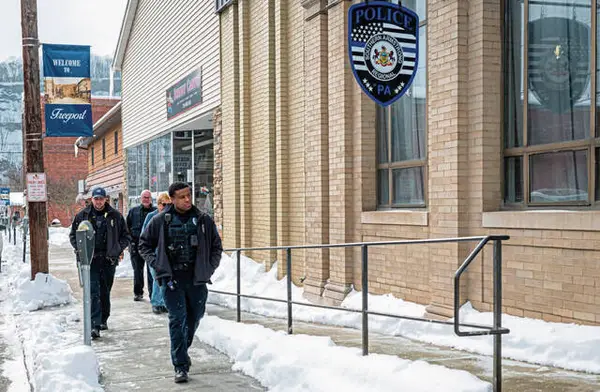
Police mergers, which have long provided staffing and financial relief for smaller departments, are emerging as a solution for forces of all sizes across the Alle-Kiski Valley.
As equipment costs climb and retaining part-timers becomes increasingly difficult, consolidation is more often being eyed for viability.
“There are only so many state troopers to help cover departments in need,” said Chris Fabec, chief of the Southern Armstrong Regional Police Department, which provides coverage for Freeport, Gilpin and Ford City.
“Regionalization in Armstrong County is the future.”
Prior to the formation of Southern Armstrong Regional in 2022, Freeport didn’t have enough police officers to provide 24/7 coverage in the small community.
Now, under the regional force, there are at least four officers on patrol during the day and three at night.
“They’re getting staffing like they never had before,” Fabec said.
In addition, regionalizing has provided the increased police coverage at a lower cost to the borough.
Freeport budgeted $261,000 for public safety in 2021. It now pays $243,000.
“At this point, four years later, we would be paying over $300,000 for an independent police force,” Borough Manager Tina Ferringer said.
According to state data, the average per capita cost of regional police departments is 26% less than municipal departments. Other perks often include higher salaries, officers with more specialized skills and a decrease in overtime hours.
Staffing as important as savings
Tarentum absorbed the dwindling department of neighboring Brackenridge in 2023, when Brackenridge had only three officers.
The combined department has 14 officers, including Chief Bill Vakulick. It added a police dog, Kilo, to the force last year.
Brackenridge Mayor Lindsay Fraser said the move didn’t save money but was crucial for access to resources and benefits and to maintain a sense of community.
Brackenridge pays about 18% more than it did in 2023. The police budget was about $567,700 then.
This year, the borough will pay Tarentum about $672,400 toward its $2.2 million budget.
Fraser said the payoff is worth it: Training and equipment are beyond what the borough could offer as a standalone department.
Combining forces also allowed officers familiar to the borough to continue patrolling, which was not the case in the months following the on-duty shooting death of Chief Justin McIntire in early 2023.
Tarentum Borough Manager Dwight Boddorf echoed Fraser’s sentiment that the benefits don’t always show up purely as cost savings.
“In many cases, the value is risk reduction and service continuity, which is harder to quantify but very real for small municipalities,” he said. “We’d say it’s increasingly becoming one of the few viable options for small communities.”
For Tarentum and Brackenridge, the move has improved coverage and scheduling flexibility; created clearer command structure and accountability; and allowed for more consistent policies, training and equipment standards, he said.
“We’re careful not to frame it as a one-size-fits-all solution,” Boddorf said. “Each community has to weigh the pros and cons for itself, based on finances, geography, existing service levels and local expectations.”
No data is available to compare response time pre- and post-consolidation. But the department’s first annual report, released in January, showed arrest and citation rates, when measured as a proportion of calls for service, were split among the communities almost identically.
Officers responded to nearly 2,500 calls resulting in 242 arrests last year.
Police answered about 1,740 calls in Tarentum, which led to about 160 arrests, or 9%, Mayor Bob Lang said.
In Brackenridge, officers responded to about 760 calls with about 80 arrests, or about 10.5%.
“Our officers are committed to treating every call, every resident and every situation with the same level of care and professionalism,” Vakulick said.
State data
Justin Backover, press secretary for the state Department of Community and Economic Development, said there are 44 regional police departments in Pennsylvania. Two of them were created this year, one in Swissvale-Braddock Hills and the other in Luzerne County.
Across the state, there are 880 municipal police departments. Municipalities without their own departments or a regionalized force are covered by the state police. There are 1,303 such municipalities in Pennsylvania.
“The DCED is doing several regional studies each year,” Backover said. “Officials from several regional (police departments) have made many positive comments and are extremely supportive of the regionalization process and what it has provided for their officers, the overall operation of their departments, and the community and policing benefits to their municipalities.”
‘Worth every penny’
East Deer Commissioner Tony Taliani believes his town did the “absolute right thing” when it merged with the Allegheny Valley Regional Police Department in 2022. That department was formed three years prior, when Cheswick and Springdale Township created the first regional police department in Allegheny County in 50 years.
“Our model of one full-time officer and the rest part-timers wouldn’t work today,” Taliani said. “You can’t find part-timers. There’s no way we could provide a standalone department.”
The Allegheny Valley Regional Police Department has 11 officers who rotate patrols from three substations, one in each municipality. The department plans to hire another officer in July.
Police secretary Pam Manning said the $1.1 million budget is split among the three similarly sized communities, with each paying about $387,000.
“In Springdale Township, (they) were paying about $373,000 (prior to the merger),” Manning said. “That was how many budgets ago, and we’re not paying much more now.”
Combining resources has allowed the department to pay outright for necessary expenses instead of pinning their hopes on receiving state grants, Manning said.
“We rotate our vehicles so they’re fairly new,” she said. “A lot of times, municipalities aren’t able to budget for those kind of things.”
The same goes for technology and training, where the department can afford to keep up with the times, Manning said.
East Deer has a modest budget of about $1.7 million.
With one full-time officer in 2020, the township was paying $270,000 for public safety. Costs went up by 43% with the merger. But Taliani said every penny is worth it.
The township doesn’t have to struggle to retain part-timers. It gets 24/7 coverage and maintains a police station in town.
“We see officers in our community every day,” Taliani said. “There’s no question about it. It was the smart decision.
“We’re paying more, but we’re getting so much more. If we tried to be standalone, it would cost $700,000.”
Community remains the focus
The Southern Armstrong Regional force welcomed Ford City into the mix in January 2023.
Borough Manager Charles Stull said that at the time, the borough’s police budget was more than $500,000. Around-the-clock coverage was not provided.
This year — three years later — Ford City contributed $380,000 to Southern Armstrong Regional. That’s 24% less than what they paid three years ago.
“Three years later and we’re still seeing huge savings,” Stull said.
“Assuming 5% increases, a full-time independent department would cost us $621,000 this year.”
In addition, he said the benefit of better staffing has provided residents with a sense of comfort.
“There was a struggle before because being small, it’s tough to pay a part-time officer what they’re worth to stay,” Stull said.
Similarly, Gilpin’s police budget prior to the merger totaled $379,000. When it joined with Freeport, the bill was $320,000 — a nearly $60,000 savings.
“The cost savings is one of many benefits,” Fabec said. “The staffing retention is a major benefit.”
Prior to the merger, Freeport had two full-time officers and Gilpin had three. Ford City’s staff fluctuated but was minimal, he said.
“Now they all have 15 officers, with three to five on at a time,” Fabec said.
“They start in different communities and rotate through a 12-hour shift.”
To people who are skeptical of losing a hometown feel of community police, Fabec said he understands.
“We get that,” he said. “I would say it hasn’t changed. The same people are still here, and we embrace all of our communities.”