
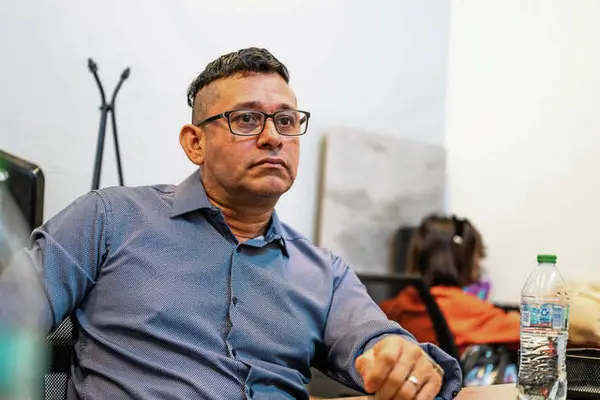
For a time, Jose Flores thought he would never see his family again.
The morning of Jan. 29, Flores was getting ready for work and to drive his 8-year-old daughter, Lily, to school.
“It started like any normal day,” Flores, 47, said through an interpreter as he and his wife, Hariett, spoke with TribLive about being detained by Immigration and Customs Enforcement agents.
As he was clearing the snow from his car with Lily buckled inside, a black Tahoe parked on the street behind him.
At first, Flores didn’t think much of the vehicle. He was expecting their landlord to send someone that day to fix a leak in their ceiling.
“She told us someone was coming to fix the leak,” he said.
Flores said he was approached by two people, a man and woman, dressed in plain clothes. Thinking they were members of a maintenance crew, Flores didn’t hesitate to confirm his identity when they asked if he was Jose Flores.
Flores described the woman as Latin and said she spoke Spanish to ask if he had documentation or papers that indicated he was here legally, or if he was able to work here legally.
“At that point, I knew what was happening,” Flores said.
Flores declined to answer the Immigration and Customs Enforcement agents’ questions multiple times.
The agents told him they were taking him into custody and claimed he entered the country illegally. Flores said they didn’t identify themselves or show him a badge or a warrant before taking him into custody.
“I said OK. I didn’t fight it. I didn’t protest,” Flores said.
He told his daughter to get out of the car, to get her mother and have her call Marc Serrao, the owner of Oakmont Bakery where the couple works.
Flores said he didn’t know if they were going to take his wife, too, or if they were just there for him. He said he wanted people to be there for his family or for his daughter in the event his wife was arrested as well.
In a statement to TribLive, an ICE representative said Flores “was previously arrested by Border Patrol on Oct. 30, 2022, after he illegally entered the United States and was released into the U.S. by the Biden administration. He was placed in removal proceedings and will receive full due process.”
Coming to the States
The Flores family came to America from Nicaragua on Oct. 30, 2022. They were escaping what they described as a corrupt government. Flores had worked in real estate in charge of 12 employees. He was sometimes contracted by the government. Hariett, 38, was in law school and working for the government.
Flores said the couple began noticing abnormal practices the government was starting to impose on the Supreme Electoral Council. Flores said that if they didn’t comply, they were at risk of being arrested under false charges.
Flores met his wife when he spotted her walking past his father’s shop one day. He said he could tell Hariett was someone of strong character and it wasn’t easy to win her over.
“As they say, the more effort that you have to put in, the more you appreciate something,” Flores said.
They began dating in 2016 and married Aug. 10, 2021.
“My life has really changed for the better since I met Jose,” Hariett said. “He gives me the inspiration, the strength, the motivation when I feel incapable of doing something.”
She said her husband reminds her she is intelligent and gives her energy to keep going.
The family originally planned to come to the States in 2021, but Flores contracted covid and lost his father later that year. In 2022, Flores, Hariett, their daughter, Hariett’s sister and her children ended up entering the States through Ciudad Juárez, Mexico, and into El Paso, Texas. The couple made a home in Houston for a bit while Hariett’s sister made a home in Pennsylvania.
Her sister worked for Oakmont Bakery at the time and introduced the Flores family to Serrao. The Floreses came to Oakmont in August 2024. They began working for Serrao in January of 2025.
Hariett previously told TribLive she and Flores each have pending asylum applications and five-year work permits. They also both have Real IDs, valid driver’s licenses and Social Security numbers.
Detainment
After Flores was handcuffed, he was shuttled to an unmarked vehicle by the agents shortly after 10 a.m. He said the agents did not use force when taking him into custody.
Flores was processed in the ICE field office in Pittsburgh’s South Side neighborhood. Agents took his fingerprints and photos and documented what items he had on him.
“I’d never been incarcerated before,” Flores said. “I had no experience with that, so I didn’t really know what it was going to be like.”
They allowed him to call Hariett before transferring him.
By the end of the day, he was transported to Northern Regional Correctional Facility and Jail near Moundsville, W.Va.
“I knew it was going to be difficult,” Flores said. “I just didn’t know how difficult. It all still affects me to this day.”
Flores was one of three people kept in a cell at the correctional facility. He said other cells had up to four people. There were about 26 cells with detainees.
When he entered the facility, Flores was given a small carton of milk. Other detainees told him to keep the empty carton so the cellmates could share water.
Each person was given one hour of free time outside their cell each day. They could use this time to get water, call their families or whatever else they chose to do. When a person was out, they would fill their carton with water and bring it back to the cell to share it. The hour came sporadically each day, he said.
Flores said they could ask for water while in the cell, but the guards would bring one small cup for the cellmates to share.
He said they received three meals a day. The first would come at 4 a.m., the second at 2 p.m. and the third at 4 p.m. They did not eat most of the food, Flores said, as it seemed inedible and not prepared well. The one thing the cellmates saved and shared was a sweet bread they received with meals.
Flores said the situation was so stressful that most of the detainees didn’t eat. He thought he was getting deported and didn’t know if he would see his family again.
“I was worrying, ‘What’s going to happen to me? What’s going to happen to my family?’ ”
He spent eight days in West Virginia before being transferred to Moshannon Valley Processing Center near Philipsburg in Clearfield County.
“For us, it was a relief when they transferred us from West Virginia to Philipsburg,” Flores said. “It was much more humane. It was much more relaxed, a much calmer type of treatment than in West Virginia.”
In Moshannon, Flores said, the detainees were given unlimited access to water. He said medical treatment was available if needed and they were given three hot meals a day.
On the outside
Hariett was given a link to an app that allowed her to contact Flores.
She could make calls to him throughout his detainment. Because his free hour was sporadic and couldn’t be predicted, she was always on alert to receive his phone call.
She said it was hard to keep up daily life during her husband’s arrest. Hariett said she immediately took Lily to her sister’s home and stayed there.
“We didn’t feel safe at home,” she said through the interpreter.
Hariett said Flores’ arrest was especially hard because they came here and tried to do everything by the book and follow all the processes.
“To have this happen, it was absolutely horrible,” she said.
When she was told Flores was going to be transferred, she thought she was never going to see her husband again. As they spoke on the phone, Flores told her to be strong, she said.
“Jose said, ‘You need to be strong. You are my strength. I am strong if you are strong. … I can survive in here from the strength you give me,’ ” Hariett said.
Hariett continued to work while Flores was detained. She said she used the time at work to distract her from the situation. She said she also knew she had a responsibility to pay bills and take care of Lily.
Serrao said he admired Hariett’s strength.
“We have all this opportunity, and so did they,” Serrao said. “And that ended one day, and they came here actually going after the same thing they already had.”
Serrao said the Floreses were given permission to be in the country by the Biden administration.
“It’s so unfair. It almost reminds me of a family where the husband and wife get divorced, and then the kids are stuck in the middle and they’re fighting over them,” Serrao said. “And that’s what these two administrations — one did one thing, one’s doing the opposite, and (the Flores family) are in the center, suffering for something they had nothing to do with.”
Serrao connected Flores’ family with an immigration attorney after his arrest and helped them with legal fees. He was in almost daily contact with Flores’ lawyer, Peter Rogers, and Flores’ family.
Homecoming
On Feb. 7, Flores was told he was going home.
“I couldn’t believe it at first,” he said.
The Moshannon facility runs checks on detainees once a day, checking mental and physical health. On the day he was released, Flores was called for a second check, which was out of the ordinary. When he reported, guards handed him paperwork to sign and told him he was being released later that day.
Even then, he said, he still wasn’t sure if he was going home to his family or being deported until he was on the phone with Serrao and Hariett. Hariett learned Flores was coming home when he called her saying, “My love, they’re releasing me.”
“It was incredible,” Flores said. “It was amazing.”
Serrao picked up Flores later that day.
“I lost my father in 2021,” Flores said. “I had never felt that embrace, that hug, ever again until I hugged Marc and felt that again.”
Flores said he is very grateful for the community and the effort people put in to reunite him with his family.
Hariett said she began to shake and cry tears of joy when she learned her husband was coming home. As Serrao was on his way to pick up Flores, Hariett and Lily were trying their best to get their apartment ready for his arrival.
She said it didn’t quite happen as she had planned because they were both so full of emotion. Serrao’s son picked up dinner for the family, including steak and potatoes — Flores’ favorite meal — to welcome him home.
She said Lily was ecstatic to see her father. She kept yelling, “my dad, my dad,” when Flores came home.
Serrao said Flores was given an ankle bracelet to track his location. The ICE Alternatives to Detention program, known as ISAP (Intensive Supervision Appearance Program), uses GPS ankle monitors to track nondetained immigrants.
According to the ICE web page, the devices require daily charging, monitor real-time location and are used to ensure compliance with court hearings and immigration appointments. The duration varies on a case-by-case basis.
Flores said he was most excited to return to normal when he came home. Serrao told him to take time off, and Flores said he wanted to go back to work the next day. He didn’t want to feel enclosed or trapped.
“Oakmont Bakery doesn’t have employees,” Flores said. “It’s a family. That’s what I needed, to get back to the broader family of mine and get back to normal.”
But the experience of detainment is hard to shake.
He said guards would enter the facility at all hours, bringing detainees or taking them away. Every time they would enter, the lights would turn on.
Now, he has trouble sleeping. If the light changes, or if someone turns a light on, he jolts awake, forgetting where he is for a moment. He said noises wake him up easily as well.
“It makes sleeping very difficult,” he said. “I’m getting through it little by little. I know it’s a process, and we’re just getting through it as best we can.”
Hariett said the family still feels uneasy because they don’t know if it could happen again. Despite the troubles here, she said, they don’t want to return to Nicaragua because it would be worse for them.
She said they came to the U.S. to better their lives and fight for a better future for themselves, but ultimately for a better future for Lily. They want to do everything they can for her to be successful and be whatever she wants to be — which, right now, is a teacher.
“We wanted to create a home where she wouldn’t be kicked out or taken away from,” Hariett said.
The couple continues to recover from the ordeal. They work together each day to heal the mental and emotional wounds from Flores’ detainment.
“It’s difficult, but here we are,” Hariett said.