
The Pittsburgh Penguins’ practice Wednesday in Cranberry was a highly energetic affair.
Coach Dan Muse skated his players fairly hard for a session that lasted approximately an hour and a half.
Even with that demanding pace, those on the ice were upbeat and buoyant as they attended to their tasks, largely oblivious to the outside world (or at least the portions of the planet beyond the confines of the 200-by-85-foot sheet of ice they were skating on).
But half a world away, things became potentially dire for the Penguins.
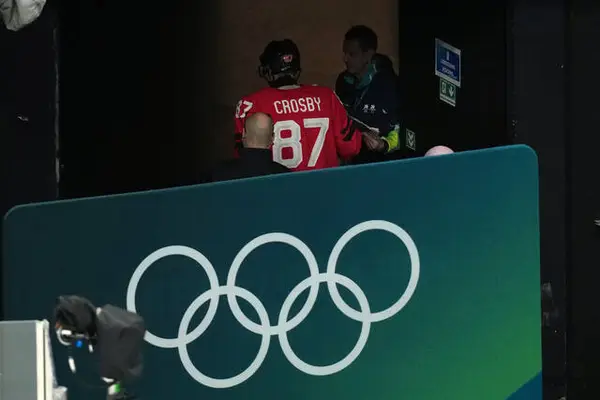
Captain Sidney Crosby — perhaps the most consequential figure in the sport who doesn’t (yet) have a plaque in the Hockey Hall of Fame — suffered an undisclosed injury while skating for Canada in the Olympics being staged in Milan.
Crosby got tangled up near the boards with Czechia defenseman Radko Gudas during the second period and fell to the ice awkwardly.
Videos of the collision were limited, particularly due to the International Olympic Committee’s archaic rules regarding video rights, but Crosby’s right leg appeared to buckle when bracing for contact from Gudas, who initiated the check.
Crosby looked to be laboring after the check. Czechia forward Martin Necas and Gudas then crunched Crosby along the boards.
The 38-year-old Crosby retreated to the bench and was evaluated by a Hockey Canada staffer before heading to the dressing room.
Canada rallied to claim a 4-3 overtime victory in the quarterfinal round contest. Following the win, Canada coach Jon Cooper did not offer a substantive update on Crosby’s status while speaking with reporters in Milan.
ESPN reported Crosby will undergo imaging on the injury.
“Right now, I don’t know,” Cooper told ESPN about Crosby’s status for Friday’s semifinals. “I don’t even have my poker face on either, because I honestly don’t know.”
Cooper added that Crosby’s absence served as motivation.
“(Crosby) couldn’t come out for the third, but he did address the players, and I think that was a big thing coming in,” Cooper told ESPN. “If we lose this game, we didn’t want this to be Sid’s last game at this Olympics. So it was big motivator for the guys coming out.”
Crosby’s mishap unfolded as the Penguins’ non-Olympians practiced. Players and coaches largely found out about their captain’s ordeal as they departed the ice during the second intermission.
Muse was limited in what he could offer as he spoke with reporters in front of a television with the game on.
“First I heard of anything was when I was walking down the hallway here,” Muse said. “You’re always keeping tabs on everything. We’ll see where things are at.”
The NHL has been an on-and-off participant in the Olympics since 1998.
During the 2018 Olympics in PyeongChang, South Korea, the league declined to make players available due in part to a dispute over insurance between the NHL, the IOC and the International Ice Hockey Federation, the sport’s governing body.
That impasse was partially sparked by Canada forward John Tavares — then of the New York Islanders — suffering a season-ending left knee injury during the 2014 Olympics in Sochi, Russia.
A blustery Garth Snow — then the Islanders general manager — called the NHL’s participation in the Olympics a “joke” while speaking with Newsday following that tournament.
“This is probably the biggest reason why NHL players shouldn’t be in the Olympics. It should just be amateurs,” Snow said. “And it could have happened to anyone. It just happened to be us that lost our best player.
“Are the IIHF and IOC going to reimburse our season-ticket holders now? It’s a joke. They want all the benefits from NHL players playing in the Olympics and don’t want to pay when our best player gets hurt.”
The Islanders wound up missing the playoffs that season and were, at the very least, deprived of two games worth of lucrative postseason revenue while Tavares — who carried a salary cap hit of $5.5 million at the time — was sidelined.
The NHL, IOC and IIHF ultimately reached an agreement over insurance and other matters for the 2022 Olympics in Beijing, but a covid-19 outbreak prompted the NHL to pull out of that tournament.
With the considerable exception of the IOC and IIHF banning Russia and Belarus from participating in response to the ongoing invasion of Ukraine, the current Olympics faced no major impediments and NHLers returned to the world’s largest stage for the first time in 12 years.
But debate over NHL players being put at risk was renewed earlier in the tournament when Switzerland forward Kevin Fiala, a member of the Los Angeles Kings, suffered multiple fractures in his left leg, ending his season.
Fiala is the Kings’ second-leading scorer with 40 points (18 goals, 22 assists) in 56 games and carries that team’s second-largest salary cap hit of $7.875 million.
The Kings, who are battling to stay in the playoff picture of the Western Conference, will pursue that endeavor without his services.
The Penguins could potentially be facing a similar scenario with a player who is far more vital to their fortunes as they try to return to the postseason for the first time since 2022.
The tangible benefits the NHL enjoys from the Olympics are uncertain.
Despite making players available who carry salary cap hits potentially worth hundreds of millions of dollars cumulatively, the league doesn’t even have rights to video from the tournament that can be displayed on any digital platforms, such as the NHL’s website or social media.
Does any benefit the NHL gains from participating in the Olympics justify the considerable risk of injury to many of the league’s top players?
Penguins forward Bryan Rust, who was considered for the United States’ team, bluntly rejected the premise of the query.
“You can get injured in practice,” said Rust, a steady linemate with Crosby for several years. “Look at (Florida Panthers forward Aleksander) Barkov, he (is missing) the year because he got injured in practice. (Penguins forward Kevin Hayes) got injured in practice. Things can happen all sorts of places. With the way these practices are now, with how intense they are, guys across the league, somebody might get injured.
“I don’t think guys in this league are too worried about that. The opportunity to represent your country at the highest level, the world stage, I think guys are more than willing to accept that risk.”
In addition to Crosby, Penguins players who are participating in the tournament are Sweden defenseman Erik Karlsson and forward Rickard Rakell, as well as Latvia goaltender Arturs Silovs.
Muse professed his focus is on the opportunity for his players, not the potential risk.
“It’s the Olympics,” Muse said. “Anytime these guys get an opportunity to represent their countries, I’m just happy for them. To play in a tournament like that, to be playing in that setting, that is something I think everybody dreams of. The only thing for me is that I’m excited for those guys getting that opportunity that they’ve earned.
“Excited for them being over there. There’s no other thoughts in my mind other than that.”
Crosby’s status may not be determined for some time. But clearly, his well-being largely dictates the well-being of the Penguins in a variety of ways, on and off the ice.
“He’s the heart and soul of this organization,” Rust said. “He’s obviously a big, big part of this city, this team, this organization.
“Hopefully, it’s something minor and he’ll be fine,” Rust said. “But we’ll see.”
Note: Penguins rookie forward Filip Hallander was deployed to Wilkes-Barre/Scranton of the American Hockey League for a conditioning assignment. Currently designated to injured reserve, Hallander has been sidelined since Nov. 3 because of a blood clot in an unspecified leg.