
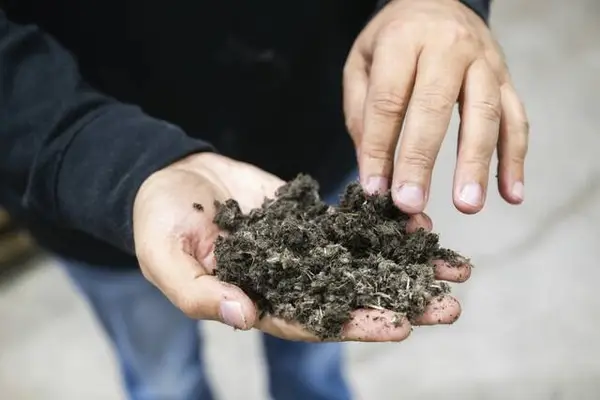
PittMoss says its paper and cardboard-based peat moss alternative can do a lot: reduce waste, cut carbon emissions and, critically, grow plants better than the real thing.
The proprietary mixture of shredded recyclables and organic fertilizers might even be able to “totally transform” the soil of one of the driest countries in the world, according to PittMoss CEO Brian Scott.
The company, which operates out of a humble warehouse in Ambridge, Beaver County, reached an agreement in December with Shumukh Al Ezz Group in the United Arab Emirates to explore using its products to enrich the Middle Eastern country’s loose, sandy soil.
Nothing is final, but the goal is for PittMoss to license its technology to Shumukh Al Ezz Group so the Abu Dhabi-based firm can start its own factory. That would mark the first time PittMoss has been made outside of Southwestern Pennsylvania.
“If we feel it’s helpful in our agriculture, then we can do the manufacturing here, because it’s costly to bring all these things from the United States,” Sheikh Mohammed bin Musallam bin Ham Al Ameri, the billionaire businessman who runs Shumukh Al Ezz Group, told TribLive by phone on Wednesday.
The country’s agricultural sector could use all the help it can get. As a government website puts it, the UAE is characterized by “low rainfall, high temperatures, poor soil and lack of natural waterways.” That makes farming a challenge for the tiny petrostate, whose more than 11 million inhabitants are fed mostly by imports.
Hydroponics, which uses nutrient-rich water to grow plants with little to no soil, has helped the UAE become more self-sufficient. But these setups are effective only for crops with shallow root systems and a high water content, like herbs and leafy greens.
Traditional farms can grow a wider range of produce, but irrigation is a constant struggle. Scott saw these fields firsthand while visiting Abu Dhabi in December to sign the memorandum of understanding with Shumukh Al Ezz Group.
“If the roots extend beyond that splash of water they give it, they basically can’t grow.” he said.
That’s where PittMoss could be a game changer.
Similar to peat moss, PittMoss can help improve water retention in meager soil, allowing for greater agricultural output with fewer resources. A study commissioned by the company shows a 60-40 blend of PittMoss and native soil in Phoenix, Ariz., held water roughly twice as well as the native soil alone.
But unlike peat moss, which grows in cool, moist climates, the UAE will be able to make its own if PittMoss and Shumukh Al Ezz Group further their partnership.
Shark Tank origins
In 2015, Mont Handley, a former national sales director for VisitPittsburgh, went on the ABC television show “Shark Tank” to pitch his alternative for traditional substrates. Three panelists verbally committed to invest a combined $600,000.
Only Mt. Lebanon native Mark Cuban followed through, joining a $1.5 million investment round with other Pittsburgh-area venture capitalists. He’s made two additional investments since.
Cuban declined to comment on PittMoss’ deal with Shumukh Al Ezz Group, citing a lack of involvement. But when he made the original investment, he told TribLive: “It has a chance to disrupt the peat moss industry, have positive environmental impact, make a lot of money. … What’s not to like?”
That early cash infusion allowed PittMoss to tear down its pilot production facility in North Huntingdon and open a proper plant in Ambridge. A year later, Scott took over as CEO, though Handley stayed involved in the operation.
The company has hardly taken off in the years since, but it’s still kicking — more than can be said for many Shark Tank brands. Cuban said in 2022 that about a quarter of his Shark Tank investments are big misses.
PittMoss sells eight products on its website: five growing blends and three types of animal bedding, which are also made with paper and cardboard. At least some of these mixtures are also available online through Amazon and Home Depot.
Dozens of garden centers in the Pittsburgh area carry bags of PittMoss, as well.
While 98% of its sales are in the U.S., the soil additive has also been tested on a small scale in Kuwait, which borders the UAE, as well as in Jamaica.
“We’ve had success with pineapple in droughts that could last four to six months in some cases,” Neil Curtis, founder and executive director of Farm Up Jamaica, said in a testimonial for PittMoss.
The main barrier for PittMoss right now is its production capacity, Scott said.
The setup in Ambridge, which still looks a bit jury-rigged in some spots, can churn out only about a ton of product every two hours. Scott hopes licensing fees from a future plant in the UAE can help fund improvements at the U.S. facility.
Compare PittMoss’ output to that of the peat moss industry in Canada, which supplies most growers in North America. More than 1.1 million tons of the stuff is harvested each year, according to data cited by the Canadian Sphagnum Peat Moss Association.
The peat moss debate
When a peat bog is dug up, it releases carbon trapped within layers of partially decomposed matter. Peat moss grows only about a millimeter a year, making it effectively a nonrenewable resource.
It’s these environmental concerns that inspired Handley to develop PittMoss.
But because Canada’s peat bogs are so vast, the industry downplays sustainability concerns. Over 20 million tons of peat accumulates across the country each year, the Canadian Sphagnum Peat Moss Association says, again pointing to outside data.
The group did not return a request for comment.
In Scott’s mind, PittMoss could make harvesting its naturally occurring competitor pointless.
“The bottom line is our product just works much better than peat moss, and it’s made from recycled products, it’s sustainable, helps save water — a bunch of benefits,” he said.