
Editor’s note: This is Part 1 of a three-part series.
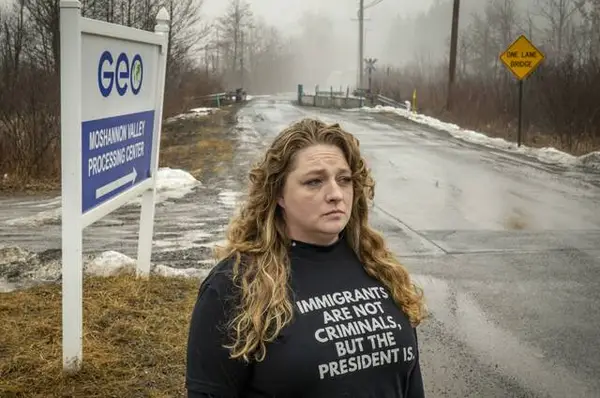
PHILIPSBURG — Atop a wooded ridge in Central Pennsylvania, beyond two-lane highways and dense stretches of forest, rises the largest U.S. Immigration and Customs Enforcement detention facility in the Northeast — the Moshannon Valley Processing Center.
From a distance, it blends into the rolling hills of Clearfield County. Up close, it appears as an imposing presence tucked within sight of small businesses and modest homes.
The sprawling complex is owned and operated by The Geo Group, one of the nation’s largest for-profit prison operators.
Yet despite its scale and proximity to everyday life, much of what happens inside Moshannon Valley remains mysterious. For many nearby residents, the facility is little more than a name on a highway sign that doesn’t interfere with daily life. For others, it is a source of unease — raising questions about who is being held there, under what conditions and with how much oversight.
The Geo Group reopened Moshannon Valley as an ICE detention center in 2021 via an agreement between ICE and Clearfield County, approved by the board of commissioners there. Moshannon Valley initially opened in 2005 as a Federal Bureau of Prisons facility until it closed briefly during the 2021 transition.
Immigrants rights advocates have called for the closure of Moshannon Valley Processing Center — in the wake of a scathing report published in September 2024 by the Sheller Center for Social Justice at Temple University Beasley School of Law, titled “In the Shadow of the Valley.” The report details allegations of inhumane conditions at the ICE facility.
Leonard Oddo, warden at Moshannon Valley Processing Center since 2018, scoffed at the report. Oddo works for the prison operator.
“I’m in charge of the safety and security and oversight of the detainees and staff, who are detained at this detention facility,” he told TribLive on Thursday. “We have a very well-trained professional staff that exhibit dedication integrity responsibility, ethical conduct and pride in their daily lives, and the detainees that are here at our facility are taken care of.”
Moshannon Valley has been averaging 1,650 detainees, with a 50-day average stay, according to Oddo. The facility has never housed over 1,800 detainees at one time. Its capacity is 1,876.
The facility currently has 417 full-time Geo employees and 27 full-time ICE employees on staff.
ICE did not return TribLive’s request for comment regarding alleged inhumane treatment at Moshannon Valley.
TribLive also requested a media tour of the Moshannon Valley Processing Center, to which Oddo said he would agree. However, ICE has not granted the request as of Friday.
“Any denied access would’ve come from ICE,” Oddo said. “If ICE approves the visit, then I’m the one who would facilitate it, along with ICE leadership.”
‘In our backyard’
Bobbi Erickson is co-founder of Indivisible: Mayday, named after the underground resistance group in Margaret Atwood’s novel “The Handmaid’s Tale.”
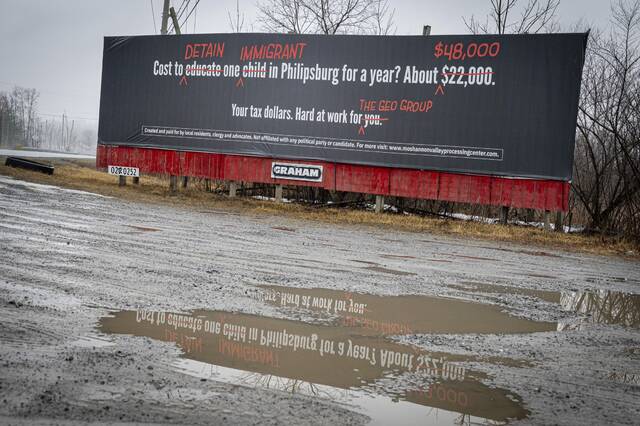
The activist group, which is a local arm of the Indivisible nationwide anti-ICE organizing movement, alongside the Shut Down Detention Campaign and Pennsylvania Women for Democracy, funds an anti-ICE billboard — located just behind the Moshannon Valley Processing Center’s entrance sign.
The billboard says it was created and paid for by local residents, clergy and advocates.
Erickson, 35, of Brockway, said she and other local activists regularly call for the shutdown of Moshannon Valley Processing Center and have protested around four or five times outside of the facility.
“I think it’s important people in Pittsburgh know a lot of people locally — the majority — don’t want this facility here,” she told TribLive of her concerns with Moshannon Valley. “We don’t want to be stealing and kidnapping your neighbors; we don’t want them held here. We think they should be home with their families.”
Erickson said that whenever she has protested near the facility or been in the area, she has encountered families leaving in tears after being denied access to visit detained loved ones.
“There are people in this facility being treated not as humans — lack of access to medical care is what we hear a lot, lack of access to legal representation — the allegations are a mile long, and they’re not just this facility,” she said. “It’s for-profit; it’s a private prison, which means they’re going to cut every corner they can in order to turn a profit, which means human beings aren’t being treated well — for profit.”
For Chuck Campbell, the Moshannon Valley Processing Center is quite literally in his backyard. Though he can’t see much, he can hear detainees participating in recreational activities outside.
“I haven’t had no trouble, besides noise,” he said.
Campbell, 60, of Decatur Township, lives about a half-mile from Moshannon Valley. He says he regularly sees employees coming and going. From his vantage point, though, there isn’t much to see — just stretches of fencing topped with barbed wire.
It wasn’t until a couple of weeks ago that he realized the facility was operating as an ICE detention center. He said he had no idea the prison had partnered with federal immigration authorities.
“I don’t give a (expletive) as long as they’re leaving me alone,” he said of Moshannon Valley’s operations.
Rich Harvey has been a lifetime resident of Philipsburg, and he works as the cook manager at Sarina’s Pizza & Restaurant — about 2 miles away from the ICE facility in Decatur.
He said he has “no issues” with Moshannon Valley.
“To me, it’s not harming the area,” said Harvey, 46. “The only thing I think is harming the area is when they have the protests.”
At Sarina’s, he said, Moshannon Valley workers order food “all the time,” and sometimes they order in bulk.
“We get a lot of the workers … people do a lot of talking,” Harvey said of Sarina’s patrons. “To me, it has nothing to do with me; they create a lot of jobs.”
Growing up locally, he said he used to go out to the land behind the prison, as there’s popular places “to go mudding up there.”
“I haven’t heard anything negative … I haven’t heard or seen anything bad about it,” Harvey said. “To me, I’m old school. We all do what we have to do to be here in America.”
Another business near Moshannon Valley is the Best Travel Inn Philipsburg, a motel that’s about a mile away.
Bob Roy, who works at the front desk of the motel owned by his father, said he has seen many families spend the night there while visiting loved ones held at the detention facility.
“Personally, I haven’t seen anything recently or anytime soon as ICE activity — it’s pretty much quiet,” said Roy, 24, of Philipsburg. “Sometimes, there have been sirens going on, police coming down at night on the road.”
Most recently, he recalled a 2023 incident where an inmate briefly escaped Moshannon Valley, and “there was a siren going on with the escape.”
“There was road blockage all over the place,” Roy said. “I was going down to the Walmart; there was pretty much a checkpoint where they checked the cars to see if the guy who escaped (was there).”
When his car was searched at that checkpoint, he was asked to provide his ID.
Roy said police officers have stopped by the Best Travel Inn to inquire about who has stayed overnight at the motel — but he doesn’t recall them being ICE agents.
Erickson said she believes people in the local community who aren’t mad about Moshannon Valley just haven’t been personally affected.
“ICE is not kidnapping our neighbors — (they’re) kidnapping people from Pittsburgh, Philadelphia, New Jersey,” she said. “You’re not hearing from locals because they’re not impacted by this facility.
“Of course we feel impacted by this; this is our backyard. None of what is happening here is what this community stands for.”
Erickson added that she’s sometimes told by a “very small minority of community members” that if the prison closes, then the detainees can come stay at her house.
“Guess what? You are publicly admitting that you don’t view the people here as human beings,” she said. “They have homes — they have family that want them home with their children and their wives and their husbands because there are women kept here as well.
“They need to go home. They are awaiting their immigration hearings; they can do that at home.”
‘Significant impact’
Moshannon Valley Processing Center is the biggest economic driver in Central Pennsylvania, aside from Penn State University, according to local officials.
Oddo said Moshannon Valley generates an economic impact of about $33 million to the Clearfield County area — including $711,000 in taxes paid to local government and the Philipsburg-Osceola Area School District as of 2025.
Moshannon Valley is the largest single taxpayer in the Philipsburg-Osceola School District, according to Tim Winters, chairman of the Clearfield County Board of Commissioners.
As mayor of Philipsburg for 20 years, John Streno said he supports the operations at Moshannon Valley Processing Center.
Out of the over 400 Geo employees at the prison, he estimated that around 300 hail from Philipsburg.
Streno, 76, of Philipsburg, worked for Geo at Moshannon Valley as a corrections officer for 10 years during his mayoral tenure. This was before the ICE contract began in 2021.
“No matter how much you could hate law enforcement, there’s a lot of good people there, and they try their best to help the people that they truly believe should be helped,” he said. “Not everybody up there is a terrible person, inmate wise and even (corrections officer)-wise.
“They’re not all perfect either, but they’re just people. And when you treat people as people, as long as you’re obeying the rules and the laws that are set down, everybody gets along. So, it’s a necessary evil … that we have to lock people up.”
Now, Streno said, he comes to the Moshannon Valley at least once per month to officiate weddings for the past 10 years.
“When I actually watch the people come in to be married, and watch the other inmates that are in visitation watching the wedding, they’re all in pretty good moods,” he said. “Things like that show that they’re still humans — they still have feelings.”
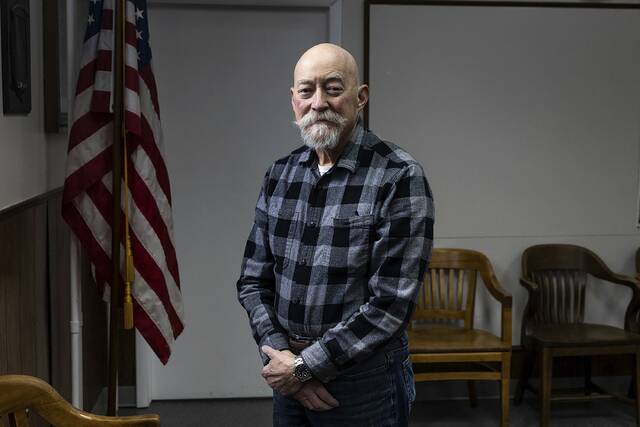
Moshannon Valley Processing Center “has never been a negative” for the local Philipsburg community, Streno said.
“The jobs are very important to my community,” he said. “I’m glad the place is there. I believe what they’re doing is very legitimate, very honest and necessary.
“I am proud of the fact that I worked there..”
In addition to employing people in Clearfield County, the Moshannon Valley facility pulls in staff from about an hour radius, including Centre County, he said, emphasizing the facility’s “significant impact” in Central Pennsylvania.
State Rep. Scott Conklin, a Democrat from Centre County, was a Centre County Commissioner at the time Moshannon Valley was initially built in the 2000s. He said its construction was backed by many local officials, but there was “a lot of back and forth,” as it was the first private prison built in Pennsylvania.
“What’s really difficult for many people who aren’t in politics is to understand exactly the difference between this facility and a state institution or a county institution. This is a private facility, and it always has been so,” he said. “It’s a private company (whose) contracts deal with the federal government to house those individuals who have been detained by ICE, and that’s where the controversy comes in.”
There are no state or county inmates housed at Moshannon Valley, Conklin said. As an elected official — both now and when the facility first opened — he said he has “never had a say in the facility.”
People picked up by ICE since the second half of 2025 have had “no due process,” according to Conklin, which he said is illegal.
“They were basically picked up and expelled, which isn’t what the law says, but because Congress will not step in and do their part and take control of what they should be overseeing, it’s happening,” he said. “So it’s caused individuals who care about humanity to want this all to stop.”
Conklin said there are solid arguments on both sides of the immigration issue.
He said he believes undocumented immigrants should pursue legal status and follow the law. At the same time, he acknowledged that those protesting Moshannon Valley have “good cause,” arguing that detainees have not been afforded due process.
“Obama deported a million more than what the present president has done, but Obama used due process,” he said. “He did it without masks, without locking up children, without terrorizing neighborhoods.”
ICE agents “who are not trained to be out there” are detaining people unlawfully, Conklin said.
“They aren’t trained like your local police or your state police or your sheriff’s department. They don’t have that training,” he said. “So, you’re seeing individuals being picked up off the street who are American citizens. You’re seeing individuals who (are) young children are being picked up. You’re seeing individuals who have not committed crimes being picked up, and they’re being picked up with masked individuals who are not identifying themselves. And that is what’s causing the problem.”
People who become ICE agents get a maximum $50,000 sign-on bonus over five years, and if they leave employment early, that bonus has to be paid back before taxes, according to Conklin.
“Every law enforcement knows, even folks like myself who are elected office, knows de-escalation is the first thing. … When you look at these individuals who are doing escalation — intimidation — and that doesn’t work. It does not work psychologically on people.”
He said Moshannon Valley employs a lot of his friends, but there have been problems there, and it’s “very tight-lipped” in terms of access.
“This facility is a privately run operation with federal contracts, and the individuals, the way they’ve been doing the work over the last year, has not been, quite bluntly, within the constitutional restraints,” Conklin said. “It’s causing absolute chaos in the streets.
“When you’re watching something with your own eyes — what’s happening in our country — and they’re telling you it’s not happening, that causes distrust.”
Because the facility runs on federal taxpayer money funneled from the government through Clearfield County to The Geo Group, Conklin believes the public “has a right to know what’s going on” inside Moshannon Valley, as well as members of the media.
“These are still public dollars,” he said. “If they were smart, they would open that facility up and allow you to see what’s going on, because as long as they keep it hidden, there is going to continue to be mistrust.”
As someone who was on the Centre County prison board for seven years, Conklin said he has “never believed in incarceration for profit.
“I am not against anybody that’s working there. They’re my friends. They have a job,” he said, but “it’s almost like a secret-run organization up there, which it is. And most people do not realize the amount of individuals who are being housed there,” which is concerning to him.
“They’re making better money than they’ve ever had, and that’s their employment,” he said. “I see both sides. … Do I like the way ICE is doing business? Absolutely not. I believe they need to be better trained. I think they need unmasked. I think they need to run it just like any law enforcement there is, and be open and transparent.”
But coupled with due process issues and Moshannon Valley’s status as a private prison, Conklin said no one is able to know what’s going on inside. “If there’s nothing going on there,” everyone should have a right to know its operational details.
“There is no sunlight on this,” he said.
Gov. Josh Shapiro’s administration told TribLive in a statement Friday that the commonwealth has “no general authority to oversee operations at a federal facility” like Moshannon Valley Processing Center, which reopened prior to Shapiro’s term in office.
“The Trump administration is indiscriminately stopping and detaining record numbers of people, including children, based on the flimsiest of justifications and without any legal basis,” the administration said.
The Shapiro administration said it’s “very concerned” about the reporting of “repeated violations of detainees’ constitutional rights at the Moshannon Valley Processing Center.”
According to the U.S. Department of Homeland Security, members of Congress must submit requests at least seven days ahead of visiting Moshannon Valley. Family visit requests must also be made at least seven days in advance.
These rules are in accordance with updated DHS guidance released at the beginning of January, “following significant and sometimes violent incidents at ICE facilities.”
Erickson, the Indivisible Mayday co-founder, said she’s concerned with the advance notice timeline.
“Why do you need a week to clean everything up?” she said. “I have a teenager at home. If I told her I’m going to go check her room or she’s grounded if it’s dirty, I wouldn’t tell her, ‘Yeah, in seven days I’ll come check.’ ”
Rural Pennsylvania is absolutely impacted by Moshannon Valley Processing Center, Erickson said.
“There are people in here who need your help and people calling for you to do so,” she said, calling on lawmakers across Pennsylvania. “This is a draw on the community that shouldn’t exist.
“One day, history will uncover what took place here.”