
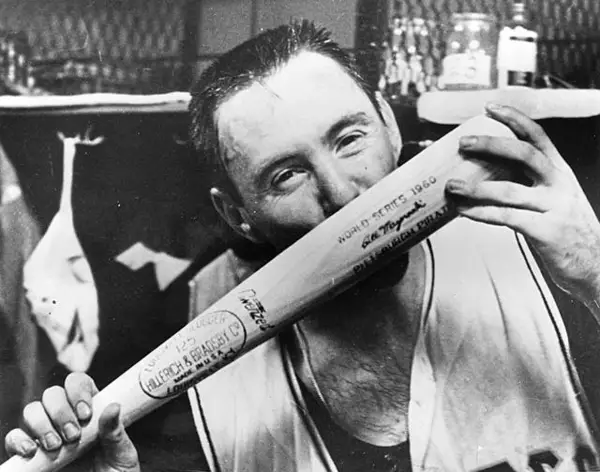
Bill Mazeroski, the Pirates second baseman whose one swing of the bat nearly overshadowed his reputation as a wizard with the glove, died Friday. He was 89.
The Pirates announced his death Saturday morning.
It is with a heavy heart that we relay the news of the passing of legendary Pirates and National Baseball Hall of Famer, Bill Mazeroski.
Maz was a 7-time All-Star who hit the greatest home run in baseball history. He was a beloved member of the Pirates family and he will be… pic.twitter.com/515ZhPgqxe— Pittsburgh Pirates (@Pirates) February 21, 2026
A seven-time All-Star, Mazeroski had more than 2,000 hits in 17 big-league seasons, all with the Pirates, from 1956-72. He played on two championship teams.
He also won eight Gold Gloves. Defense defined Mazeroski’s career and punched his ticket to the Baseball Hall of Fame. Which made it wholly ironic when his magic moment arrived Oct. 13, 1960, in Game 7 of the World Series against the powerful and heavily favored New York Yankees.
Leading off the bottom of the ninth inning at Forbes Field in a 9-9 game, the 24-year-old Mazeroski launched Ralph Terry’s second pitch, a high fastball, into the warm, fall afternoon and over the red, brick wall in left field to win the game and the Series. The home run touched off pandemonium on the field (Mazeroski was engulfed by fans) and a delirious, all-night celebration the New York Times described as “sweeping through the city like a vast conflagration.”
Hall of Fame 2B Bill Mazeroski reminisces about his Game 7 walk-off home run to win the 1960 World Series before throwing out the ceremonial first pitch at the Pirates-Yankees game at PNC Park. pic.twitter.com/bXfJWko7io
— Kevin Gorman (@KevinGormanPGH) July 5, 2022
“Maz was one of a kind — a true Pirates legend, a National Baseball Hall of Famer and one of the finest defensive second basemen the game has ever seen,” Pirates chairman Bob Nutting said in a statement. “His name will always be tied to the biggest home run in baseball history and the 1960 World Series championship, but I will remember him most for the person he was: humble, gracious and proud to be a Pirate.”
The 10-9 victory clinched the Pirates’ first championship since 1925. It was a significant upset in baseball history and the most dramatic Series finish ever. Every Oct. 13 since 1985, fans and nostalgia buffs have gathered at the old Forbes Field site in Oakland to listen to a broadcast of the game. The 50th anniversary celebration in 2010 attracted several former Pirates, including Mazeroski, and more than 1,000 fans.
Never before or since has a World Series ended with a Game 7 home run, and the baseball world, especially the Yankees and their legion of fans, was shocked. During a screening of the game 50 years later, Yankees second baseman Bobby Richardson, the only Series Most Valuable Player to come from a losing team, recalled, “All of a sudden it was over, and we were out of it.”
Pirates manager Don Kelly shares his sincere condolences on the passing of Bill Mazeroski, calling the Hall of Fame second baseman and 1960 World Series hero “an icon” and “one of the most humble men you’d ever meet.” pic.twitter.com/qBrXTJlYFi
— Kevin Gorman (@KevinGormanPGH) February 21, 2026
“What an icon. What a guy for the Pirates, the City of Pittsburgh, for Major League Baseball and what he meant overall and what he meant to a lot of people,” Pirates manager Don Kelly said Saturday morning at LECOM Park in Bradenton, Fla. “I know (for) the men and women here that new him, extremely special. And that’s not even mentioning 10-time All-Star, eight-time Gold Glove, two-time World Series champion, biggest home run in World Series history and probably one of the most humble men you’d ever meet.”
Mazeroski hit 158 career home runs, a respectable total for a second baseman. But in a World Series populated by Roberto Clemente and other Pirates with long-ball prowess, and the Bronx Bombers in their heyday, Mazeroski provided an unexpected power source.
Years later, Pirates pitcher Bob Friend would describe the home run as “a life-changer for all of us.” Mazeroski, the humble and unpretentious coal miner’s son, put it differently. “I just thought it was another home run to win a ballgame and would never last 40 years,” he told a reporter in 2000.
No one else saw it that way. Friend was right, especially in Mazeroski’s case. His life never was the same. From the moment of contact until his death, the home run provided a vast source of interest and conversation. Forty years? For more than a half-century, Mazeroski gratefully but reluctantly accepted the accolades.
“I didn’t expect that much attention, just hitting a home run to win a game,” he said. “I don’t know. I just kind of wish maybe somebody else had hit it, or explained it better than I did. I just never came up with a good way.”
However, he conceded, “I felt great, I know that. No better feeling.”
The home run was sweet vindication for Mazeroski, who suffered through a poor 1959 season along with several teammates and took his share of the blame for the club finishing fourth. But it was Mazeroski’s steady, fundamentally pure defense that formed his larger body of work.
Respected statistician and historian Bill James labeled Mazeroski “the most effective defensive second baseman ever.” Mazeroski’s most notable skill was turning the double play. Naming Mazeroski the best glove man at his position, Sports Illustrated called him “the undisputed master of the pivot.” Teammates nicknamed him “No Touch” because he got rid of the ball so quickly.
“Nobody ever played second base like he did,” said Mazeroski’s longtime double-play partner, the late Dick Groat. “Most people didn’t realize he had great feet. Everybody talks about his hands, and that’s a fact, but his feet were so quick. And he was strong. The first thing the coach says when you get to first base is, ‘Break up the double play,’ but I never saw Maz go down.”
“And I can never ever remember Maz, when the ball was hit to him, giving me a ball at second base where I was gonna get killed or banged up by the baserunner,” Groat said. “He consistently gave me the ball where I could get rid of it.”
Remembering a true legend. A proud member of the Pirates family and Pittsburgh community, a Hall of Famer, and above all, a great man. pic.twitter.com/NpQWzCPdqw
— Pittsburgh Pirates (@Pirates) February 21, 2026
William Stanley Mazeroski was born Sept. 5, 1936, in Wheeling, W.Va., the son of Lew and Mayme Mazeroski. He had a sister, Mary Lou, who was two years older. His family lived in a one-room house in Little Rush Run, Ohio, but the nearest hospital was just across the West Virginia border.
Lew Mazeroski worked as a coal miner but was an excellent ballplayer as a youth. He harbored dreams of a professional career until losing part of his foot in a mining accident. He was 18.
Bill Mazeroski’s father taught him the finer points of the game, but their relationship was mostly contentious. In a book in which famous athletes described overcoming childhood problems, Mazeroski wrote of his father’s heavy drinking and foul temper. In one passage he described his father as a “bitter” man who frequently came home drunk late at night and once waved a gun “threatening to shoot everybody.” Eventually, Lew Mazeroski moved out, returning every two weeks or so before leaving again. “When he was gone, we lived on the 10 bucks a week he gave us,” his son wrote.
Known as “Catfish” because of the copious amount of fish he caught in the Ohio River to feed his family, Mazeroski survived the problems at home thanks largely to sports.
By age 13, he was playing with men in a semipro league. After moving several times, he starred in baseball and basketball at Warren Consolidated High School in Tiltonsville, Ohio, signing with the Pirates for $4,000 in 1954 at age 17. It took just two years to reach the big leagues.
In addition to the World Series home run, Mazeroski was known for another play of note, hitting into a game-ending triple play against the New York Mets. But it wasn’t real. The event was staged as part of the movie “The Odd Couple,” starring Walter Matthau and Jack Lemmon. Extending the fiction, Mazeroski, who earned $100 for his work, was “pinch-hitting” in the film for Clemente. The Pirates’ outfield star was asked to do the scene but declined, explaining that he wouldn’t even hit into a double play for a hundred bucks.
Picked for the Hall of Fame by the Veterans Committee, Mazeroski, also a member of the Pirates’ 1971 championship team, had a long wait for his induction in 2001. Then he gave the shortest speech on record, tearfully choking up and pocketing his intended 12-page address after 2½ minutes.
“The author of one of the game’s most indelible moments, Bill Mazeroski will be remembered as one of baseball’s most respected figures — both for his character and for his brilliance on the field as one of the game’s best second basemen,” said Jane Forbes Clark, chairman of the Baseball Hall of Fame. “Maz remained humble about his career, even as he was celebrated in Cooperstown. On behalf of his Hall of Fame family, we send our deepest sympathies to his loved ones and to Pirates fans everywhere.”
His humility again was tested in 2010 when the Pirates erected a 14-foot bronze statue outside PNC Park, depicting Mazeroski — not turning a double play or making any other fielding gem — rounding second base and waving his helmet after his famous home run.
Asked what it was like to have a statue created in his likeness, Mazeroski, who still donned the uniform in his later years and worked with young Pirates players, replied, “I’d rather strike out with the bases loaded.” Still, he seemed to enjoy the celebration attended by his friends, fans, former teammates and family members.
“I’m overwhelmed,” he said that day. “I can’t believe this could happen to me, a little guy from a coal town on the Ohio River. Geez, who could have ever dreamed of something like this?”
He was later inducted as an inaugural member of the Pirates Hall of Fame class in 2022.
Mazeroski is survived by his two sons, Darren and David and his four grandchildren. Darren is a member of the Pirates’ scouting department, serving as an area supervisor.
“I feel fortunate to have spent time with Maz over the years. Welcoming him and his family back to Pittsburgh as part of the inaugural Pirates Hall of Fame class in 2022 was a special moment for all of us,” Nutting said.
“Our hearts are with his sons, Darren and David and the entire Mazeroski family. Maz was a great man who will be deeply missed.”
Mazeroski continued to visit the Pirates in spring training and for World Series reunions into his mid-80s, and Pirates outfielder Bryan Reynolds has fond memories of interacting with the Hall of Famer who has “the most iconic home run of all time.”
“It’s sad,” Reynolds told TribLive. “He’s an icon for baseball, an icon for his family. He leaves behind a great legacy. He did something that every kid who’s ever played baseball has dreamed about. The home run will live on and so will him with the Pirates.”