
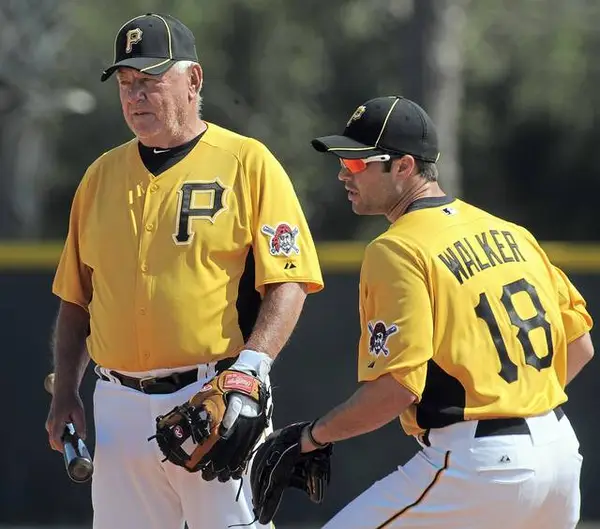
Former Pittsburgh Pirate Neil Walker was about 8 or 9 years old. He remembers the words of advice from his father.
“Make sure you ask him for an autograph. You tuck that away. You are going to want it when you are older,” Tom Walker told his son.
Walker was at a Pirates’ alumni event with his dad, who was a former MLB pitcher. Walker wanted his son to appreciate the importance of who he was about to meet.
Bill Mazeroski.
The only man to end a World Series Game 7 with a home run. The man who vanquished the mighty New York Yankees to win the 1960 title for the underdog Pirates. One of the best fielding second basemen of all time. A player who would eventually wind up in the Hall of Fame.
The irony is that Mazeroski never saw himself that way. Not as he was rounding third base after his homer cleared the wall at Forbes Field. Not for the ensuing six decades he held hero status in Pittsburgh, all the way up until news of his death at 89 was announced by the Pirates on Saturday morning.
Mazeroski never positioned himself as the Western Pa. civic icon that he was made out to be for the past 66 years. Nor did he wallow in the importance of that legendary moment on Oct. 13, 1960.
“When I hit that home run, all I could think of is that I was so excited that we beat the Yankees,” Mazeroski told me in 2022. “But I figured in a year or two, it’d all be forgotten, and nobody will remember that — like it was a regular game or something. But the fans kept it up. Everybody kept talking about it. It got bigger and bigger and bigger.”
As Walker got older and his youth baseball career in Pittsburgh began to ascend, he grasped the importance of the person he met that day. His mother grew up in West View. She told him stories of being outside of Forbes Field celebrating after Maz’s homer.
“As a teenager. You hear stories. You see some stuff. You see how Pirates fans react when they would meet Bill,” Walker said Saturday morning. “That stuck with me. I was in eighth, or ninth or 10th grade. You say, ‘Oh my gosh, look at what this guy accomplished.’”
As Walker would go on to say, “fast forward to spring training of 2009 and 2010.” Walker had been selected by his hometown team in the first round of the 2004 draft after a standout WPIAL career at Pine-Richland. He was converted from a catcher to a third baseman and now a second baseman. Mazeroski was on board with the Pirates in Bradenton as an infield instructor and took Walker under his wing.
“I badly needed somebody to help me at second base because I never played the position,” Walker said. “His wealth of knowledge and his willingness were integral to me becoming a Major League second baseman.”
More on Maz
• Bill Mazeroski, former Pirates World Series legend, dies at 89
• Remembering Maz: Pirates legend, Pittsburgh hero — a photo gallery
• Reliving Bill Mazeroski’s iconic home run in the 1960 World Series
Walker vividly remembers how those days in Florida would go. Arriving at 6:30 in the morning to see Mazeroski and fellow Pirates legend Kent Tekulve behind the facility with cigars, welcoming the players to the field. The hours spent on footwork around the bag, learning how to use the (then still allowed) “neighborhood play” to his advantage. How to catch throws in the palm of your glove to get them out quickly in an effort to turn double plays.
“He still had the hands (in his early 70s). He had the footwork, which was incredible,” Walker laughed. “The stuff that he was teaching me was really important. The double-play turns and feeds. All those things stood the test of time.”
It was a friendship that would last all the way through Walker’s playing career and now into his role as a broadcaster with the team. But it wasn’t only fielding nuance that Walker learned from Mazeroski.
“You understood not only did they care about helping, but they understood the assignment from a perspective about passing the torch, wanting the best for the organization and for the city,” Walker said of Mazeroski and other Pirates alumni. “I certainly feel the same way. Getting to know people like Maz has helped me even more now that my career is done.”
As Walker’s father foretold, his son is 40 years old now. He is a father himself, and in the middle of a move. His family was starting to get things organized and packed up at the house before he went down to spring training. That autograph he got as a child from Mazeroski will be making the move with him.
“It’s always front and center in a room where I have some of my most favorite autographs,” Walker said. “I’ll never get rid of that.”
And Pittsburgh will never let go of Maz.