
Editor’s note: This is Part 2 of a three-part series.
PHILIPSBURG — When detainees first step into a U.S. Immigration and Customs Enforcement detention center facility in Clearfield County, their risk level is quickly determined — and it shows in the color of their jumpsuit. Red marks those classified as high risk, yellow signals medium-high and blue identifies low-risk individuals, said Warden Leonard Oddo.
“The blue is housed all in separate units, and highs are housed with medium highs,” Oddo said. “They’re never housed together — we never house lows with highs.”
Clearfield County Commissioner Dave Glass, who has toured the facility, said the blue jumpsuits are for people with no criminal background, the yellow for some criminal background and the red for those with “very serious” criminal backgrounds.
“There were just way too many of the blues, in my opinion,” he told TribLive. A breakdown of inmate categorizations was not available last week.
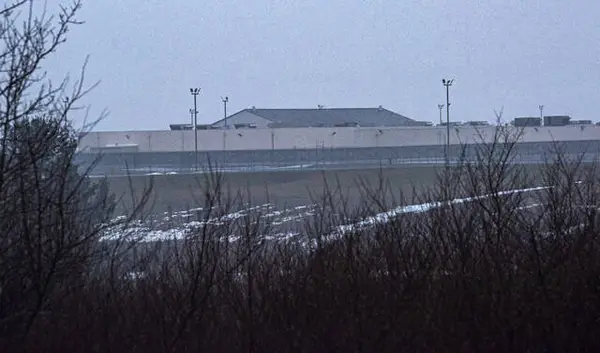
About 130 miles from Pittsburgh, the Moshannon Valley Processing Center has operated as an ICE detention facility since 2021.
It’s the largest ICE facility in the Northeast.
Related article
• Part 1: Clearfield County ICE detention center steeped in secrecy, drives local economy
Detainees are placed in one of four housing units once they’re processed. Each housing unit has six “pods.”
The pods can hold up to 70 or 72 detainees, according to Oddo. He said numbers at the ICE facility have kept each pod at 55 to 60 detainees.
“It’s always been open-bay pods, never cells. We did not change the physical design structure,” Oddo said of the transition to ICE operation in 2021. “(In the) open-bay pods, they have access to televisions in the pods, the tablets, telephones 24 hours a day, recreation equipment, pretty much full access, showers and bathroom facilities.”
Oddo, who lives in central Pennsylvania, said he is employed by The Geo Group, not by ICE. The facility has 417 full-time Geo employees and 27 full-time ICE employees on staff.
The Geo employees include medical staff, mental health workers, detention officers, case managers, recreation staff, administrative staff, business staff and food service staff, he said.
The Geo Group is a for-profit, private prison corporation based out of Florida. It operates 97 secure facilities, processing centers and community reentry centers encompassing about 74,000 beds. The company is publicly traded (GEO) and is ICE’s largest contractor, according to the Brennan Center for Justice at New York University School of Law.
The Geo Group had initially opened Moshannon Valley in 2005 as a Federal Bureau of Prisons facility. It became an ICE detention center in 2021.
Part 1
• Moshannon mystery: Clearfield County ICE detention center steeped in secrecy, drives local economy
Operating amid controversy
Local and national immigrants rights advocates have consistently called for the closure of Moshannon Valley.
A September 2024 report by the Sheller Center for Social Justice at the Temple University Beasley School of Law alleged there have been inhumane conditions at the ICE facility
Titled “In the Shadow of the Valley: The Unnecessary Confinement and Dehumanizing Conditions of People in Immigration Detention at Moshannon Valley Processing Center,” the report includes over 70 in-person and phone interviews of detainees at Moshannon in the spring and summer of 2023.
Of the 77 immigrants interviewed, 58% expressed medical and mental health care issues, 50% reported instances of general mistreatment by facility staff, 31% were subject to racial or derogatory slurs, 10% felt threatened by the possibility of being transferred to an out-of-state facility and 6% were victims of physical force, according to the publicly available report.
The Pennsylvania Institutional Law Project last October filed a formal complaint under the Prison Rape Elimination Act against Moshannon Valley, alleging that a woman detained since November 2024 has been subjected to sexual abuse.
On Dec. 14, Fouad Saeed Abdulkadir, 46, from Eritrea, died in ICE custody at Moshannon Valley. He was pronounced dead “after experiencing medical distress,” according to the ICE Detainee Death Notification publicized after the incident.
Oddo denied all negative claims in the Temple report.
Despite the report’s criticisms regarding health care, Oddo, representing The Geo Group, said detainees have around-the-clock access to medical, dental and mental health services.
“My philosophy is, every human being deserves to be treated with dignity and cared for, and I believe that we have a well-trained, diverse staff,” he said. “They’re committed and dedicated; they’re professional.
“We’ve had no complaints. … I take my job seriously.”
A closer look
Located at 555 Geo Drive in Decatur Township, Moshannon Valley has a detainee capacity of 1,876. Its client is listed as “Clearfield County/U.S. Immigration and Customs Enforcement,” according to The Geo Group’s website.
Moshannon Valley has been averaging 1,650 detainees, with a 50-day average stay, according to Oddo. These are 90-day averages, he said, and the facility has never housed more than 1,800 detainees at one time.
“We’ve never been at full capacity,” he said. “We’ve never had overcrowding here — no one sleeping on the floor … or on cots.”
Glass, the county commissioner, said he got a look at what detainees were served inside the facility: a plastic tray holding spaghetti, a portion of corn and a single piece of bread.
“It wasn’t gourmet, but it looked edible,” he said. “I didn’t eat one.”
The kits for the detainees included a toothbrush, pillow and “other essential toiletries like little soaps,” according to Glass.
“We saw the kits they get, we saw the visitation area. I understand that there’s questions about the visitation times. You know, Geo swears it’s not an issue. Other people say that they’re having trouble being able to see them.”
As for the pods, he said there are no individual rooms for detainees aside from the solitary area.
The women’s unit is separate from the men’s, he said.
“There’s a communal area with tables where they can eat, and TVs lining all around, when you can put different shows on,” Glass said. “There’s a few phones around. There’s a couple private booths in there where you can talk to your attorneys.”
There were also five or six showers with curtains and a bank of toilets in each pod, he said. The beds are set up in bunk bed style, according to Glass.
Oddo said detainees have access to ICE-funded Talton Tablets, which allow them to video chat with family members and research case law.
Annually, Oddo said, Moshannon Valley generates an economic impact of about $33 million to the Clearfield County area — including $711,000 in taxes paid to local government and the Philipsburg-Osceola Area School District as of 2025.
“It has a pretty significant economic impact on the local area when we opened back up in 2021,” he said, citing the housing market, grocery stores and local small businesses.
The school district did not return TribLive’s request for comment on the facility’s operations and taxpayer impact.
Moshannon Valley’s facility has provided $18,000 in student scholarships, the website says. This is “an annual donation to local scholarships,” Christopher Ferreira, director of corporate relations for The Geo Group, told TribLive.
The website also denotes two accreditations for Moshannon Valley: the American Correctional Association and the National Commission on Correctional Health Care.
Oddo said the ACA reaccreditation just came back in, with “full compliance” with all standards and “very high marks.”
“We are very active in the community,” he said. “I’ve represented Geo Group for a number of years here, and we provide nothing but quality, diversified services.”
As a “secure immigration processing center,” Moshannon Valley’s “primary contractual responsibility is to provide support services to the Department of Homeland Security, Immigration and Customs Enforcement on behalf of Clearfield County.”
“It is the mission of the Moshannon Valley Processing Center to provide the highest level of service to our client; our primary objective being to ensure the safety of the community, staff and those entrusted into our custody,” Geo Group’s website says. “This mission is accomplished through well-selected, trained, professional staff that exhibit dedication, integrity, responsibility, ethical conduct and pride in their daily lives.”
There are three other ICE detention facilities listed in Pennsylvania alongside Moshannon Valley, according to the ICE website:
• Clinton County Correctional Facility at 58 Pine Mountain Road in Wayne Township.
• Pike County Correctional Facility at 175 Pike County Blvd. in Blooming Grove Township.
• Federal Detention Center Philadelphia at 700 Arch St., a couple of blocks away from Independence Hall.
Wedding bells ring
At Moshannon Valley, there have been over 70 marriages conducted at the facility since October 2021, according to Oddo, between detainees and their partners on the outside.
Philipsburg Mayor John Streno said he comes to the ICE facility at least once per month to officiate these weddings.
Previously, Streno, 76, of Philipsburg, worked for Geo at Moshannon Valley as a corrections officer for 10 years during his mayoral tenure. This was before the ICE contract began in 2021.
There are four main buildings at the facility, he said.
“I did all the different jobs there — watched the yard, worked in the buildings, worked in medical,” he said. “Anybody locked up is locked up; I mean, it’s not a nice place that way. You’re limited. They offer as much as they can to keep them busy so they don’t get in trouble, they don’t fight.
“So there’s a lot to do for the inmates. But as far as a lockdown facility, it’s run very efficiently. They eat good, I can tell you that, because I ate the same food they ate.”
Out of the over 400 Geo employees at the prison, Streno estimated that around 300 hail from Philipsburg.
“The only problems they’ve had up there (are) with suicides, a couple of them, people hanging themselves in the shower, because the cameras cannot be in there,” he said.
As for the inhumane treatment allegations, Streno said “most of it’s exaggerated.”
“When I actually watch the people come in to be married, and watch the other inmates that are in visitation watching the wedding, they’re all in pretty good moods,” he said. “Things like that show that they’re still humans — they still have feelings.”
When Streno shows up for a wedding, he has to check inside the couple’s mouths for drugs, he said, before they are married.
“They’re hoping for the best, and the worst case is the inmate has to be deported,” he said of the marriages. “But then, (he) at least has a wife that he can petition to come back.
“And it’s my understanding that if, depending on what they’ve done, if they’re not really criminals, if they’re just illegals, they will stand, within a year’s time, a decent chance of coming back to be with their spouse. Now, if there are children involved, they stand even a better chance.”
For Luther Gette, the sole Democratic councilman in Philipsburg, Moshannon Valley’s prominence in the local community is concerning.
“It’s a huge payroll, and this is an economically depressed area, so people like those jobs,” he said. But Gette has been part of protests held against the ICE detention facility. “It’s quite alarming, actually.”
Gette, 87, of Philipsburg, said the people being held at Moshannon Valley “for the most part, have not been convicted” of any crimes.
He said he’s heard rumors of people who quit their jobs at the facility because of the “conditions,” but no one has been willing to speak out and give their name publicly.
When asked about specific detainees’ immigration and asylum statuses, as well as medical issues experienced within the facility, Oddo said he can’t speak to particular people’s cases.
He also referred TribLive to ICE regarding the question of unlawfully detained detainees and those who are in asylum process.
ICE did not return TribLive’s request for comment regarding alleged inhumane treatment at Moshannon Valley.
Additionally, TribLive requested a media tour of Moshannon Valley, to which Oddo said he would agree. However, ICE had not granted TribLive’s request as of Friday.
The same goes for congressional attempts to tour the private facility, Oddo said. According to the U.S. Department of Homeland Security, members of Congress must submit requests at least seven days ahead of the visit.
Family visits must also be made at least seven days in advance. Any requests to shorten the time frames must be approved by Homeland Security Secretary Kristi Noem.
These rules are in accordance with updated DHS guidance released at the beginning of January “following significant and sometimes violent incidents at ICE facilities.”
“Any denied access would’ve come from ICE,” Oddo said, not The Geo Group. “If ICE approves the visit, then I’m the one who would facilitate it, along with ICE leadership.”