
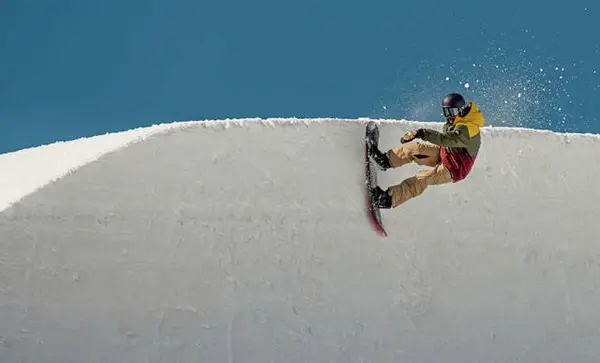
Snowboarder Nolan Johngarlo was attacking the new halfpipe — a 13-foot-high wall of snow — at Seven Springs Mountain Resort on Saturday, maneuvering back and forth on the walls of the football-field length special feature at the Somerset County resort.
“There’s so much things you can do. The jumps are cool. It’s fun,” said Johngarlo, 25, of Vandergrift, surrounded by a group of friends on skis, all of whom were beneficiaries of Seven Springs’s snowmaking operations.
The slopes and halfpipe were covered in snow thanks to the snowmaking guns on both sides of the halfpipe and ski jump. They created a stark contrast to the brown spots in the woods, which had been covered in natural snow before the recent warm spell.
The 13-foot-high halfpipe, 350 feet in length, that Johngarlo and others were using opened last week at Seven Springs, said Keenan Gillian, director of mountain operations at Vail Resorts’ three ski operations in Southwestern Pennsylvania: Seven Springs near Champion, Hidden Valley near Bakersville and Laurel Mountain in Ligonier Township.
Some of the skiers rode the wall of the halfpipe to the edge, while others used the momentum they gathered to continue above the edge and into the air, doing turns as if they were practicing for the Winter Olympics.
“It’s a pretty good halfpipe,” said Frank Ross, 57, of Murrysville, a coach for the PA Freestyle team at Seven Springs, who was with a group of young team members learning the finer points of snowboarding, skiing and navigating moguls on the slopes.
The halfpipe is a feature Seven Springs always aims to offer when conditions allow, Gillin said. But that’s after first making snow on the slopes that serve the most guests.
Once there is sufficient snow on the slopes and the weather supports it, the mountain operations team shifts its focus to constructing the halfpipe. Snowmaking in that area was timed strategically to coincide with winter storm Fern in January and a long stretch of cooperative weather.
The halfpipe is made by creating a large mound of snow carved into shape by tracked vehicles known as Snowcats. The grooming team pushes snow into place and forms the two walls, making sure the snow is fully “processed,” meaning it’s broken down repeatedly so there are no hidden ice chunks or voids that could compromise the walls once cutting begins.
Building a halfpipe is a highly specialized skill, and there are very few professional halfpipe builders in the country, said Anna Weltz, Seven Springs spokeswoman.
Gillin, who leads the design and construction phase, has more than a dozen years of experience shaping halfpipes. He mentors the other groomers on the team, Weltz said.
“The two walls are built differently based on sun exposure. The ‘sun wall’ receives more direct sunlight and is constructed slightly wider to ensure durability throughout the season. The ‘ice wall,’ which stays shaded longer, can be built narrower without sacrificing longevity,” Gillin said.
To keep the halfpipe open for skiers and snowboarders as the calendar moves into March, the halfpipe requires regular grooming and reshaping to keep the walls clean, consistent and safe. The snowmaking and grooming teams continually monitor conditions and touch up the halfpipe using new snow and existing on‑hill snow piles as needed throughout the season.
As of late February, Seven Springs and the Vail resort in Ludlow, Vt., are the only two resorts in the eastern United States to open a halfpipe this season.
Size differs
The halfpipe is a Seven Springs staple, one that has deep roots in the resort’s terrain‑park history, Weltz said.
In past seasons, Seven Springs has built a full‑size Olympic‑height pipe of 22 feet, but that takes a significant amount of resources. “Not all resorts have the topography, snowmaking capacity or demand to support larger pipes, so design often varies,” Gillin said.
“It takes a whole lot of snow buildup to do that,” said Ross, the PA Freestyle Coach.
However, only a small number of riders have the skill or comfort level required to use a 22-foot-high halfpipe safely, Gillin said.
A 13‑foot-high pipe is considered a mini or progression halfpipe, but that’s intentional, Gillin said. A 13‑foot progression pipe, which is 55 feet wide with a 16‑degree pitch, makes far more sense for Seven Springs, taking into consideration the mountain’s snowfall patterns and the skill levels of most riders, Gillin said.
“This size provides an approachable, skill‑building environment that allows East Coast skiers and riders to develop confidence and progress comfortably. It still delivers a high‑quality terrain‑park experience,” Gillin said.
“It’s beautiful. The height of it is perfect,” said Tucker Canary, 14, of the Johnstown area. “It’s just enough (height) to make you feel comfortable.”
“It’s amazing,” said Andrew Schurman, 13, of Pittsburgh’s Shadyside neighborhood. “It’s the best jumps they ever did. I feel super safe. It’s challenging enough.”