
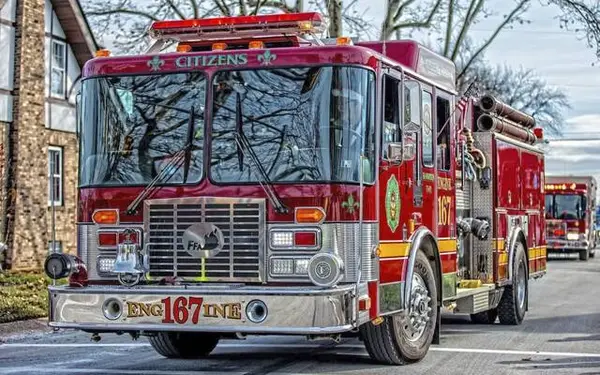
A newly established fire tax in Harrison will help pay for a $1.3 million fire engine at Citizens Hose.
Commissioners in December voted to create a 0.55-mill tax solely to help with fire apparatus and other specialized equipment. The money will be used to benefit each of the township’s three departments: Citizens, Hilltop Hose and Harrison Hills departments.
The tax amounts to about $41 a year for the owner of a home assessed at the township’s median assessed value of $75,100.
Township Manager Amy Rockwell said fire tax revenue will generate $136,000 a year toward the loan for Citizens’ engine as well as $110,000 to be socked away in a capital equipment fund.
“The township has recently transitioned to a much more structured funding model to ensure long-term stability for its three volunteer departments,” Rockwell said.
“Establishing a fire tax allows the township to prepare for capital funding and look to the future rather than be reactionary.”
Citizens’ new Ferraro engine will replace one that’s 30 years old, Chief TJ Bajack said.
The National Fire Protection Association recommends frontline apparatus be replaced after 15 years.
“We got it new back in the day, and it’s been good, but it’s time,” he said. “It’s starting to show its age.”
The township will earn a multi-apparatus discount by piggybacking on a department purchase of a $1.4 million rescue truck from the same manufacturer, FireFighter One in New Jersey.
Citizens’ rescue truck is from the late-1990s. It is used to respond to vehicle accidents, trench collapses and other disasters. Bajack said it carries specialized equipment that ranges from generators to ropes to air supply.
“We’ve saved over the years and watched how we spent,” Bajack said.
“There’s been a lot of fundraising and donations to help.”
The rescue truck should be delivered in spring 2027. The engine will follow by the end of the year or early 2028, Bajack said.
The department responds to about 350 calls a year.
Rockwell said the fire tax will provide stability through predictable equipment replacement.
“Rather than waiting for a truck to break down and then scrambling for funds, the township now maintains a replacement schedule based on the age of the apparatus,” she said.
The township owns, insures and maintains a first-line piece of apparatus at each station.
It also pays for workers compensation insurance for the three volunteer fire departments and covers the operational costs through the purchase of fuel, electricity for the buildings, natural gas, sewage and water. Each department also receives $47,500 a year.