
Darlene Mayes has many mementos, but she doesn’t have her daughter’s engagement ring.
It was buried with 22-year-old Christine Mayes after she was killed by an Iraqi Scud missile during Operation Desert Storm.
Thirty-five years after the attack on a local Army Reserve unit serving in Saudi Arabia, Mayes keeps other memories of her daughter’s life front and center in her Indiana County home.
“I have a curio cabinet of all of her stuff and pictures,” Mayes said Wednesday before an hourlong memorial service at the U.S. Army Reserve Center in Hempfield’s Carbon section. While the engagement ring Christine’s fiancé gave her before she was deployed in January 1991 remains with her for eternity, Mayes finds comfort in the photographs and personal belongings kept behind glass in her home.
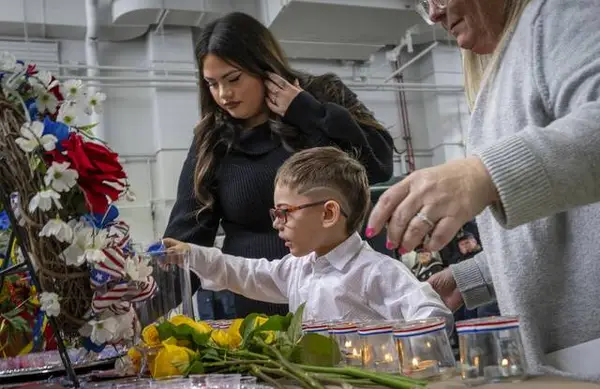
The service honored 13 members of the 14th Quartermaster Detachment killed in the Feb. 25, 1991, strike.
More than 100 family members, Army personnel, veterans and the Greensburg VFW Post 33 honor guard crowded into the center for the service. Inside, a table held 13 candles alongside photos of the fallen reservists. Family members of the victims poured sand into a common jar, which was later poured onto the monument by those families.
“Events like this ensure that the sacrifices made are not confined to history books or fading memories,” said Maj. Robert Prah of Rostraver, executive officer for the 327th Quartermaster Battalion. “Instead, they are carried forward, taught, shared and honored by each new generation of soldiers. Our past gives meaning to our present.”
In all, the missile claimed the lives of 15 other soldiers and wounded 99 members of the Quartermaster unit and the 477th Provisional Transportation Unit.
The local water purification unit had landed in Saudi Arabia just six days before the strike. They were part of a military operation aimed at removing Iraqi troops that in August 1990 had invaded Kuwait, which supplied the U.S. with oil, according to a Department of War website.
The anniversary brought back memories that are not always easy to handle.
“It’s a hard day. It feels like it was just yesterday,” said Connie Clark of Armagh, regarding the death of her daughter, Beverly S. Clark, 23.
Clark also maintains a curio cabinet for Beverly. Her memory is kept alive at every family event, holiday and Sunday dinner, Clark said.
“She is with us every day,” said Clark, who noted that her son, Robert, named his daughter Alexis Beverly.
Clark and Mayes share a special bond. They are both from Indiana County and they each have daughters who died in the explosion.
“We’ve become friends,” Clark said.
Before deploying, Clark’s daughter was anticipating an engagement and planned to study elementary education at Indiana University of Pennsylvania.
Like the other loved ones, Barbara Keough of North Huntingdon, whose 22-year-old son, Frank, was killed in the attack, has his uniform, his medals and his Purple Heart.
Darla Madison of Monessen, whose 27-year-old son, Anthony, was killed, recalled watching news clips of the attack at the time, thinking how terrible it was for the soldiers involved.
“I don’t forget. It’s so fresh in our minds and our hearts. It seems like yesterday,” Madison said, adding that a whole wall of her house is dedicated to Anthony’s medals and photographs.
His father, Anthony Madison, said he likes to walk in Monessen’s Ninth Street Park, where a sign features his son’s picture.
Family members remarked on how, after all these years, the families of the victims have bonded over the tragedy.
“We’ve become pretty good friends. We have a lot in common,” Darlene Mayes said. With the passage of time, “I’m meeting a lot of new friends” at the memorial services.
“It helps everybody to come together and reminisce,” said Christine Poth-Keough of Jeannette, sister of Frank Keough. She described her brother as a “loving, caring, charismatic friend, son, brother and uncle.”
“We’ve lived with these families for 35 years,” said Rebecca Boxler of Richland Township, Cambria County. Her father, John Boxler, was killed in the attack.
Attending the service these decades later is important so the younger generation understands his sacrifice, Boxler said.
“It’s a way for the younger generation to know the stories of their grandfather,” who was the “old man” of the unit at age 44, she said.
Boxler recalled how her father had already served two tours of duty during the Vietnam War, but he wanted to deploy for Operation Desert Storm. He transferred from a Johnstown-based unit to the 14th Quartermaster Detachment to ensure he went overseas.
“He wanted to go so bad,” despite opposition from his family, including the then 15-year-old Rebecca. Boxler said they haven’t thrown anything away in 35 years.
Survivor Mary Rhoads of California, Pa., said it’s important for her to attend as a way of remembering her fellow reservists. Rhoads was outside the barracks when the missile hit. She still struggles with post-traumatic stress disorder and does not like to talk about it.
Following her custom, Rhoads left a small white teddy bear and a white rose at the base of the monument in memory of her friend, Clark.
“I had made a promise to the unit that I would never forget,” Rhoads said.