
Anyone familiar with the music and subculture of the Grateful Dead understands the innate physicality of a Dead show. A closely packed crowd flows in unison with the slow build of a jam, collectively exhaling as melodies resolve. The audience gives its energy to the band, and the band gives it right back to the music.
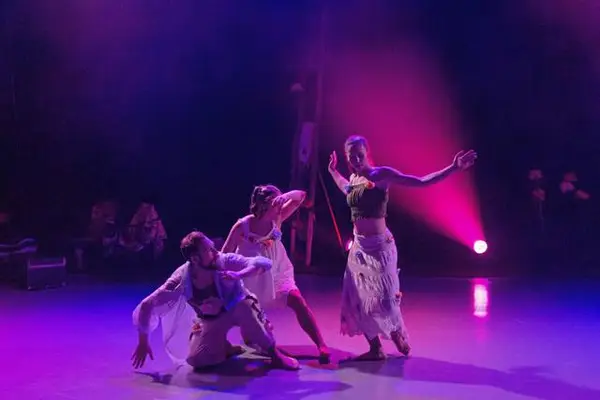
In Attack Theatre’s “Once in a While,” co-directors Michele de la Reza and Peter Kope ask the question: What if that experience could be danced?
Staged as part of Attack Theatre’s 30th anniversary season, “Once in a While” blends contemporary choreography with archival Grateful Dead recordings. The show runs through March 7 at the Attack Theatre Studios in Lawrenceville.
The Dead recordings have been supplied by the Owsley Stanley Foundation, the nonprofit preserving the “sonic journals” of the late Grateful Dead sound engineer Owsley Stanley. Known by the nickname “Bear,” Stanley was also the amateur chemist who supplied LSD at scale in the 1960s counterculture.
“Once in a While” explores the many dimensions of the Grateful Dead experience.
“From scaffolding, swings, ramps and our very own box that rains, we continue our spirit of fearlessness and creativity,” de la Reza said. “You’ll be immersed in a sonic experience of live Grateful Dead recordings, crowd sounds from shows, psychedelic mayhem and more.”
The show replicates and interprets the Grateful Dead experience from a variety of different angles: the parking lot bazaar known by fans as “Shakedown Street,” the band’s interactions with the audience and crew, and even the occasional technical difficulties.
Deadheads in the audience may even notice that the show is set up in a way that mirrors the traditional flow of a Grateful Dead concert. As the night progresses, the music becomes increasingly free-form and psychedelic, and so does the choreography.
One of the Dead’s most exploratory songs, “Dark Star,” is a highlight of the second act. The dancers coalesce in a swirling kaleidoscope, creating a striking visual representation of a core piece of the Grateful Dead’s repertoire.
Though it may not be apparent at first, the connections between the Grateful Dead and Attack Theatre are certainly there, just waiting to be found.
“This show turns inward to look outward,” Kope said. “Throughout the last 50 years, the music of the Grateful Dead has brought millions of people together over the generations. Each person feels, hears and sees the music from their perspective. Attack Theatre has always drawn inspiration for artmaking from our environment and the people who are in the room creating together. For us, that’s the spirit of the Dead, making community and sharing together.”
Considering the wild and free dancing Deadheads are known for, it’s surprising that there has never before been a full-length dance production based on their work.
During the Grateful Dead’s primal years, they were the poster children of the countercultural movement of the mid- to late ’60s. Many cities still had laws on the books regulating dancing, often targeting “disorderly establishments” where young people danced together without a chaperone.
One of the Dead’s many transgressions against the era’s repressive cultural norms was the Acid Tests, a series of wild parties thrown by Ken Kesey and his Merry Pranksters. LSD, still legal at the time, was handed out to partygoers, and the Grateful Dead took to the stage.
“If you think about the early Acid Tests, they weren’t just music. It was supposed to be about people dancing, too,” said Redbird Ferguson, daughter of Owsley Stanley. “It was actually illegal to dance at a concert in those days, so dance in itself was this sort of political act.”
“Dance to Grateful Dead music by a dance company and putting it into this frame is an element of political act in itself,” Ferguson added.
The executive producer for the Owsley Stanley Foundation, who goes by the name Hawk, is the creative adviser on the production.
“Not only is this the first collaboration between Attack Theatre and OSF, but it is the first modern dance performance of a full-length, original piece of choreography set to the Grateful Dead’s music,” he said. “That’s never been done before.”
With the recent death of Grateful Dead founding member Bob Weir, fans of the music continue to speculate on how the Dead’s legacy may continue to grow and develop. Before his passing, Weir spoke of a 300-year legacy of the music. It is clear today that the music continues to take on new life and find new audiences.
Starfinder Stanley, son of Owsley Stanley, said that Weir’s vision was that “the Grateful Dead would still be playing in 300 years, because the Grateful Dead would always be that group of music, and whoever was in the band as they move through time, it would evolve, it would change, but it would always still be the Grateful Dead.”
With community being so central to the Deadhead ethos, organizers of “Once in a While” felt it was crucial to bring in other collaborators and partners. They include Lawrenceville’s Thunderbird Music Hall and Cafe New Amsterdam; sound designer Stewart Blackwood; lighting designer Forrest Trimble; and costume designer Bunny Brand.
“This is going to be a really big community event,” Hawk said. “They’re having a Dead versus Beatles night during opening night. There are coupons to go from the Attack Theatre performance — walk down the block to the Thunderbird and see some live music. New Amsterdam across the street is having a Grateful Dead DJ and a cocktail hour. You can go there, have some drinks and then come over to the performance. Other folks in the neighborhood are going to participate as well. This is like Dead Week in Lawrenceville. It’s going to be really amazing.”
Attack Theatre’s 30th anniversary season began in the fall and continues through late spring. The next performance is “212 Stories” in April, a dance event inspired by the history of their building at 212 45th St. in Lawrenceville. The season concludes with “The Thirty Ball” on May 30, a gala event. Details are at attacktheatre.com.