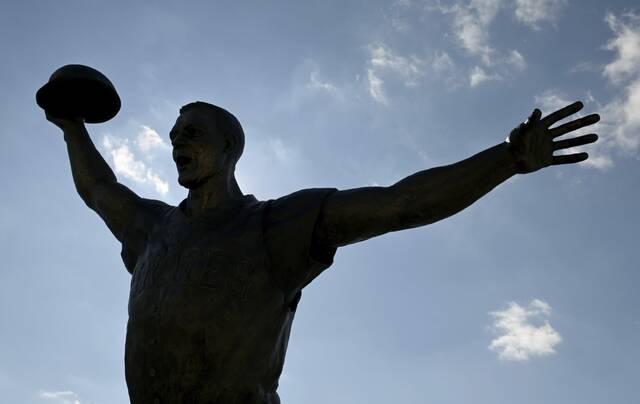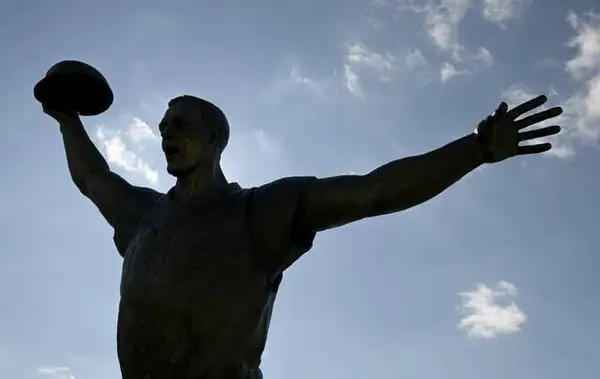
Every so often, Susan Wagner will visit PNC Park to see those powerful Pirates legends’ statues.
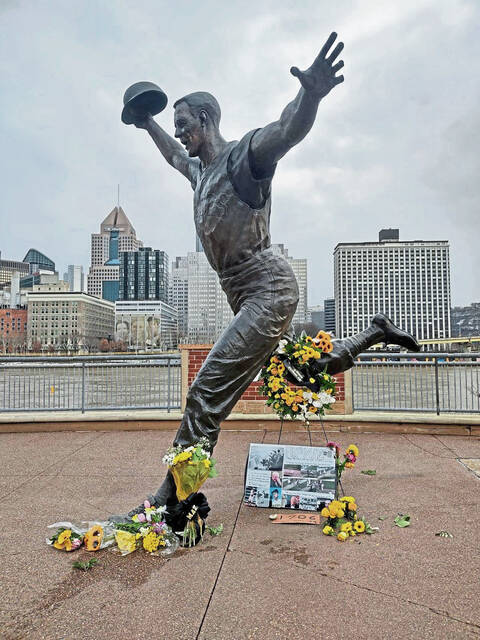
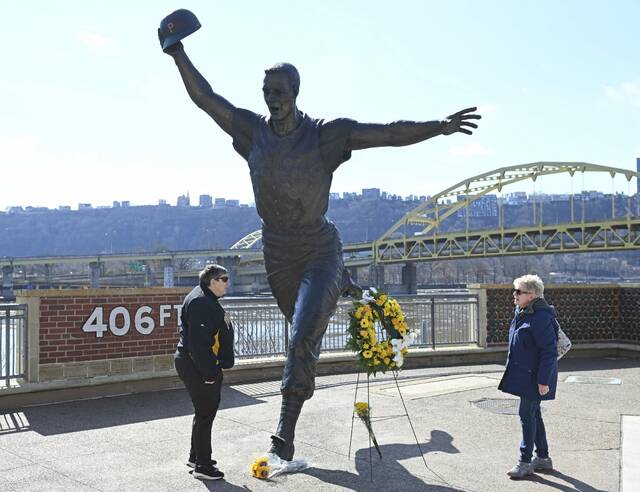
Last weekend provided such an occasion, albeit a sad one. Bill Mazeroski had died. Dozens journeyed to his bronze likeness at the end of the cul-de-sac on Mazeroski Way, near the right-field entrance, in front of an actual piece of Forbes Field wall featuring the number “406.”
There, a 12-foot-tall Mazeroski forever rounds the bases, helmet in hand, after smashing the ball over that 406-foot mark to beat the mighty New York Yankees in Game 7 of the 1960 World Series.
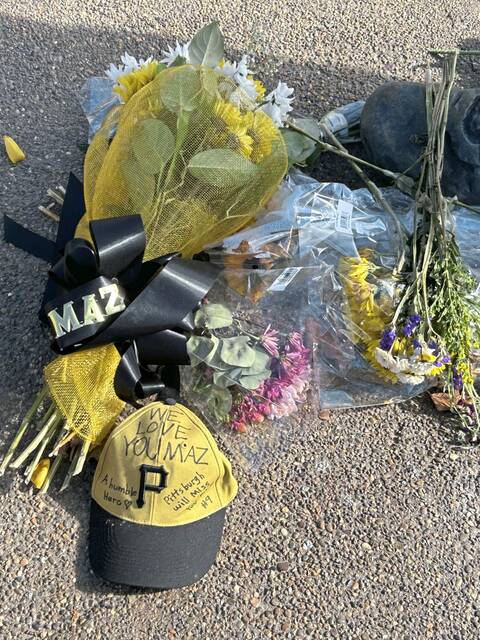
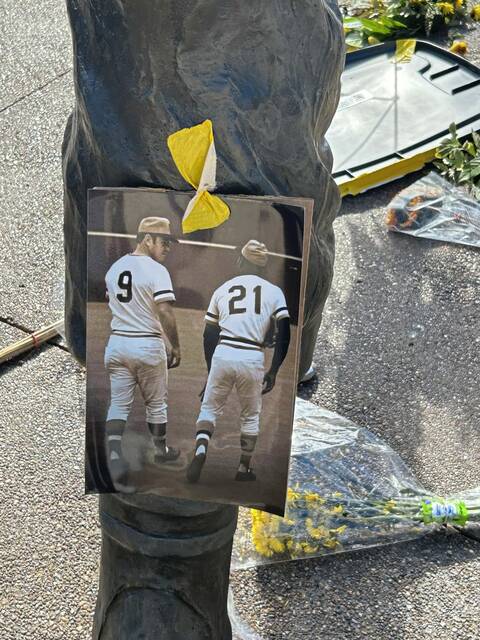
I thought of the statue as the Mazeroski tributes poured in. I wondered who created it and how his death might have impacted that person. It sure impacted others. Fans left flowers and assorted mementos at the statue’s base, including a photo of Maz with Roberto Clemente and an old Pirates hat inscribed with a handwritten note: “WE LOVE YOU MAZ. A humble hero. Pittsburgh will miss you No. 9.”
Wagner stopped to snap some photos. She then moved aside as a couple stepped in to snap their own. They had no idea, of course, that Wagner wasn’t just another fan but the sculptor of that statue — as well as the nearby ones of Clemente and Willie Stargell (a man named Frank Vitto sculpted the Honus Wagner statue).
Those are among the many gifts Wagner has given us. And hardly anybody knows.
To hear her tell it, the interaction above was not an isolated instance. Few recognize her, save for maybe a neighbor or her local Giant Eagle clerk. Why would they? Much like Mazeroski in his later years, Wagner lives in the shadows, humbly moving through life while leaving others to admire her work.
Sometimes, like last weekend, she is afforded the opportunity to observe people relating to her creations.
“I do get to hear their comments and watch how they interact with the bronzes,” Wagner says. “They mostly touch and pat them, always with a smile, bringing back good memories.”
One such memory is her lone interaction with Mazeroski. It happened weeks before the statue dedication on Sept 5, 2010 (Mazeroski’s 74th birthday) and left an indelible mark.
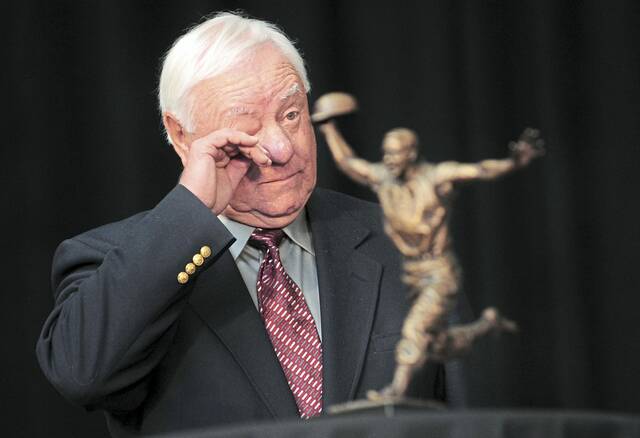
“I had already made a small version of what you see (at PNC Park) when I met him at a press conference announcing it,” Wagner recalls. “He turned to me and said he didn’t understand why they wanted to make a statue of him. I think he was just in shock. His modesty really struck me. He didn’t think he should have a sculpture made of him.
“I turned to him and said, ‘Everybody loves you. They want to honor you.’ He just looked down and smiled. I’ll never forget that.”
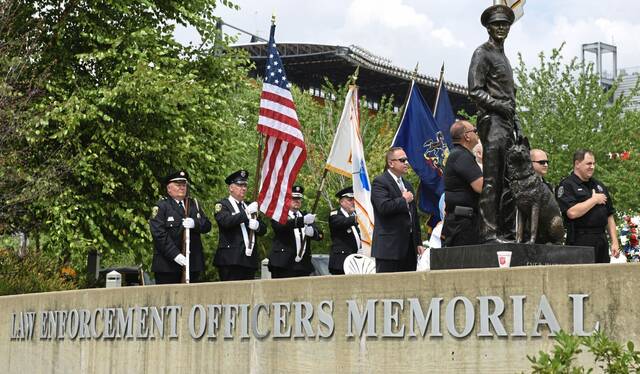
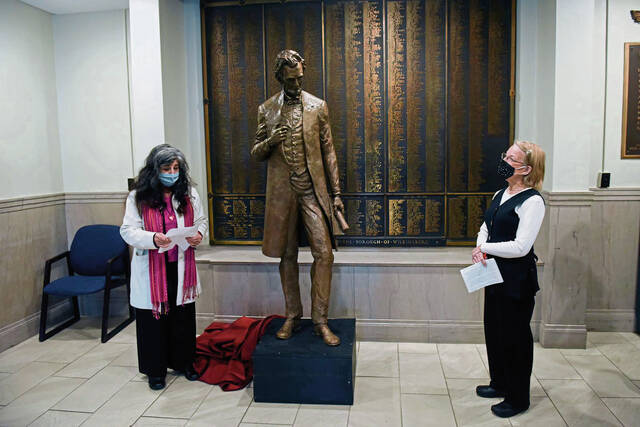
Wagner’s other works include a bronze of Dr. Thomas Starzl, the organ transplant pioneer, sitting on a bench at the University of Pittsburgh; a little boy and girl looking at a sea lion at the Pittsburgh Zoo; and a copper statue of fallen K-9 hero Rocco, a Pittsburgh police dog, on the North Shore. Her work has appeared as far away as the Vatican and as close as Wilkinsburg, where her latest creation — a life-size Abraham Lincoln statue — went up in 2021.
Some of those things might mean something to you. Maybe they’ll mean more when you hear Susan’s story. That she would grow up to sculpt sports statues is about as unlikely as the ’60 Pirates. She comes from a working-class, nearly sports-free Penn Hills household — excepting her mom’s infatuation with Clemente.
“I remember when I was a little girl, her sitting in the living room watching baseball on TV, and he’d come on the screen, and she’d say, ‘Oh, there he is!’ She was in love with him,” Wagner recalls. “And I remember when he passed away, she was crying in the kitchen.”
Wagner had little interest in sports. She was a born artist. Her passions included digging up red clay from bulldozed ground around her house and using it to make mini sculptures.
“Nobody knew what to do with me,” she says. “To me, heaven was getting a blank piece of paper and having crayons.”
Upon graduating from Pitt with a double major in art and anthropology, she went into business for herself in the highly non-lucrative world of painting and sculpting. Her first big job was fashioning a Gulf War Memorial statue in Greensburg. It is a stunning work of art.
Shortly after, Wagner heard the Pirates were holding a competition to create a Clemente statue. She was shocked when team officials, the architect involved and the Clemente family chose her mini-statue as the winner. She subsequently visited Puerto Rico and came to know Clemente’s wife, Vera, as she prepared to shape his essence from a ball of clay.
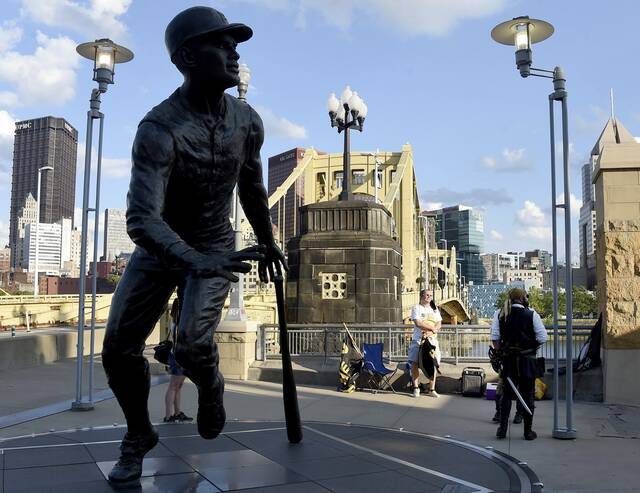
Her goal, as always, was to capture something far beyond the physical likeness.
“I don’t sculpt the game,” Wagner says. “I’m sculpturing the spirit of the person.”
It takes a spirit to sculpt a spirit. If you’ve seen Wagner’s work, you know. You can feel it. You can see it in the details, like the joy in Mazeroski’s face, the ripples in his shirt, the steel spikes on the bottom of his shoes and the way he holds his helmet.
That all comes straight from Wagner’s bare hands and beating heart. She sure isn’t in it for the money. She lives alone in Friendship and has often resorted to odd jobs over the past 40 years in order to keep the spirit alive in her third-floor studio.
“I don’t make much,” Wagner says. “There are times I cleaned houses, or hired myself out to paint people’s walls with a roller. It’s very difficult. But I’d rather do that than anything else. I will paint walls rather than get a 9-to-5 job, so I can have time to do my art.”
That nearly changed at one point. Wagner was in a long dry spell when she found herself on a ladder cleaning the Clemente statue, as she would do from time to time (and does the same with the Mazeroski and Stargell statues).
“I was up on that ladder and thought, ‘God, give me a sign: Should I stop altogether and have another career?’ ”
Just then, something highly unusual happened. Somebody recognized her.
“It gives me chills to tell you this,” she says. “When I was coming off the ladder, some guy across the street ran across and startled me. He threw his arms around me. He said, ‘I know who you are. Thank you for giving Roberto back to us.’
“You know, I’m so dense. But I realized that was my sign.”