
At least 115 people, most of them likely children, were killed Saturday in a strike on a girls’ elementary school in southern Iran, health officials and Iranian state media said.
The search for survivors in the rubble of the Shajarah Tayyebeh school in the southern town of Minab ended Sunday, according to Mohammad Radmehr, the governor of Minab, Iranian state media reported. It appeared to be the deadliest attack in the ongoing American-Israeli bombing campaign.
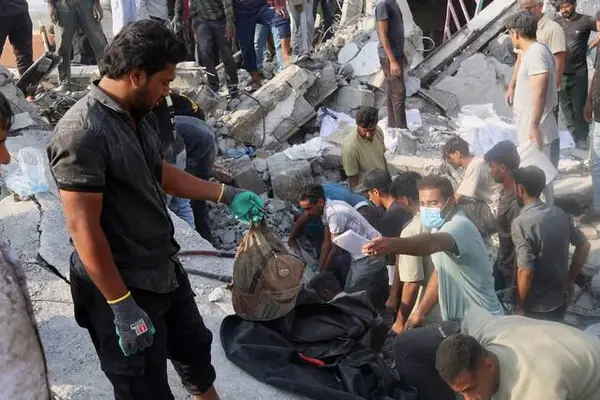
Several videos and images verified by The New York Times showed that at least half of the two-story school was destroyed in the explosion. Emergency workers with the Red Crescent could be seen alongside families desperately combing through the rubble, which was littered with schoolbooks and book bags covered in blood and ashes. Portions of the building jutted out from the rubble, with bits of colorful murals visible on what were once the walls of the school. Desks were piled with debris.
In other verified videos, rescue workers retrieved a severed arm from the rubble. Victims were laid out in body bags at the scene, where throngs of people were gathered among ambulances and rescue workers.
“The Minab school incident has no comparison with any other incident,” said Pirhossein Kolivand, the head of Iran’s Red Crescent, in a video posted on social media Sunday.
“Even in Gaza,” he added, there had not been such a high number of students killed simultaneously, calling the attack “a unique and bitter incident.”
Times reporters are trying to confirm the death toll and details about the attack. It was not immediately clear why the school had been hit, or which country’s forces had done so.
The United Nations cultural and education agency, UNESCO, condemned the strike, saying in a statement on social media Sunday: “The killing of pupils in a place dedicated to learning constitutes a grave violation of the protection afforded to schools under international humanitarian law.”
Intentionally attacking a school, hospital or other civilian structure is a war crime, and indiscriminate strikes also violate the law. Even if schools are used for military purposes, the law requires armed parties to avoid or minimize harm to civilians and civilian infrastructure, according to the International Committee of the Red Cross.
Citing in part the strike on the school, the Center for Civilians in Conflict, a Washington-based nonprofit dedicated to minimizing civilian harm in war, on Sunday called for “immediate de-escalation, maximum restraint, and urgent action to protect civilians and civilian infrastructure.”
Malala Yousafzai, the Pakistani campaigner for female rights and the youngest recipient of a Nobel Peace Prize, said Saturday on social media that she was “heartbroken and appalled” by the strike.
The school is adjacent to a naval base belonging to Iran’s most powerful military force, the Revolutionary Guard. Satellite images reviewed by the Times show that, in 2013, the school building was part of the base. Roads led to and from other areas of the base to the school building that was struck on Saturday. But by September 2016, satellite images show, the same building had been walled off and was no longer connected to the base.
Other witness videos shared by Iranian media and verified by the Times showed dark plumes of smoke billowing from two buildings inside the naval base, indicating that it had been targeted in Saturday’s wave of Israeli and U.S. strikes.
The Israeli military did not respond to requests for comment Sunday.
“We are aware of reports concerning civilian harm resulting from ongoing military operations,” Capt. Tim Hawkins, a U.S. Central Command spokesperson, said Saturday. “We take these reports seriously and are looking into them.”
He added that protecting civilians was of “the utmost importance.” No new details were available from Central Command on Sunday.
The midmorning strike on Shajarah Tayyebeh was one of two attacks that appeared to have hit schools Saturday. Another strike appeared to have hit the Hedayat High School in Iran’s capital, Tehran, near 72nd Square in the district of Narmak, local media and rights groups said. Two students died in that attack, according to the U.S.-based Human Rights Activists News Agency, which focuses on Iran.
A spokesperson for the Red Crescent Society said Saturday that nearly 750 people had been injured and that more than 200 had been killed in attacks across 24 provinces, Iranian state media reported.