
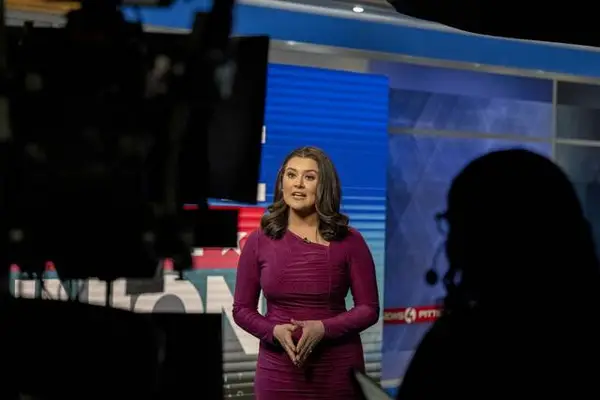
As the clock in the WTAE studio counted down, Elena LaQuatra’s bubbly personality turned serious.
She scanned scripts behind the anchor desk and made quick adjustments to her hair and dress. With a hand signal from show control operator Taylor Jones, LaQuatra’s face was broadcast live on televisions around Pittsburgh.
But something viewers can’t see has played an important role in the 34-year-old woman’s rise to morning anchor on the news station. Hidden beneath her brown hair is a cochlear implant.
LaQuatra is deaf as a result of a bacterial meningitis infection 30 years ago.
Television news anchors typically use an earpiece to hear producers and show content, but in LaQuatra’s case, that isn’t possible. Medical technology advances have been a springboard for her career — she uses a Bluetooth connection through her implant to hear that audio instead.
“I don’t know what I would’ve done if I was an anchor a decade ago,” she said.
• • •
Shortly after her fourth birthday in 1996, LaQuatra was hospitalized with bacterial meningitis. Parents Effie and Paul LaQuatra of Mt. Lebanon weren’t sure if their youngest daughter would live.
After doctors at Children’s Hospital got her stabilized, they realized she couldn’t hear. That ear damage led to difficulty with balance and walking.
Bacterial meningitis is an infection of the fluid and membranes that surround the spinal cord and brain that can cause swelling and life-threatening problems, according to Johns Hopkins Medicine. It can be treated with antibiotics if caught quickly, but patients may still have lifelong complications including brain damage, seizures, vision problems and hearing loss, according to Mayo Clinic.
Up until then, Effie and Paul LaQuatra knew a loquacious, animated little girl who loved performing and playing dress up. It was devastating.
“We brought home a different child than the one we had admitted to the hospital,” Effie LaQuatra said. “We were very concerned about what her life would be like.”
LaQuatra’s speech gradually changed because of the hearing loss. She was enrolled in the DePaul School for Hearing & Speech in Shadyside, which LaQuatra credits with changing her life. Her family learned more about cochlear implants there, eventually opting for right ear surgery in April 1996.
A cochlear implant consists of external and internal parts that collect sound and stimulate the auditory nerve, sending signals to the brain while bypassing the damage, said UPMC audiologist Jillian Chapman Glasstetter. At first, a patient may just hear sounds, she said. It takes time for the brain to adjust and make sense of what it is hearing.
The right ear procedure ultimately didn’t succeed because of the damage the meningitis left behind. But it worked on her left ear. Those initial moments brought Effie LaQuatra to tears, she recalled. An audiologist turned on the external device during an appointment the day before Thanksgiving 1996 and asked the little girl if she could hear.
Elena LaQuatra gave a thumbs up, her mother said.
Her balance was improving, too, with the help of physical therapy and a quick return to dance classes before the successful implant surgery. It didn’t matter she couldn’t hear the music — a video from the time shows a young Elena, wearing a sparkly blue dress and white hair bow, tap dancing on stage during a recital, looking to her classmates to keep up with the steps.
“We tried to not change her life at all,” Effie LaQuatra said.
That attitude sticks in Elena’s mind. She now sees her hearing loss as a blessing.
“(My parents) never let me use being deaf as an excuse for anything,” she said. “So I never had it in my head that … I need special treatment because I’m deaf.”
When it came to auditioning for roles in plays and musicals, she beat out the other kids who had perfectly fine hearing.
“I think she was so determined that it wasn’t going to be a crutch,” Effie LaQuatra said.
• • •
Elena (pronounced Ellen-a) LaQuatra loved the DePaul School, where there was a range of services to help her family navigate an unfamiliar world. She remembers how much fun the classes were and how they taught her to advocate for herself. She’s now on the school’s board of trustees.
“They completely taught me how to speak again and how to interpret sounds with my implant,” she said.
After a few years at DePaul, LaQuatra switched to Mt. Lebanon School District. She got involved in pageants, winning Miss Pennsylvania’s Outstanding Teen in 2007 and Miss Pennsylvania Teen USA in 2010, the same year she graduated high school.
She was crowned Miss Pennsylvania USA in 2016. Through those pageants LaQuatra started to hone her public speaking skills and meet local news personalities. She earned a broadcast communications degree from Point Park University in 2014 and became a digital content creator at WTAE before taking a job as a reporter in Erie.
A return to Channel 4 as a general assignment reporter in 2018 was followed by a switch in 2021 to morning traffic reporter and noon news anchor. All the while, she was manifesting the job she really wanted — morning news anchor.
The dream was within reach as longtime morning anchor Michelle Wright announced her retirement. Her last show was Friday and LaQuatra joined Janelle Hall behind the anchor desk Monday.
During an interview last week, LaQuatra greeted coworkers as they walked through the hall near the studio. She is grateful to WTAE for their support when adjustments are needed, such as hand signals from photographers at noisy news scenes during her time as a reporter.
“I know not everybody who has a disability has that support at work,” she said.
The studio is a much calmer environment, though it still helps to have the visual cues just in case something goes awry, she said. The challenges still arise from time to time — and so do the situations where LaQuatra realizes something is a little harder for her because of the hearing loss.
After being named morning anchor, LaQuatra authored an emotional Facebook post about perseverance. It brought friend and fellow anchor Kelly Sasso to tears.
It’s easy to forget LaQuatra is deaf, Sasso said, “because she’s flawless.”
• • •
Technology advances have helped with her career.
Even though LaQuatra’s implant is an older model, it’s a far cry from what she had at 4 years old. Then, a microphone on her ear was connected by a cord to a processor the size of three cassette tapes she had to wear in a harness.
Now, the entire device fits around her ear and blends into her hair. That upgrade, which included Bluetooth capabilities, was a game-changer.
“The technology has gotten a lot smaller,” said Glasstetter, the audiologist who coordinates UPMC’s cochlear implant program. “It’s a miniature computer on your ear, on your head.”
Cochlear implants were first approved in the mid-1980s, according to the National Institute on Deafness and Other Communication Disorders. Estimates from the U.S. Food and Drug Administration show, as of December 2019, about 118,000 devices had been implanted in adults nationwide and 65,000 in children.
The potentially life-changing technology is constantly evolving to better help more people, said Glasstetter, who works with adult patients.
“It’s really cool to see them come back to life,” she said, encouraging anyone experiencing hearing loss to get evaluated.
• • •
On Monday morning, LaQuatra woke an hour earlier at her home north of Pittsburgh, left her husband Jordan and their 1-year-old daughter Emelina and headed to the station to get ready. But instead of checking on traffic, she read through scripts and got caught up on breaking news before her first live broadcast as morning anchor started at 4:30 a.m.
By 7, LaQuatra and Hall will switch to two hours of cut-in updates during “Good Morning America.” After that, she’ll be free to work on projects — which she hopes will be stories about medical issues and interesting Pittsburghers.
It’s special to LaQuatra that she’s following in the footsteps of Wright, her longtime mentor and college professor. She said she’s honored to continue building on the legacy Wright left behind.
Effie LaQuatra planned to turn on the television early Monday to catch all of her daughter’s first morning broadcast behind the anchor desk. Rewinding to that touch-and-go time in 1996, she just wanted her daughter to live. Now, 30 years later, it’s no surprise to her that her daughter’s dreams are coming true.
“I don’t know who she would’ve been if she hadn’t lost her hearing,” Effie LaQuatra said, “or if it would’ve changed the trajectory of her life.”