
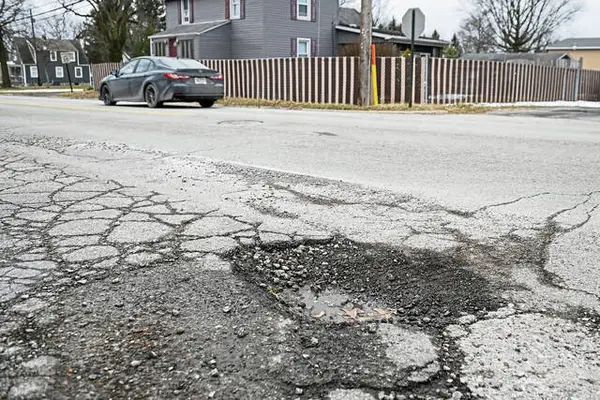
If you’re seeking the culprit behind that crater you have to avoid on your morning drive, look past the local road crew — and blame Mother Nature.
That’s because of a process called the freeze-thaw cycle, something particularly present in Western Pennsylvania’s wet climate and varied topography. It’s a recipe for potholes.
In the freeze-thaw cycle, snow melts during the day and refreezes at night. Day after day, night after night.
“It’s not necessarily a harsh cycle, but we see it almost every day in winter,” said Brian Hutton Jr., meteorologist at TribLive news partner WTAE. “Our normal lows stay below freezing through the entirety of winter, while our highs are normally above freezing.”
The melted snow — in other words, water — flows into streams, creeks and rivers. But some of it also seeps into cracks in the roadways.
When that water freezes overnight, it expands as ice. That makes the cracks in the road grow larger.
From the constant expansion of freezing and thawing water — combined with pressure from roadway traffic and winter plows — potholes emerge.
“The freezing and thawing can create potholes as water sits on/in the asphalt and concrete, expands as it freezes, shrinks as it thaws and so on,” Hutton said. “This can force the road surface to expand and contract each day, which eventually breaks down the material and causes cracks, which makes this worse, and then potholes.”
Winter precipitation — snow, sleet or rain — is a fact of life in the Pittsburgh region. According to National Weather Service data, the region averages 155 days per year of measurable precipitation. Typical February temperatures top out in the high 30s and low 40s, while lows mostly hover in the 20s.
In a year that’s seen much of the region blanketed by more than a foot of snow, the coming months could prove particularly tough, said David Stoltz, a Lower Burrell councilman who oversees the city’s public works crews.
“In spring, when everything thaws, instead of a road, you have a pile of gravel,” he said. The situation isn’t helped by the presence of road salt, a corrosive material that breaks down asphalt.
Acting Director of Pittsburgh Public Works John McClory said his crews in winter rely on cold patch as a short-term solution. Made up of ready-to-use asphalt, cold patches don’t require heating or mixing, but they fail quickly under heavy traffic.
Once things warm up, McClory said, crews can begin paving projects and filling potholes with hot mix, which is a longer-lasting solution.
Pittsburgh Public Works crews recently fanned out throughout the city in a “pothole blitz.” The effort involved 30 trucks in every neighborhood of the city, McClory said.
In Westmoreland County, Delmont Public Works Chief Bill Heaps has plenty of potholes to patch, with one major exception.
“We did new binder, milling and topping along Greensburg Street,” Heaps said. “It was in really bad shape.”
The main thoroughfare through the Delmont’s downtown area was the focus of its 2025 road work program and has held up well despite the recent deep freeze.
“Hopefully, it will last like that for a few years,” Heaps said.
In Greensburg, Tom Bell’s public works staff forms a list every morning of potential patch jobs.
“The warmer weather coming up is actually a better situation for us because you don’t have the cold temperatures and we’re not putting salt down,” Bell said. “The warmer weather can also make the potholes more visible. Stuff we might not see in cold, snowy weather is lot easier to pick out.”
On one recent Friday, Bell had crews on the east and west sides of the city.
“Main Street is kind of the dividing line, and they’re out looking for whatever they can find to patch up,” he said. “We’ve gotten a few complaints for specific alleys and a few roads, and they keep an eye out for others.”
The key to pothole mitigation, Stoltz said, is constant triage. He said Lower Burrell crews try to fill potholes as soon as they see them, especially in warmer seasons.
Tiny holes in September can be craters by March.
“Maintenance in the summer is key to the winter,” Stoltz said.
PennDOT also announced plans to begin pothole repairs soon on state roads, citing “Pennsylvania’s aggressive and rapid freeze-thaw cycle. Crews will address higher traffic roadways first and then secondary routes as soon as possible.”
Already, PennDOT announced it has begun pothole repairs on a stretch of Interstate 70 in Rostraver, forcing lane restrictions on motorists there. That work is part of an $89 million reconstruction project.
TribLive staff writers Patrick Varine and Megan Swift contributed to this report.