
Allegheny County Council’s public safety committee on Monday voted to move ahead with a bill that would prohibit county employees from cooperating with U.S. Immigration & Customs Enforcement.
The 4-3 vote followed about an hour of debate among council members about whether to amend the bill, whether existing policies already accomplished the same aims and whether there could be repercussions from President Donald Trump’s administration, which could attempt to withdraw millions in federal funding.
“I don’t think there is anyone in this room who is not appalled, aghast, virulently opposed to what has been taking place by government agencies in this country,” Councilman DeWitt Walton, D-Hill District, said. “I believe there is uniform distaste.”
But he dismissed testimonies from residents who claim to have seen county employees cooperating with ICE, noting that council has not heard such assertions under oath.
He pointed out all county offices and departments, when asked by council, responded they had policies already that stated their workers would not cooperate with ICE absent a judicial warrant.
Council members rattled off a list of those offices and departments, which they said included the sheriff’s and district attorney’s office.
At-large Councilwoman Bethany Hallam, one of the bill’s sponsors, has alleged county workers — including those in the sheriff’s office — have assisted federal immigration officers.
The bill — which Hallam co-sponsored with five council colleagues — would bar county employees from cooperating with ICE and prohibit ICE or Border Patrol from housing immigrant detainees in the county jail.
The measure would not allow the county to transfer anyone from the jail into ICE’s custody without a judicial warrant, signed by a judge.
The measure further stops federal immigration officers from accessing the county’s databases or other equipment for immigration enforcement operations.
Council’s public safety committee on Monday amended the bill to provide a carveout that would exempt employees of the county court system if the president judge would order them to cooperate with federal officials.
Another amendment passed Monday outlined reasons for the bill’s introduction.
Several more amendments were not read, introduced or voted on during Monday’s meeting.
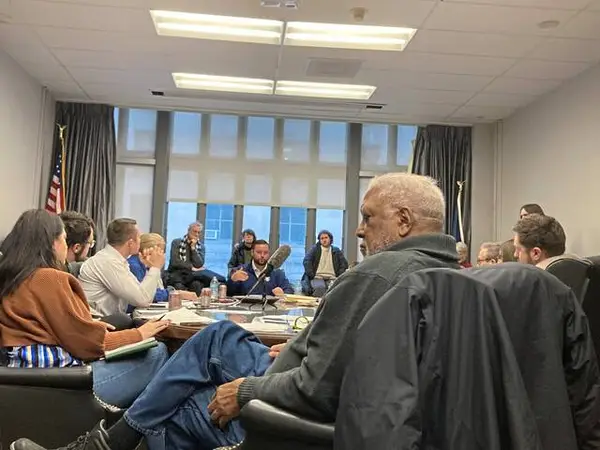
About 50 residents — some holding signs urging officials to pass the legislation or criticizing ICE — crammed into a conference room in the Allegheny County Courthouse for Monday’s meeting. They alternately clapped and guffawed at various comments from council members.
They applauded when the committee voted to advance the measure to a full council vote. A date was not announced.
Hallam said she felt that the county needed to legislate a formal rule about ICE cooperation, despite any existing policies that county row offices may have in place. She pointed out that less formal policies could change.
‘Vengeful’ president
Councilwoman Suzanne Filiaggi, R-Franklin Park, raised concerns that the federal government could yank federal funding from the county in retaliation for such a policy. She pointed to programs like Allegheny County Executive Sara Innamorato’s 500 in 500 housing initiative that rely heavily on federal dollars.
“We have a president who is vengeful,” she said. “If he decides to play fast and loose with that money, it is something we as council have to think about as a consequence.”
She also pointed out that the bill restricts county employees from cooperating with ICE but would not stop federal immigration officers from operating in the county, snatching people off the streets or deporting immigrants.
Feeling powerless
County council members also seemed to disagree about whether the measure would be enforceable.
Under the legislation, county sheriff’s deputies or county police officers found to be assisting ICE would be referred to the Independent Police Review Board. Other workers would be referred to the Human Relations Commission for discipline.
Councilman Dan Grzybek, D-Bethel Park, said the bill would provide county workers with guidance on how to handle potentially tense or emotional situations with ICE officials.
“Right now, they feel unsure of what they should be doing, regardless of any policies we’ve been provided,” Grzybek said, explaining that county workers have told him they are currently uncertain about what the proper procedure is when ICE arrives.
“They feel powerless to tell them no, even though morally they know that’s the right thing.”