
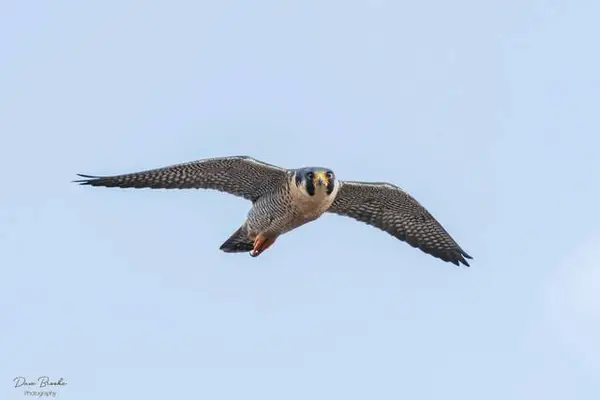
Peregrine falcons that nest under the Tarentum Bridge will be protected as best they can during an upcoming, long-term construction project along the span.
PennDOT is working with the state Game Commission to safeguard the nest — one of six in Allegheny County — when the $97.5 million rehab project gets underway in early 2027.
Steve Cowan, PennDOT spokesman, said his environmental unit is working to coordinate mitigation during the three years of work.
Draft plans include:
- No work to occur within 1,000 feet of the falcon box until Aug. 1, 2027.
- No work to occur within 1,000 feet of any peregrine falcon nest during nesting season from mid-February to July 31.
- Full covering of the bridge prior to Feb. 15, 2028.
“PennDOT and the PA Game Commission will continue to work together to incorporate methods that reduces impacts to the falcons,” Cowan said. He noted that the plans could be modified.
The Tarentum Bridge nest is especially important to the health of the peregrine falcon species.
The National Aviary reported that the six nests in the county, which were recorded during the Audubon Christmas Bird Count in December, is the highest number ever.
Peregrine falcon populations declined sharply in the early 1960s, with the birds no longer nesting anywhere across the state. Nearly extinct, they were placed on the federal endangered species list and not removed until 1999. The birds were removed from the state’s endangered species list in 2021, a few years after the birds started breeding with spotty success under the Tarentum Bridge.
In 2015, the game commission installed a man-made nest box on the second pier of the bridge, near the New Kensington side.
The game commission’s Josh Zimmerman said the nest box helps to track the birds, which can better help plan construction around the breeding season.
“Even though Peregrines were delisted in 2021 in (Pennsylvania) by the game commission, the species is still vulnerable, as most nests occur on human structures,” he said.
Harrison resident Dave Brooke, a member of the Friends of Harrison Hills, has monitored the falcons since 2018 and reported his findings to the game commission.
He said the female is nearly ready to lay her eggs.
“I wouldn’t be surprised if she lays one within the next week,” Brooke said. “This female will lay either three or four eggs with 24 to 48 hours in between each one.”
She’ll start incubating after she lays her next-to-last egg, he said.
In 2025, Brooke spotted the first chick mid-April. They fledged around the end of May.
“This is a full three-month process that shouldn’t be interrupted by whatever construction is being done,” he said.
There have been 27 chicks since the birds began breeding on the bridge.
A nest on top of the University of Pittsburgh’s Cathedral of Learning is also thriving. The National Aviary runs a livestream camera to allow people to watch those falcons, Carla and Ecco, raise their family.
PennDOT and game commission efforts to protect the Tarentum Bridge nest during construction will support the falcons’ resurgence locally, Brooke said.
About 36,000 vehicles cross the bridge every day, according to PennDOT.
Construction will require full closure for at least a short period, with traffic likely rerouted through East Deer to New Kensington.
Work will include a new deck and sidewalk, steel and concrete repairs, and bearings.
Motorists will luck out for the main portion of the project: the deck across the Allegheny River will be replaced in half-widths to maintain traffic flow. But ramp work will require the bridge to be shut down.