
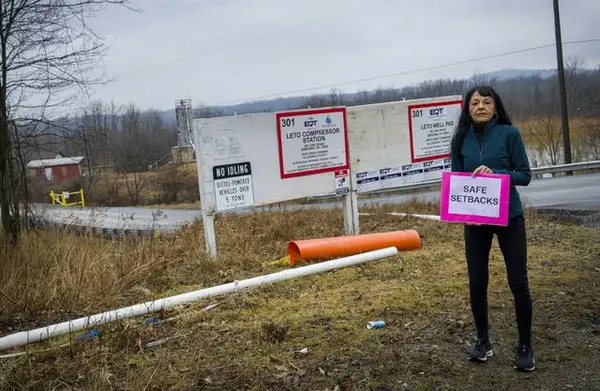
A case argued Tuesday before Pennsylvania Commonwealth Court could test the reach of local efforts to challenge natural gas fracking.
Concerned Residents of West Deer (CROWD), a local advocacy group, has raised concerns for years about the Leto fracking well, which is located near the heart of the West Deer community of Bairdford. They’re the appellants in a legal case against the township itself, its supervisors and the EQT Corporation, which took over the Leto well from Olympus Energy LLC last year.
During Tuesday’s hearing, John Smith, a lawyer for CROWD and several area residents, noted that the well site had been approved after substantial public comment. However, he argued that an adjacent stormwater pond on a residential-zoned property — which the state Department of Environmental Protection deems “necessary” for well development impoundments — was not approved.
The Leto site consists of two lots, both sold by the same owner to Olympus amid a flurry of drilling, with each well appropriately given the name of a Greek deity (mythology holds Leto to be the mother of gods Apollo and Artemis). But residents aligned with CROWD say living near the well has been anything but divine.
Attorney Blaine Lucas, representing EQT, told the Commonwealth Court judges that the company had dealt with 98% of the Leto well’s impact during approval hearings for the well itself. EQT appeared to take the position that because the stormwater pond is not enclosed, it is not subject to the same approval process as the well facilities themselves.
The case, heard by Commonwealth Court Judges Stella Tsai, Patricia McCullough and Bonnie Leadbetter, will determine if the current state of affairs can continue.
Facing setbacks
A 2024 poll found that about half of Pennsylvanians support fracking.
However, an overwhelming majority of those polled approve of tighter regulations for the industry, including setback rules stipulating the minimum distance a well can be drilled from occupied structures. Per a 2012 law, the commonwealth stipulates that fracking wells must be set at least 500 feet away from occupied structures.
Bairdford residents were concerned early that, even at that distance, the Leto well would be a disruptive neighbor.
This wasn’t the first round of debate over fracking in West Deer. The township previously rejected Olympus’ Dionysus well for not meeting Pennsylvania’s 500-foot setback rule, but plans for Leto and another well, Tyche, went ahead.
Jack Rearick, who got involved with CROWD around 2021, told TribLive that “regardless of our personal feeling about fracking as a group, we [CROWD] are very clear that we’re not against it. We are for doing it safely, and at safe distances from people, and that’s been our biggest concern with these well pads, particularly Leto.”
Rearick and others interviewed said that, after the Dionysus well was shelved, the composition of the township’s board of supervisors changed. Some voiced suspicions that the new chairperson, Bev Jordan, was more beholden to energy interests due to her job at Back Roads Solutions, a Houston, Pa. firm with ties to the industry.
Jordan, who has since termed out of board service, denies that politics or business played a role. In fact, she said, she was the tiebreaking vote for denying approval to Dionysus and said her current job often involves checking for DEP compliance.
“I don’t really like where Leto is, but drilling is permitted in that zoning district, which was decided long before me,” Jordan told TribLive.
She said that it complied with all of the township’s ordinances around setback distance — which are unclear as to how that setback are measured.
West Deer Township stipulates a 650-foot setback within the township’s borders for drilling.
“There’s just so many things that made it very ambiguous, and so my thought process was, from point A to B, it met the current ordinance,” Jordan said.
She joined a unanimous board in approving the Leto and Tyche wells.
Rearick said the township’s ordinances measure setback distance from a bore hole to an occupied structure, meaning the well itself can be much closer to area residents’ property lines. Adding to the complications is the fact that a well pad can contain multiple bore holes.
“On these super pads, they’ll have up to 40 bore holes. So, which bore hole are you measuring from? No other industry gets to do that,” Rearick said
Following the Dionysus debate, all West Deer residents interviewed for this article say public hearings grew contentious. Residents affiliated with CROWD said they felt the board of supervisors hadn’t reviewed Olympus’ plans.
Jordan said a minority of township residents took to social media in a “smear campaign” that resulted her receiving online threats. Minutes from hearings on the wells reveal a tense back-and-forth.
Almost immediately following the wells’ approval, CROWD filed lawsuits against the township and Olympus.
With two suits pertaining to the Olympus/EQT Interconnect pipeline and the Leto well since denied appeal, the suit related to the approval process for Leto and its adjacent stormwater pond and EQT’s plans to bring the site online. Smith said appellants have appealed the Interconnect case to the state Supreme Court.
Some Bairdford residents still say 650 feet simply isn’t enough. In fact, they say an October incident made it feel like far too little.
‘Like snorting WD-40’
The Leto site is clearly visible from Oak Road, Bairdford’s main thoroughfare, which runs among thick trees, clusters of modest homes and Bairdford Park. The access road for the well is situated directly next to the parking lot of a local Dollar General.
“The well is actually about 800 feet from my house,” Bairdford resident Vicki Austin told TribLive.
Austin, who’s named as an appellant in the Commonwealth Court case and has been involved with CROWD, said an incident in the fall justified her misgivings.
Austin and other residents say that, at the beginning of October 2025, the Leto well sprung a leak. One resident who claimed to be an 811 operator posted that they had been notified of a cleanup. Austin said the leak produced a noxious odor, and she immediately reported the issue to the DEP and county authorities and posted about it on Facebook.
“The smell was very, very heavy,” Austin recalls. “It was like snorting WD-40.”
Josh Wiegand, a volunteer firefighter and the current West Deer supervisor, said he visited the scene and, like Austin, got an “instant headache.”
“They did not report [the spill] as required,” he said. “DEP was notified, and they did investigate, and they cited them for having a spill and not reporting it.”
Wiegand and Austin both say EQT claimed the spill was only 1.5 gallons of chemicals, which they suspect is a low estimate. Wiegand also said Olympus and EQT brought unpermitted dwellings on site for well pad workers.
In his capacity as a firefighter, Wiegand said he already had concerns about a lack of communication from Olympus and their emergency plans, and, although he said EQT has been much more forthcoming since they purchased Olympus’ portfolio, he’s concerned about what would happen if the well caught fire.
Still, he said, there’s little anyone can do now that the well site is mostly complete.
“The gas company kind of has a case,” he said. “I feel like it’s an uphill battle.”
Fracking at the Leto site is scheduled to begin soon. Austin worries about how that will change her close-knit community.
“I’m concerned about the health effects. I’m concerned about the stress effects of consonant noise,” she said, citing fracking’s well-documented health impacts. She said noise from construction has made spending time outdoors unpleasant. “Although it doesn’t exceed what is allowed in the township, it will make you lose your mind.”
Commonwealth concerns
Without additional legislation, the CROWD appellants argue that challenging how the Leto well was permitted to proceed — specifically, without explicit approval for the stormwater pond — could lessen the effects of EQT’s Oak Road operations and help prevent similar situations from occurring elsewhere.
Appellant counsel Smith framed the issue as: “The whole site encompasses two parcels. The hearing [for the Leto well] was only scheduled and held on one parcel.”
Further complicating matters, Smith said, is evidence of ongoing sitework that could be part of adding a yet-to-be-approved compressor station before litigation concludes.
Smith provided TribLive with satellite imagery showing a level area just north of the existing Leto well pad, as well as documentation arguing that DEP code stipulates the inclusion of a stormwater pond.
“If you talk to DEP, if you don’t build this wet pond, the site doesn’t get built,” he said.
In other words, if Olympus didn’t explicitly seek approval for the pond, and thus the West Deer board of supervisors shouldn’t have permitted it to go ahead.
“They only applied to use this parcel. Our argument today was, this was violative of the law,” Smith said. “And if this violates the law, if you don’t have this [wet pond], this whole site fails.”
Lucas said the appeal wouldn’t stand on the merits at all if the Leto well had been drilled on one contiguous lot.
“If you go back and consolidate the two lots, this issue disappears completely,” he told the panel.
Lucas said the well’s neighbors, including those organized with CROWD, were all aware of the project’s full scope.
“Everyone knew,” he told the court.
It remains to be seen who the Commonwealth Court agrees with. Appeals can take as long as a year, and Judge McCullough commented after the proceedings that both Smith and Lucas had done a “good job.”
Some jurisdictions in Greater Pittsburgh, including Crafton Borough and Plum and Cecil townships, have since amended laws, rejected proposed wells and increased required setback distance. The commonwealth has not, with the state Environmental Quality Board tabling a petition to increase setbacks in spring 2025.
And neither has West Deer Township, leaving some residents with lingering concerns about the Leto and Tyche wells and worries that local debates on social media have damaged community trust.
Rearick said he would encourage residents of other areas to be “proactive” about the issue in their communities.
“Everything is about the ordinances,” he said, “and if you don’t have good ordinances and protective distances, you’re going to default to the Pennsylvania default of 500 feet, which is not anywhere near enough.”