
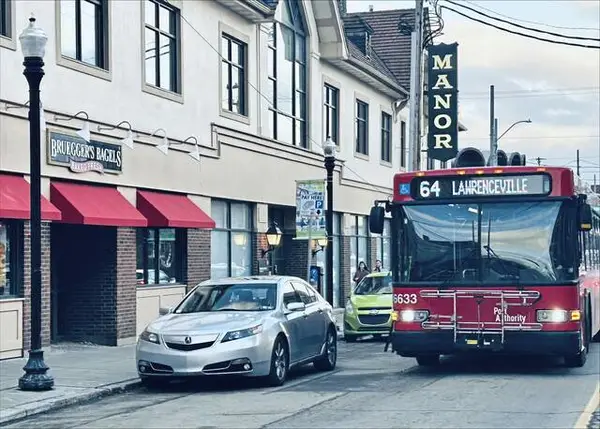
Every weekday morning, thousands of Pittsburghers board a bus to get to work or school. That bus is operated by Pittsburgh Regional Transit (PRT). It travels along a street paved and maintained by the City of Pittsburgh’s Department of Mobility & Infrastructure. It often crosses a bridge maintained by the Allegheny County Department of Public Works. Along the way, it moves through traffic signals maintained by a mix of municipalities.
No one experiences this fragmentation during their commute. Riders simply expect the system to work. But behind the scenes, mobility in Allegheny County is divided among layers of government that evolved over decades.
Pennsylvania’s tradition of strong local control produced more than 130 municipalities and a separate transit agency in Allegheny County. Each retains authority over pieces of the public right-of-way. That structure may have made sense in a different era. Today, it is becoming expensive.
For a region the size of Pittsburgh and Allegheny County, maintaining separate agencies overseeing city and county roadway facilities and transit is increasingly inefficient. It is time to explore a serious question: Should Allegheny County create a Regional Mobility Administration to consolidate planning, capital delivery and long-term financing of transportation infrastructure?
What is a Regional Mobility Administration?
A Regional Mobility Administration (RMA) is a multi-jurisdictional public authority empowered to plan, finance and deliver transportation infrastructure across municipal boundaries. Unlike a traditional transit agency or a stand-alone public works department, an RMA treats mobility as one integrated system inside one municipal boundary.
Pennsylvania law already allows the creation of municipal authorities under the Municipal Authorities Act. It also authorizes metropolitan transportation authorities under Title 74 of the Pennsylvania Consolidated Statutes. Pittsburgh Regional Transit itself operates under that framework.
What Pennsylvania does not currently have is a statute that explicitly consolidates city streets, county public works and transit operations into a single regional mobility entity with unified bonding and revenue generation authority. Creating such an entity would require new enabling legislation from Harrisburg. But the concept is not theoretical.
In Texas, regional mobility authorities were authorized by state law in the early 2000s to accelerate transportation projects through tolling and revenue bonds. The Central Texas Regional Mobility Authority has used those tools to advance corridor improvements that might otherwise have waited years in traditional state and federal funding pipelines. They function like a regional version of Pennsylvania turnpike commission.
Other regions have taken different paths. Metropolitan Transportation Authority oversees subways, buses, commuter railroads, bridges and tunnels under a single state-created authority serving the New York metropolitan area. Its recently implemented congestion pricing program in Manhattan represents one of the most significant transportation finance reforms in the United States in decades, linking mobility management to long-term capital funding. In Metro Vancouver, TransLink integrates buses, rapid transit, major roads and bridges under one regional authority created by provincial legislation in 1998. It is funded through a mix of fares, fuel taxes and property-based levies dedicated specifically to transportation investment.
These models differ in structure and operating policies. But they share a principle: mobility does not stop at municipal borders. So, governance should not either.
Why consider this in Allegheny County?
The case for reform begins with fiscal reality. Whether federal and state funding uncertainty, property reassessment or nonprofit fare share saga, PRT, city and county, all three entities are currently struggling financially to provide the service they promised to its constituents. Each entity plans capital projects on separate timelines. Each negotiates separate labor agreements. Each maintains its own procurement systems, planning and engineering staff and asset management protocols. Large-scale infrastructure projects can require prolonged sequential approvals from city, county and state agencies before a shovel ever hits the ground.
An RMA would not eliminate funding challenges overnight. But it could align capital planning across agencies, coordinate corridor design and reduce duplication in staff, procurement and fleet management. That integration could translate into faster project delivery, reduced administrative overhead and better long-term asset management.
Financially, if authorized by the General Assembly, a regional authority with dedicated revenue streams could issue transportation bonds backed by various usage fee, property and sales tax of the county. It would also streamline the grant process, reducing overlapping and competing funding requests from the same region. Pennsylvania already uses authority structures for airports, ports and water systems. The Allegheny County Airport Authority and regional water authorities demonstrate that complex infrastructure can be governed regionally when scale demands it. The question is whether mobility infrastructure warrants similar structural coherence.
The legal and political reality
Any proposal to merge or consolidate functions of city and county agencies would require state legislation. It would also require negotiated agreements with organized labor representing transit operators, city employees and county public works workers. Pension obligations, seniority systems and collective bargaining frameworks cannot simply be merged overnight.
A realistic path would likely be incremental. A newly created Regional Mobility Administration could begin as a capital coordination authority, overseeing corridor-level planning to construction, procurement consolidation and long-term asset management while day-to-day operations remain within existing agencies during a transition period. If efficiencies are demonstrated and public trust builds, deeper integration could follow. Or certain daily maintenances can always remain in individual agencies.
Pennsylvania’s governance culture strongly values local control. The General Assembly would need bipartisan support to authorize new regional bond or other revenue tools. Local elected officials would need to relinquish some authority in exchange for long-term stability and strategic coherence.
Is it worth the conversation?
Yes. Because maintaining fragmented governance will not make the financial struggles facing the city, county and transit agency disappear. A Regional Mobility Administration for Allegheny County would not be a quick fix. It is a long-term structural reform requiring legislative action, labor negotiation and sustained public engagement. But the infrastructure systems we rely on today from airports to ports to water authorities exist because earlier leaders chose structural reform over incremental patchwork.
This will not be easy. But if we want a region that competes economically, supports transit and safe roadways for all users, shares resources efficiently when snow hits the roads and maintains its infrastructure responsibly, then governance itself need to evolve. And that start with a serious public debate about whether our current approach to managing mobility still matches our needs and our fiscal realities. That debate is long overdue.
Panini A. Chowdhury is a professional planner specializing in infrastructure planning and a resident of Allegheny County. He also serves as a gubernatorial appointee to the Pennsylvania Pedalcycle & Pedestrian Advisory Committee.