

Shady Side Academy Senior School senior John Ludden has one less thing to occupy his time during the school day.
His cellphone.
Ludden and his 400 fellow senior school students were met with a new cellphone policy implemented in August, exclusive to the Senior School, prohibiting students from using their cellphones during school hours from 8:15 a.m. to 3 p.m.
The policy was introduced after an almost yearlong student, faculty and administrator cellphone committee drew inspiration from many areas and sources, including the popular book “The Anxious Generation” by noted psychologist Jonathan Haidt.
Haidt’s book explores Generation Z — those born from 1997 to 2012 — and their experiences growing up with phone-based childhoods and the subsequent fallout to mental and emotional health.
Ludden, 18, of Squirrel Hill said initially he was a bit “panicked” to hear cellphone use wouldn’t be allowed during school, but he since has recognized that a school day spent off his phone isn’t so bad.
“I realized my screen time was getting a little bit out of control, and this has helped bring that down,” Ludden said. “I adjusted quite quickly, and so far it’s been OK.”
Senior School Dean of Students Chad Green said the decision was not made in a hasty fashion, rather in a slower, deliberate rollout leading up to the start of the 2025-26 academic year.
Green said students who once walked through the halls clutching and looking at their phones and used them throughout lunchtime and beyond served as a reminder that cellphone usage is a reality that school administrators must tackle.
“Suddenly, people were really talking about what needed to be done, and we wanted to be really thoughtful about how going phone-free would be,” Green said.
The committee referenced Haidt’s book. A student/faculty committee tackled the topic of student engagement and phone use for almost a year via surveys and Project Reboot with a TED Talk.
Green noted the average daily screen time for teens is about 8.5 hours per day.
The previous Shady Side Academy cellphone policy allowed phone use outside class.
Students previously used hanging shoe-type trees — dubbed cellphone hotels by some students — or baskets to place their phones in during class.
“But that was pretty unevenly enforced,” Green said. “The bigger concern for us was ‘what was school looking like in the nonacademic spaces?’ ”
Last year, the committee planned a two-week phone-free dining hall pilot program, but a severe storm disrupted the entire trial period. Nonetheless, it provided a snapshot of experiencing a dining hall without phones.
“Kids were playing games like Uno and things like that,” Green said.
How it works
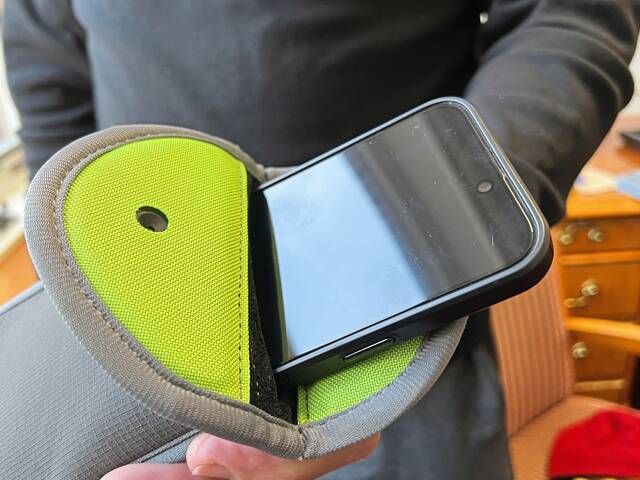
Shady Side Academy uses Yondr portable fabric pouches to create a phone-free zone by placing a phone into the pouch, securing and closing it, which activates a lock.
Yondr is used in 27 countries and all 50 states, most often in schools and entertainment venues. Each pouch costs around $30.
Each student is issued their own Yondr pouch, and the student can either turn off the phone or put the phone on airplane mode and place it in the pouch and close it, initiating a lock.
The policy permits students to keep the pouch on their person and they’re responsible for it until the end of the school day when students unlock the pouch using one of the magnetic unlocking stations located throughout the school or from staff at-the-ready with portable unlocking devices.
The number of unlocking stations gets the job done, Green said.
Students adjust
Student body reaction to Yondr has been mixed, according to Green, with some students saying they need their phones during school to contact parents or friends. Other students say because Shady Side Academy is a college prep school, phones should be allowed because they’re preparing students for life after high school.
Ludden noticed a positive change after going phone-free, especially in the dining hall after lunch.
“Even last year, we would all play video games at the lunch table after eating, but now it’s face-to-face conversation, talking,” Ludden said.
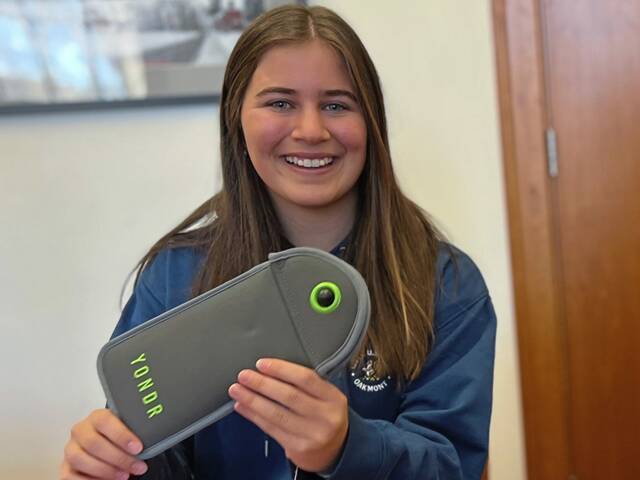
Not scrolling frequently during the school day to check social media apps has turned out to be a good thing, said senior Nora Bryan of Fox Chapel, sporting a decorated Yondr pouch.
In addition, wearable tech, including airpods, is not allowed during the school day.
“Instead of doing work, a lot of kids used to scroll Instagram or TikTok. That was a big thing, going on social media while in school,” Bryan said. “I actually really love it. That is surprising to me, but before we would have our airpods in and we were sort of unapproachable. I wouldn’t go up to a person with airpods in.”
Breaking her text habit of reaching out to her school friends when class ended was an adjustment for Bryan.
“I didn’t have that quick communication with them so I would go to the dining hall alone, which was kinda scary, but then you mingle,” Bryan said. “And my sister is a freshman, and I’ll talk with them and, like, definitely between the grades there’s been more interaction.”
To check compliance, random Yondr spot checks are performed by administrators with the first offense resulting in the student’s phone being taken away for the day and a second offense leads to their phone being taken away and requiring a parent visiting the school to retrieve the phone.
To date, Green said only about a dozen students have violated the policy.
Teacher talks impact
Claire Logsdon, dean of studies at Shady Side, sees both sides of the cellphone issue because she works in administration and teaches a U.S. history class at the Senior School.
Among the positives, Logsdon noticed less screen time has led to more socializing.
“I didn’t expect it to have as much of an impact as it did. The Yondr pouches have the students walking into the classroom without a phone in their hand. It really feels like it increased student engagement with each other,” Logsdon said. “I’ve had many conversations with students that I had never talked to before. It’s forced us teachers to be better citizens, too, with our phones.”
Parents or guardians who need to contact their student can do it the old-fashioned way — by calling the school and having them relay the message to the student.
Faculty members carry their phones in case of an emergency, and phones are in classrooms to facilitate communication among administrators and staff.
Administrators experienced a little pushback from some parents over the new policy but not much, Green said.
For Bryan, the phone-free school day scene has reached a “normalized” stage.
“In the beginning, people were trying to find ways to unlock them (pouches) or break their Yondr pouch or use burner phones, but that wave of momentum has died,” Bryan said. “If you’re that addicted to it, then that’s definitely a problem.”
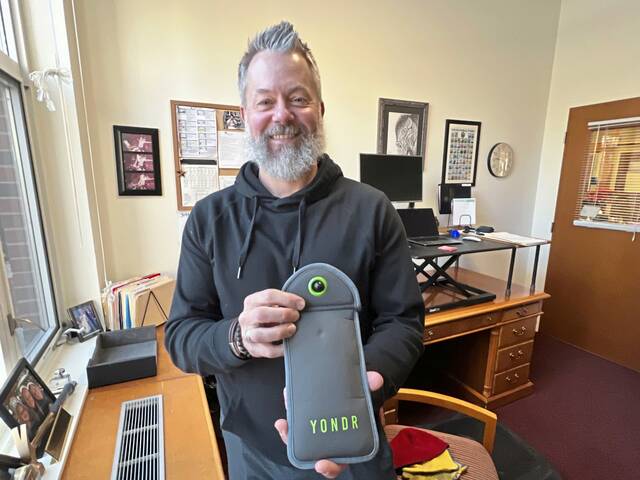
Head of Senior School Andrew Prince said the Yondr rollout is meeting expectations.
“Students are interacting with each other more. They’re talking with each other more. The hallways are loud. There’s more face to face, and they’re not on screens and that is fantastic,” Prince said. “One of the most important things when it comes to teaching and learning is a sense of belonging and trust and relatedness to others.”
The dining hall and auditorium are areas where students are talking more than ever.
“Conversations make connections,” Prince said.