
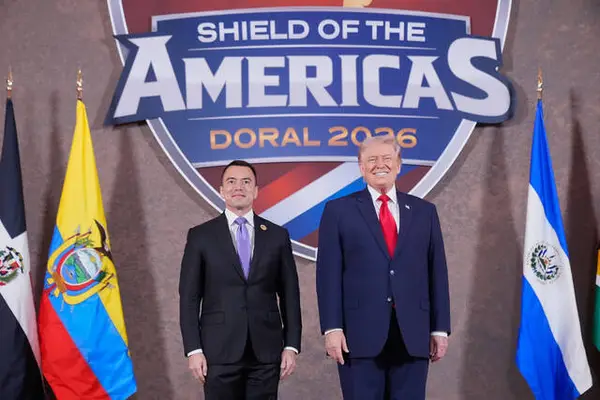
The joint military operation that the United States and Ecuador launched last week is aimed at fighting drug gangs that have turned Ecuador from one of the safest countries in Latin America to one of the deadliest, and signals the deepening ties between the countries.
For more than a year, President Daniel Noboa of Ecuador had publicly and privately courted President Donald Trump, desperate for a powerful ally who could more forcefully join his uphill, hard-line war against spiraling drug violence in Ecuador.
The Trump administration, focused on growing its influence in the Western Hemisphere, found a willing partner in Noboa. The center-right president is among the most vocal supporters of the U.S. in the region and appears more eager to welcome American military forces than many other leaders in Latin America.
Over the past few months, U.S. Special Forces began helping Ecuadorian commandos train and plan for extensive raids that are expected to unfold across the country in the coming weeks, according to a U.S. official who spoke on condition of anonymity to discuss military matters. The operation is targeting drug facilities run by gangs that have unleashed deadly violence in Ecuador and turned the country into the leading exporter of cocaine in the world.
The United States has already deployed dozens of troops to Ecuador who will advise and assist Ecuadorian soldiers, including in the sharing of intelligence, but will not participate directly in the missions, according to the official.
The months of behind-the-scenes work burst into public view Tuesday when the U.S. military’s Southern Command released a 30-second video that showed a helicopter taking off to pick up soldiers. The video depicted the operation’s first raid, according to the U.S. official, who said it did not yield any results because the targets slipped away, but that the soldiers recovered intelligence that could be useful.
Most of the details of the scale, targets and time frame of the joint operations remained unclear.
The Pentagon said it was targeting “designated terrorist organizations,” without providing additional details. The Ecuadorian defense ministry declined to comment on the location and intended targets of the future raids, citing “national security” concerns.
But Noboa, the country’s 38-year-old president, and his top officials told Ecuadorians to brace for a new phase in its yearslong fight against drug violence, which has been defined by kidnappings, contract killings and prison riots.
“We are at war,” John Reimberg, the interior minister, said Tuesday after Noboa announced a 15-day nightly curfew in four drug-rich coastal provinces where analysts predicted the raids could take place. “Stay at home.”
The U.S.-Ecuador military efforts have opened a new front in the deepening efforts between both countries to disrupt cocaine trafficking routes at a moment of extreme violence in the South American country. Ecuador had already struck agreements with the United States to increase intelligence sharing, U.S. funding, assistance detecting aircraft transporting narcotics and the use of Coast Guard vessels to strengthen maritime interdiction.
But unlike Mexico, whose president, Claudia Sheinbaum, has firmly rejected the involvement of U.S. troops in Mexico’s fight against drug cartels, Noboa had openly clamored for U.S. military assistance and directly appealed to the Trump administration. In April, he said that he would “love” for U.S. troops to help.
The calls for a U.S. presence come as Trump has sought to make Latin America a focal point of his foreign policy, leveraging force and finances to extend Washington’s influence in the region. Noboa has cemented Ecuador as a key player in an emerging bloc of Latin American countries, from El Salvador to Argentina, ready to back Washington.
Analysts said that the new operations could disrupt cocaine shipments and temporarily reduce violence, but they warned that relying primarily on military force without a coherent long-term strategy risked repeating mistakes seen in other conflict zones.
They raised concerns that military pressure on trafficking routes was likely to do little to dismantle the economic structure behind organized crime. And they said the strikes risked splintering gangs and creating new cycles of violence.
Glaeldys González Calanche, an analyst at the International Crisis Group, a nonprofit think tank, who focuses on the Andes region, said the joint show of force could amount to “adding fuel to the fire.”
While Ecuador does not produce cocaine, the country has become an international hub in the global drug trade, utilized by dozens of gangs as a jump off point to smuggle cocaine produced in neighboring Colombia and Peru to the United States and beyond. As much as 70% of the world’s cocaine is shipped from Ecuador’s deep-water ports on the Pacific Ocean.
“We went from being a transit country to being among the main exporters, occupying a strategic role in the geopolitics of organized crime,” said Katherine Herrera, a security policy consultant.
The drug trade has led to an explosion of violence set off by powerful drug gangs with close links to cartels in Mexico and Europe. More than 9,000 people were killed in Ecuador last year, a record-setting number that erased Ecuador’s longtime reputation as one of the most secure countries in Latin America.
Noboa, the American-educated heir to a banana empire in Ecuador, has struggled to quell the violence since he took office in 2023, despite deploying an iron-fist campaign to battle the gangs. He has mobilized thousands of soldiers, declared states of emergency and pushed for the construction of megaprisons inspired by the one built by President Nayib Bukele in El Salvador.
He also increasingly sought to built inroads with Trump as the American president ramped up the use of U.S. military force to strike dozens of suspected drug-smuggling boats in the Caribbean and the Pacific. He met with Trump in Florida last year and has welcomed top Trump officials in Ecuador, including Secretary of State Marco Rubio.
And he successfully urged Trump to designate Ecuador’s two largest gangs — Los Lobos and Los Choneros — as foreign terrorist organizations in September, meaning the United States now treats the groups as national security threats rather than just criminal enterprises.
The efforts are a stark departure from the decade between 2007 and 2017, when the leftist government of Rafael Correa cut ties with the United States and expelled both U.S. military personnel from the Manta air base and agents of the Drug Enforcement Administration from the country.